
You can find on this page
1 . Economy 2.Agriculture 3. Forestry and Fishing 4. Mining 5. Manufacturing 6. Energy 7. Currency and Foreign Trade 8. Transportation 9. Comunication 10 . LaborSri Lanka’s economy is predominantly based on agriculture.Most of the people are subsistence farmers, who make a living by growing rice on their small plots. A large export trade in tea, rubber, and coconuts is the dominant commercial activity; most businesses engaged in producing these goods were nationalized in the middle and late 1970s. The government also controlled banking and insurance, as well as mining and the manufacture of such basic goods as fertilizers, textiles, cement, and petroleum. Consumer goods manufacturing and retail businesses remained in private hands. In the late 1970s the government launched a new program to accelerate economic growth that included the elimination of various state monopolies to allow for more private-sector competition; in the mid-1980s the government sought to promote foreign investment in export-oriented industries. Beginning in the late 1980s ethnic violence strained Sri Lanka’s economy. Renewed attempts to privatize the economy, particularly the agricultural industry, began in the 1990s.
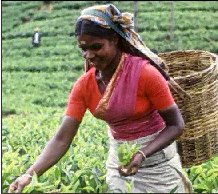
About 29 percent of Sri Lanka’s land area is under cultivation. Tea covers only 12 percent of the cultivated acreage but accounts for about one-fourth of the country’s export earnings. Tea, rubber, and coconuts together made up nearly 35 percent of Sri Lanka’s export earnings in the early 1990s.
Rice is the basic food of the people and the island’s principal crop. More acreage is devoted to the cultivation of rice than to any other crop; the annual output in the early 1990s was 2.3 million metric tons. Vegetables are grown in small amounts and are mostly cultivated for private consumption. Considerable quantities of sugar, wheat, and rice are imported.
Animal husbandry is of comparatively little importance to the economy of Sri Lanka. Cattle, buffaloes, goats, chickens, pigs, and sheep are raised.
Local timber needs are satisfied by government-owned woodlands. The annual timber harvest in the early 1990s was about 9.2 million cu m (about 325 million cu ft); more than 90 percent of the harvested wood was used for fuel. The fishing industry is restricted to a small coastal fringe and contributes relatively little to the national economy.
Although mineral resources are generally limited, Sri Lanka is an important source of high-grade lump amorphous graphite, used in the manufacture of carbon brushes for electric motors. Ilmenite, rutile, and zircon are also mined for commercial uses. Limestone is mined for a government-owned cement factory at Jaffna. Other minerals include salt, mica, kaolin (a fine clay), glass sands, and precious and semiprecious stones.
Manufacturing is relatively limited in Sri Lanka, and in the early 1990s it accounted for only about 12 percent of the country’s yearly gross domestic product. The more important industrial enterprises, most of which are entirely or partly government owned, produce such goods as steel, tires, cement, textiles, clothing, sugar, cigarettes, paper and leather goods, electronic equipment, refined petroleum, chemicals, ceramics, and processed food.
In the early 1990s Sri Lanka had an installed electricity generating capacity of about 1.3 million kilowatts, and an annual production of about 3.5 billion kilowatt-hours. More than 80 percent of the power was produced by hydroelectric facilities.
The Sri Lankan rupee, consisting of 100 cents, is the monetary unit (50 rupees equal U.S.$1; 1995). In 1994 annual imports cost an estimated $4.8 billion and exports earned an estimated $3.2 billion. The chief exports were tea, rubber, coconut products, clothing, graphite, petroleum products, and precious and semiprecious stones. Foodstuffs, mainly rice, flour, and sugar, make up a significant share of imports. Other imports include petroleum products, machinery, building materials, textiles, and transportation equipment. Sri Lanka’s chief trading partners are Japan, Great Britain, the United States, Germany, France, India, South Korea, Taiwan, Singapore, and China.
A network of about 27,200 km (about 16,900 mi) of paved roads connects most regions of the island; the best-developed road system is that in the plantation areas. Operated railroad track totals about 1450 km (about 900 mi).
Sri Lanka has three international airports. The government-owned airline, Air Lanka, provides domestic and international service.
All electronic communications in Sri Lanka are government controlled. The country has about 15 daily newspapers with a combined daily circulation of more than 780,000. In the mid-1990s the largest daily was the Dinamina, published in Colombo. During this period Sri Lanka had more than 175,000 telephones, 3.5 million radios, and 865,000 television sets. Television broadcasting began in Colombo in 1979.
In the early 1990s about 6 million Sri Lankans were economically active, mostly unskilled workers. About one-third of all workers were organized in some 1500 trade unions. Progressive labor legislation has been enacted, covering minimum wage, health, and welfare, but enforcement has proven difficult because of staff shortages.
Special thanks to Microsoft Corporation
& Ray Ellis/Photo Researchers, Inc. from IGCAS