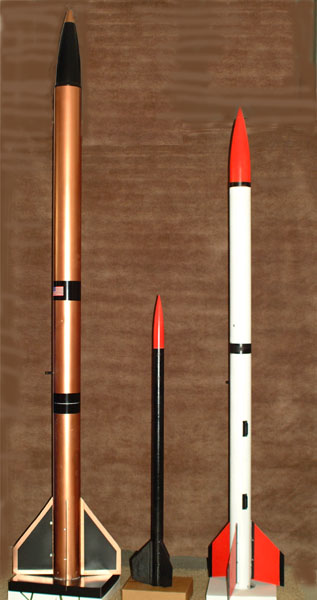
The Fleet for 2004 LaunchTurbo 3, on the left, has been completely rebuilt with lighter fins and body tube. The motor is the same but with heavier-duty heat insulation....I wasn't convinced that the motor shell could withstand the intense heat that will be generated.
The middle rocket is truly an experiment to see how light I can keep it. Final lift-off weight is just under two pounds. It should "scream". It will probably be the fastest off the pad of all the rockets and should get 6000 feet altitude.
The red/white one is 3 1/4 inch diameter and is likely to exceed 10,000 foot altitude. It will be comparable in lift-off speed to Turbo 2, which we launched last year, with a bit higher altitude.
Launch date is set for June 5 at Black Rock desert, pending FAA waiver approval.
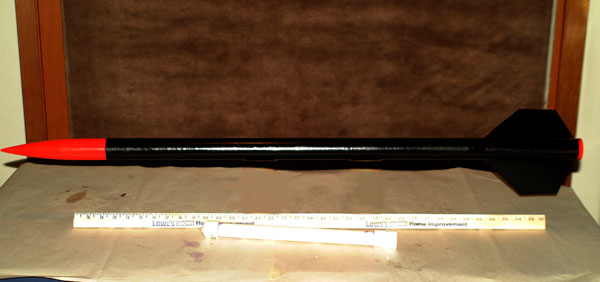 Turbo 4 nearing completion. Rocket body is 1.65 inch diameter, length is 45 inches. The finished rocket should weigh in at slightly more than one pound. It is powered with a 3/4-inch diameter motor and is ready for installation. Yet to do: install motor, parachute firing mechanism and parachute, then, final weight and center of gravity calculations. This should be done in another day or two. Turbo 4 should hit 5800 feet altitude, a bit less than Turbo 2. But, this one will leave the launch pad screaming at a much higher velocity of 62 ft/sec. At 2 seconds, it will be at 690 feet, with 14g acceleration. At 18 seconds it will be at apogee (5800 ft). Hopefully the 'chute deploys this time!!!
Turbo 5 is going to be a 3-inch diameter rocket, 5 to 6 feet long. Motor will be 2-inch diameter,and if I can control the weight-to thrust ratio, it could get to 15,000 feet. Here's hoping.
 Turbo 1 On Launch Stand
 Proud Parents Of Turbo 1
 Tail Section-separated mid-fuselage due to faulty chute ejector
 Mid-section, nose cone and unopened chute.
Launched at Black Rock lake bed, north of Reno, Nevada on June 14,2003, 10:30am.
Rocket dimensions: length 45 inches, diameter 2.68 inches
Rocket lift-off weight: 8 pounds
Predicted altitude: 6271 feet above ground level (AGL).
Time to altitude: 21 seconds
Max. velocity at 5.0 seconds: 510 feet/second
Post Flight inspection: Premature detonation of recovery system (parachute) and a faulty design of forward motor cap caused a burn-out of midbody and led to failure of rocket structure. Estimated altitude was 1500 to 2000 feet at time of failure. Peak altitude achieved is unknown, possibly 3000 feet before breakup.
Note: Turbo 2 (minor changes in length, +4 inches and corresponding increase in fin area) is now complete with all motor and recovery system design corrections incorporated.
 Turbo 2 at 95% completion
 Turbo 2 with 1 1/2-inch PVC pipe motor. Motors use solid fuel composite of ammonium nitrate, magnesium and a binder that makes the mixture a rubber-like solid.
 Launch Day October 18. The TurboThrusters with both rockets ready to go.
 Turbo 2 undergoing final "pre-flight" by our youngest rocketeer.
 Houston, we have ignition.
 Wow! Did you see that???
Turbo 2 was launched with a tremendous roar and a huge cloud of white smoke. It left the launch rod perfectly and flew straight up, going out of sight in one or two seconds. Judging the time it took to return to earth, I estimate it achieved it's predicted altitude of 9000+ feet. As with Turbo 1, the parachute recovery system malfunctioned. The ejection charge failed to detonate and the rocket disintegrated on impact.
 Installing Turbo 3 on the launch stand.
 Last minute instructions
Turbo 3 was all set to go, but because of a blown fuse in the battery system (no replacement on hand), the launch was scrubed. The weather will not be favorable for launching until next spring, so I will have a few months to fix the recovery problem and should have three or four new rockets to start the new season.
 Get your own Free Home Page