SPUDZOOKA
PNEUMATIC SPUD SHOOTER
PURPOSE
Ever seen those silly little hairspray powered spud guns that are
all the rage? How'd you like to
show up those guys with a cannon capable of launching spuds
nearly 5 times farther? Read on...
Testing of hairspray spud guns revealed they can develop no more
than 10-20 PSI chamber
pressure. Most are built from schedule 40 PVC pipe. 3" PVC
pipe has a burst pressure of 260
PSI. People have suggested using other fuels to boost pressures
higher, however this is much to
dangerous. More volatile fuels can be very unpredictable and
create pressures that would shatter
the PVC pipe. Compressed air can be regulated to exact pressures
making it an excellent
propellant. The trick is releasing a large volume of air at once
to launch the projectile. Here's how
it's done...
DRAWINGS
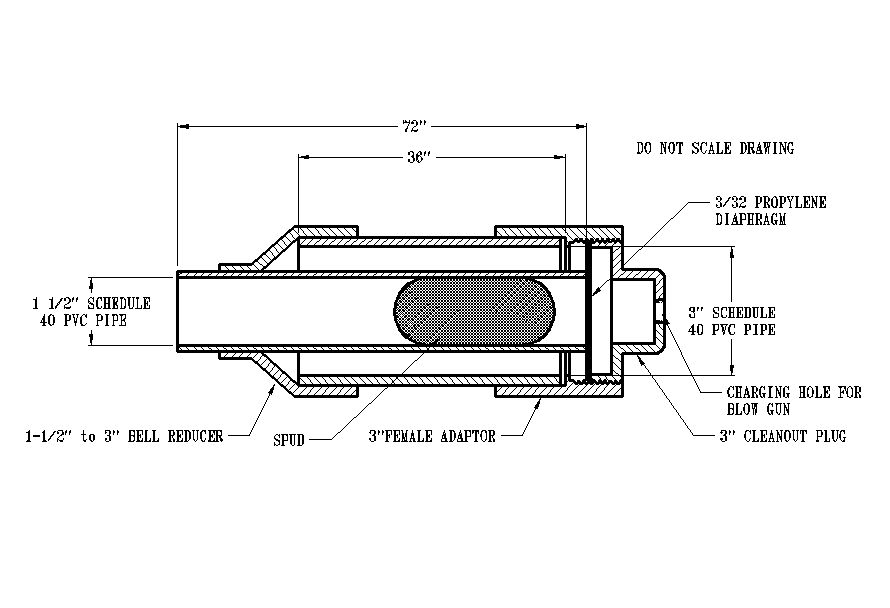
You may need a drawing to fully understand the concepts of
operation and assembly. For those of
you that have a CAD program that can read DXF files, download the
zipped version.
PARTS
All pipe and fittings are schedule 40 PVC
1 1/2" pipe 72" long
3" pipe 36" long
1 1/2" to 3" bell reducer
3" female adapter
3" cleanout plug
diaphragm (see below)
a couple old trouser legs
source of compressed air
blow gun with tapered nozzle (What's a blow gun? It's a
valve/nozzle combination that
attaches to a compressed air hose. They're commonly used in
machine shops and
garages to blow dust away. You can usually find one at most
autoparts stores.)
ASSEMBLY
Cut the pipes to length. The barrel pipe must have a perfectly
square and smooth surface on the
breach end. You may have to flat file and sand it to make sure a
good seal with the diaphragm is
achieved.
Cut a 3 3/16 diameter disk of 3/32 thick polypropylene or
polyethylene. A cheap dishpan from
Kmart may be a good source of diaphragm material.
The front bell reducer has a small ridge that would prevent
barrel from being pushed through it
during assembly. Use a half round file to remove the ridge. Make
sure you can push the barrel
though the reducer. Remove the barrel and set it aside.
Drill a hole through the center of the cleanout plug. Size this
hole to achieve a tight fit with the
tapered nozzle of the blow gun.
Assemble the outer chamber first. Glue the bell reducer and the
female adapter to each end of the
3" pipe. allow the glue to dry before proceeding to install
the barrel.
Place the diaphragm in the female adapter and screw the cleanout
plug in firmly. Push the barrel
through the reducer until it sets firmly against the diaphragm.
Pull it back out 3 inches to allow glue
to be applied. Apply glue to the barrel in front of the reducer
and push it quickly back into position
against the diaphragm. Hold the barrel in place until the glue
dries.
After the gun is assembled, remove the cleanout plug and check to
see if the barrel is properly
centered in the female adapter at the breach. If it is not, cut 3
or 4 pieces of 5/8" heater hose about
1" long and force them between the barrel and the outer
chamber.
Slip the old trouser legs over the chamber area of the cannon and
tape them in place. This simple
precaution will contain any pieces of exploding pipe from
becoming shrapnel if something should go
wrong.
FIRING
To fire the cannon, unscrew the cleanout plug and remove the
diaphragm. Push a pre-cut spud into
the breach of the barrel, making sure it is an inch or two below
flush. Replace the diaphragm and
screw the cleanout plug in firmly. Point the cannon down range.
Place the blowgun in the charging
hole drilled centered in the cleanout plug. Start squirting air
into the cannon with the blowgun. When
the sound of hissing air quiets down or stops, the cannon is
charged and ready to fire. Keep the
blowgun valve pressed down. Aim carefully and pull the blowgun
from the charging hole.
TIPS
A tapered nozzle on the blowgun is a must. Size the hole in the
cleanout plug to fit the nozzle snugly.
Sharpen a short piece of 1 1/2 pipe on the outside to precut your
potato. Portability can be had
with a 5 or 10 Lb. bottle of CO2 and a regulator. feel free to
experiment with different barrel and
chamber lengths. This plan was only a starting point. Get a
couple of friends to help spot your shots.
The spud leaves the barrel *REAL* fast and can be hard to see.
I've got one shot to go 755 yards!
THEORY
Because the diaphragm is somewhat flexible it will bend it's
outer edges forward from the pressure
and allow the air to fill the outer chamber. At the same time
this forward pressure is sealing off the
end of the barrel preventing air from escaping up the barrel.
Pulling the blowgun out of the charging
hole allows the air behind the diaphragm to escape to the
atmosphere. At this point all the pressure
stored in the outer chamber bends the diaphragm in the opposite
direction sealing off on the outer
edge of the cleanout plug. The diaphragm continues to bend under
the pressure and unseals the
barrel end allowing the stored air to escape up the barrel behind
the spud. This in turn, propels the
potato distances before unknown to mortal spud marksmen.
In the pneumatics industry, this device is called a quick exhaust
valve. It's commonly used on truck
air brakes. In an emergency, the quick exhaust valve dumps air
from the spring brake chambers to
apply the brakes fast.
SAFETY
DO NOT FIRE THE CANNON AT ANYONE OR ANYTHING. At nearly 500 feet
per second
muzzle velocity, a potato would be lethal if it were to hit
someone.
The pipe should be clearly marked SCH-40 260 PSI. ACCEPT NO
SUBSTITUTIONS or you
will be reinventing the pneumatic hand grenade.
When assembling the gun BE SURE TO USE THE PROPER TYPE OF PIPE
CEMENT! Do not
use cement made for ABS pipe. If you have any doubts about your
gluing technique, GET
PLUMBER TO HELP YOU!
USE ONLY 100 PSI MAX! This gives the plastic pipe a safety factor
of more than 2.
KEEP THE CANNON AT ROOM TEMPERATURE! Exposure to cold
temperatures can cause
the pipe to become dangerously brittle.
As pipe ages it may be a good idea to build a new cannon and
discard your old one. All plastics
have a limited life span and it would be very difficult to
estimate the safe life of the cannon.
ALWAYS KEEP THE TROUSER LEGS IN PLACE ON THE CHAMBER WHEN FIRING!
BE CAREFUL and have fun!
Potato Bazooka Plans
You may want a couple of buddies to go in buying the material
with you, or make 3 at the same
time, as the pipe comes in 10 foot chunks. I bought all material
at a local "Home Depot" for about
$15.
Note on choice of material: I have seen and heard of plans for
spud guns using PVC pipe. In fact,
an article in the February issue of "Modern Gun" uses
PVC. I chose to use schedule 40 ABS
plastic. The black pipe usually used for sewerage. If you want to
know why I chose ABS, take a
chunk of PVC pipe. Hit it with a 25 lb sledge hammer. It
fragments into many *sharp* pieces. Try
this with ABS. The sledge hammer bounces off the pipe and smashes
into your foot. But it didn't
break! (The pipe, that is, I don't know about your foot). PVC
also gets brittle with exposure to
sunlight. ABS just gets hot. Only ever use schedule 40! That's
the thick stuff. It costs a little more,
but not that much more. The bill of material says 10 foot
lengths, only because that's as small a piece
as is normally sold.
Web master's note: There does seem to be some confusion about
what pipe is safest to use.
Finding pressure rated ABS pipe is nearly impossible in many
areas. Most spud shooters are
therefore constructed of PVC pipe. If you stick to conventional
propellants and do not use
oxidizers, PVC should perform with adequate safety.
Bill of material
1 10 foot piece of 2 inch diameter schedule 40 ABS pipe
1 10 foot piece of 3 inch diameter schedule 40 ABS pipe
1 3 inch to 2 inch reducing bushing
1 3 inch coupling
1 3 inch threaded (one side) coupling
1 3 inch threaded end-cap
1 can ABS solvent-weld pipe glue. NEVER USE PVC GLUE on ABS!!!
1 Coleman sparker - these are easily found in any sporting goods
store that has a decent
camping section. They are normally made for putting inside a
Coleman lantern or stove so
you don't need matches.
Construction
Step 1 - Cut the combustion chamber to size. Cut off a 14 inch
section of the 3 inch diameter pipe.
You don't need the rest of the 10 foot length, so save it for
future bazookas, or make one with a
couple of buddies splitting the cost.
Step 2 - glue the 3inch to 2 inch bushing into one side of the 3
inch coupling, glue the other side of
the coupling to one end of the 14 inch combustion chamber. Make
sure the joints are clean first and
be liberal with the glue.
Step 3 - glue the threaded coupling to the other end of the
combustion chamber (using the slip-joint
side, obviously) make sure the glue doesn't run into the threads.
Step 4 - Cut the "barrel" to size. Cut off a 36 inch (3
foot) length of the 2 inch pipe. Glue this into
the other end of the bushing you've glued to the combustion
chamber. You should now have the
complete gun, but it's not ready for firing just yet.
Step 5 - Using a file, taper the "muzzle" for the last
half an inch on the outside. This will serve to cut
the potato as it's rammed in.
Step 6 - You'll need to mount the sparker inside the end cap. If
you got the Coleman one, it is
threaded and has two nuts with it. There is also an angled piece
of metal meant to hold the igniter
inside a lantern. Take the knurled knob off the end of the shaft.
Be careful - there's an extra flint
inside the knob. Unscrew the nut and discard the angled bit of
metal. Drill a hole dead center in the
ABS end cap of a diameter to take the shaft of the igniter. Mount
the igniter inside the end cap, put
the nut on the outside of the shaft and tighten until the igniter
is held in place. The shaft will slide
back and forth, but won't come out. Put the end knob back on and
tighten the lock screw.
Step 7 - Make sure the glue has "cured". I left mine
overnight before firing.
Step 8 - make a ram rod. I used surplus 1/2 inch PVC pipe, 4 feet
in length. A broom handle, etc.
will do. Measure and make a mark about 2 feet 8 inches down the
ram rod.
To fire: remove end cap. Ram a potato from the muzzle end. The
tapered end will cut the potato to
size. Make sure it has a good seal as you ram it down with the
ramrod. Ram to the mark you made.
I've found most misfires happen when there are gaps between the
potato and the barrel where
gasses can escape. Spray 2 - 5 seconds worth of cheap hair spray
(white rain, aqua net) I'd use an
"unscented" one if you can, or the gun stinks after a
few shots! Start at 2 seconds and build up!
After the hair spray, quickly screw in the end cap. One twist of
the igniter knob sends the spud
skyward!
Safety
Once you shoot this, you'll see the potato comes out with enough
force, you wouldn't want to be on
the wrong side! Usual safety about pointing the muzzle etc. still
apply. This is for fun only. I don't
make any guarantee you won't blow your ears off. (You may laugh
it off, however). Personally, I'd
never use acetylene, starting fluid (ether), black powder,
lighter fluid, gasoline etc. as a propellant,
but you may not value your body parts as much .
You can get 3 shots off a big spud. Partially baked ones are fun
- they seal in better and shoot
farther, but they do break up and the barrel is a mess to clean
up afterwards.
Clean up
Soap and water. Push a small towel through (here's a case where
it's OK to clean from the muzzle).
I've been shooting mine since 12/94 and have been having a barrel
of laughs. The spuds will go
nearly 200 yards! I plan to make the "220 swift"
variety by coupling a one inch barrel to the three
inch combustion chamber. I wonder if you put the barrels on
threaded couplings you could have
interchangeable barrels. Sort of an "Idaho Contender".
Other tricks
Ram in a cardboard container from McDonalds from an order of
large fries. Leave the fries in the
container. The cardboard serves as a sabot and voila - a shotgun!
Warning:
These things have a tendency to attract every 8-12 year old kid
in the neighborhood.
Have fun!