Chris's Freecell

monopoly
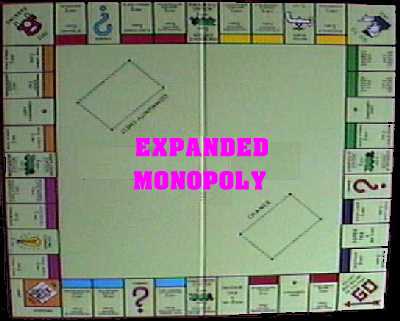
George Crawshay has suggestions for making the capitalist plot more acceptable to adults...


While Monopoly is an enjoyable enough family game and an excellent introduction for those children who are growing out of the ludo and Snakes-and-Ladders stage to the more exciting possibilities of boardgaming, many players soon reach the point where the basic flaws become apparent enough to spoil the enjoyment of the game, viz:

1. the deadlock factor: caused by the awkward contestant who either does not want to bargain with his properties or demands ridiculous terms, thereby holding up the game's progress to everyone else's annoyance.

2. the lack of balance; the winner of the game is often established very early on, with little hope for any other player to reverse the trend.

3. no compensation for inflation; as the game proceeds, fixed sums such as income from 'Go', tax penalties etc. become steadily more insignificant in proportion to the rentals received on properties.

There are probably thousands of home-made alternative systems for Monopoly which attempt to improve these and other aspects of the game; here is one which we have tried with some success, though there is certainly room for further refinement:

1. Income from 'Go' rises in relation to the number of houses/hotels built: every five houses (or hotel) on the board increases the initial 200 salary by 50. If the number of houses diminishes for any reason, the salary level is reduced accordingly. Suppose that a player had 17 houses and 2 hotels on the board, the salary level would be 450; if three of the houses had to be resold to the Bank, the level would drop to 400 until at least one more house were built.

2. Anyone holding one of a set may, on landing on another of the same set already bought by another player, effect a compulsory takeover by paying the owner double the price for it. Anyone holding two of a set may do the same for the third, but it will cost him triple the price, while in the case of the four stations the fourth one would be taken over at quadruple price.

3. The Income Tax square is converted to Capital Levy, which is paid on cash held (to the nearest complete hundred for simplicity's sake) and rises progressively according to Table 1. No levy is payable in the first round of play.

TABLE 1
CAPITAL LEVY
Capital Levy Tax %
0 - 100 0%
101 - 250 10%
251 - 500 20%
501 - 1000 30%
1001 - 2000 40%
2001 - 3300 50%
3301 - 5000 60%
5000+ 70%
4. 'Super Tax' becomes a Property Tax square, with the amount payable dependent on the number of properties held. (Table2)

TABLE 2
PROPERTY TAX
NUMBER OF PLAYERS STILL ACTIVE IN GAME2 3 4 5 6 TAX PAYABLE
PROPERTIES HELD 14 9 7 5 4 -
PROPERTIES HELD 15 10 8 6 5 100
PROPERTIES HELD 16 11 9 7 6 250
PROPERTIES HELD 17 12 10 9 7 500
PROPERTIES HELD 18 13 11 9 8 800
PROPERTIES HELD 19 14 12 10 9 1200
PROPERTIES HELD 20 15 13 11 10 1700
PROPERTIES HELD 21 16 14 12 11 2300
PROPERTIES HELD 22 17 15 13 12 3000
PROPERTIES HELD 23 18 16 14 13 3800
PROPERTIES HELD 24+ 19+ 17+ 15+ 14+ 5000 (max)
5. Landing on the 'Just Visiting' part of Gaol lets you in for housing tax (that'll teach you to associate with felons!), levied on the amount of houses constructed on your properties, acording to the table in Table 3.

TABLE 3
HOUSING TAX
Houses built Tax
0 - 3 0
4 - 6 100
7 - 9 210
10 - 12 330
13 - 15 460
16 - 18 600
19 - 21 750
22 - 24 910
25 - 27 1080
28 - 30 1260
31 - 33 1450
34 - 36 1650
37 - 39 1860
40 - 42 2080
43 - 45 2300
46 - 47 2520
48 - 49 2750
50+ 3000
6. Chance and Community Chest penalties and windfalls are doubled throughout.

7. Stations attract greater rent as other properties become improved. (Table 4)

TABLE 4
RENT ON STATIONS
STATIONS HELD1 2 3 4
HOUSES ON BOARD
0 - 9 25 50 100 200
10 - 19 30 60 125 250
20 - 29 35 75 150 300
30 - 39 40 85 175 350
40 - 49 50 100 200 400
50+ 60 125 250 500
8. The Utilities pay 5 times and 20 times the throw of dice instead of 4 and 10 times respectively.

9. Properties may be sold back to the Bank at 10% discount. If already mortgaged, the redemption expenses are of course deducted first. For example, Oxford Street, mortgaged, would be sold back for 105: The original price, 300, less 150 already received for mortgage, less 15 mortgage interest, less 30 discount (10%). This facility is sometimes used by apprehensive tycoons approaching the Property Tax square!

10. Goal release costs 100 instead of 50, and - more importantly - no rent may be charged by anyone while in gaol unless he has already paid his 100 fine.

Two optional rules which add a little spice if desired and are in very common use are the doubling of salary when actually landing on 'Go' as opposed to passing it, and the use of 'Free Parking' as a collection square for all Chance and Community Chest fines, to be lifted by the next player landing there.

I have found that these expanded rules make the game much more interesting and balanced. Players have to keep a careful watch on their accumulation of cash and properties to ensure that they are not caught napping on one of the three tax squares. The players less favoured by the dice have at least a better chance of catching up as the game proceeds, and unlike many occasions when the game is played strictly according to the original rules, a large proportion of the properties end up with hotels or fair-sized housing estates on them with most, if not all, players having had a fair run for their money. Try it - you may not throw out your old Monopoly set after all!


This page hosted by Get your own Free Home Page
Hosted by www.Geocities.ws

1