Lilith
In Jewish lore, Lilith is a female spirit of the night who, like a succubus seduces men while they are sleeping, causing them to emit semen which she takes to breed children of her own; she also strangles human infants during or after their birth. Her female offspring are called Lilim.
It seems very likely that Lilith was adopted from Mesopatamian beliefs by the Hebrews during their Babylonian Capivity.
In theTalmud, Lilith is only described as bieing a threat to "men who sleep alone", and it is said here that after Adam left Eve for one hundred thirty years and from the semen he emitted accidently there was begot "ghosts and male demons and female night demons, or Lilim." (I base this on excerpts from Hebrew-English edition of the The Babylonian Talmud edited by Rabbi I. Epstein (Socino Press, 1978) that are quoted on page ix of The Book of Lilith by Barbara Koltov (Nicholas-Hays, 1986))
In The Alpha Bet of Ben Sirah written at some time between 600 CE and 1100 CE, Lilith is said to be the first wife of Adam, made from dust like him. When she demanded equality with Adam and he refused, she retired to a cave where she consorted with demons and gave birth to demonic children. Adam complained to God about Lilith's departure. God then sent three angels named Senoy, Sansenoy, and Semangolef. to bring her back to Adam. These angels found her in her cave and threatened that, unless she went back to Adam, she would lose a hundred of her demonic children daily by death. But Lilith preferred this punishment to living with Adam. She takes her revenge by injuring or killing human infants and young children. The three angels only stopped harassing her when she swore that, whenever she saw the names and images of these angels in an amulet worn by or near to a child, she would not harm the child.
Vampiric Demi-Goddesses of Ancient Greece
The ancient Greeks believed in three types of vampiric demi-goddesses:
The lamia
The mormo
The empus
Both the lamia and the mormo originially specialized in preying upon infants by strangling them or drinking their blood. The lamia also attacked preganant women. The empusa sexually seduced young men before consuming them by drinking their blood and devouring their internal organs.
One Greek myth tells of a mortal queen named Lamia who had an affair with the god Zeus. The goddess Hera, jealous wife of Zeus, caused all of the children Lamia had by Zeus to die. In one version of the myth, Hera causes Lamia to go insane and devour her children. There is also a version where a daughter survives but becomes the water monster Scylla. In all versions, out of her grief and rage over the death of her children, Lamia became an immortal spirit half-human and half-monster. She strangles and drinks the blood of mortal children out of envy of their mothers. Lamia is sometimes depicted as having the upper body of a woman and the lower body of a serpent.
There is another myth about a mortal woman named Mormo who ruled over the cannabalistic Lystregonians. She became a monstrous spirit like Lamia after she too lost her children. But there were believed to be many lamiai and mormoi and so perhaps these legends are a cover for an even older folk belief.
The empusai were believed to be daughters of the witch-goddess Hecate. They came out of Underworld at night. They were shape-shifters whose basic form was sometimes said to have one leg of a mule and one leg that was bronze. They took the form of beautiful women to seduce the men they preyed upon. Shepherds in their fields at night and men traveling on the roads at night were especially at risk.
Hecate herself left the Underworld at night and haunted the cross-roads. Statues of her were set-up at cross-roads and offering were made there to appease her.
The Life of Appalonius of Tyana by Philostratus of Athen written ca. 200 A.D., contains a story concerning a vampiric femme fatalale who is identified as being not only an empusa but also as a lamia and a mormo. It seems that, as a result of this tale, the lamia became the vampiric femme fatale in modern literature.
Vampiric Demons and Spirits of India
The Pacu Pati, whose name literally means "master of the herd", is the lord of all vampiric spirits, witches, and ghosts. He was once regarded by some Hindu traditions as being the God of Death (a title more frequently attributed to the god Yama in classic Hindu literature. He is seen at night with a retinue of his vassals in charnel and execution grounds.
A vetala, also known in some regions as the baital or baitala, is a powerful demon who haunts charnel grounds and can take demonic possession of a corpse which he then animates as if it were his own body. We might then consider a dead person possessed by a vetala to be an "undead vampire."
A rakshasa (fem: rakshasi) is a ghoul or demon who in old tales haunts charnel grounds (cemetereries and cremation grounds) but, in modern Indian folklore, dwells in trees. A rakshasa can appear in many forms. A rakshasi can appear as a beutiful woman who seduces her victims before she takes their life and blood tough this is usually not the case. More often a rakshasa appears as an animal such as an owl, a bat, a vulture, a monkey, or a dog. The rakshasas can also take many forms that are half-human and half-animal. Some of these forms bear a resermblance to the winged gargoyles that adorn the exterior of western European Gothic cathedrals. In their essential form, they have fangs and unkempt hair, and are covered with blood. The rakshasas’ favorite prey are infants and young children.
A pisacha is a vampiric spirit often associated with the vetala and the. rakshasa but of a lower order than both of these. They are said to be hideous in appearance and blood thirsty. They haunt charnel grounds and cross-roads. They are blamed as the cause of many illnesses. But, if offered rice at a cross-road by one of his victims in a ceremony that is repeated for days, he might restore his health. The name pisacha is occasionally used in a way that includes all or nearly all the vampiric demons and spirits of India.
Celtic Fairy Vamps
The Celtic lore of the British islands includes a number of vampiric spirit-women.
The baobhan sith (pronounced as "baavan shee" and meaning "spirit-woman") of the Scottish highlands seduces men at night and drinks their blood. Like the empusai of the ancient Greeks, there are many such spirits and their prey was most often men on the road or camped in fields at night. She is also a shape-shifter and sometimes appears as a hooded crow. Even when appearing as a beautiful woman, she has deer hooves for feet which she keeps hidden under her green dress. Often several baobhan siths will appear together as a group. The baobhan sith is described in some books as belong to the broader class of Scottish spirit-women called the green glastigs though these are usually solitary spirits and generally do not drink blood.
One Scottish tale about the baobhan sith begins with four men on a hunting trip playing music and dancing and dancing by their camp fire one night. Three danced and one played. One of them expressed the wish that they had some young ladies to dance with. Suddenly four beautiful women wearing green dresses came in out of the dark. Three of these women began immediately to dance with the three dancing men. The fourth stood next to the one who was playing the music. The music player became alarmed when he saw blood dripping from his comrades onto the ground. He fled to where they had their horses tied and hid under them. The lady wh had been standing next to him pursued him but she was repelled by the iron the horse shoes. She circled around until dawn. After the sun rose, he found the dead bodies of his friends. There was not a drop of blood left in them.
Another Celtic female vampiric spirit occurs in lore from the Isle of Man, which lies between Scotland and Ireland. Her name is Liahennen-Shee pronounced "launen-shee", and meaning "female spirit-lover". She haunts wells and springs until she attached herself to a man. She appears to the man as an extremely beautiful woman while remaining invisible to everyone else. If her victim gives in to the seduction of her charm and beauty, she becomes his lover but gradually drains him of his vitality until he is eventually ruined body and soul.
In Irish lore there is the Leanan Sidhe (pronounced "lianen-shee"). Her name has the same meaning as Liahennen-Shee,. She is virtually identical to the Manx Liahennen-Shee except that she inspires her lovers to become poets at the same that she gradually drains them of their life. Sometimes it is said that she collects the blood of her lovers into a cauldron which is both the source of her long life, her beauty, and of the poetic inspiration she gives to her lovers in return.
Mermaid Vamps
In Celtic lore there are also some blood thirsty mermaids who dwelled in lakes, rivers, and the sea.
In many Scottish tales, mermaids were gentle creatures. But this is not always the case. In the story of "The Laird of Lorntie", a lord was returning to his castle with a servant when he heard the cries for help from a beautiful woman in a nearby loch. She appeared to be drowning and the lord rushed off to save her. But the servant recognized the reality of the situation and rescued his master from his folly in the nick of time. After the servant explained his forceful rescue, the mermaid then admitted:
"Lorntie, Lorntie,
Were it na your man,
I had gart your heart's blood
Skirl in my pan."
There are also tales in which mermaids caused shipwreck by luring sailors into dangerous waters with their charm and beauty and devoured them as they drowned. Good examples of this are among the folk tales of the Channel Islands in the English Channel, near the coasts of Normandy and Brittany. Here the mermaids play the role of sirens - they sing from rocks and their enchanting song lure sailors to come dangerously close to these rocks. Then suddenly a terrible storm arises and forces the ships to crash into the rocks. The mermaids then carry the sailors down into the depths of the sea and devour them. The Channel Islanders call these mermaids 'seirenes'. But at least according to the testimony of one islander, a school teacher who saw six of them on a beach, they had the upper body of a woman and the lower body of a fish. In tales told on the west coast of France, some originating in the Middle Ages or possibly even before that time, the mermaids also play the roles of such sirens.
The Mare, the Incubus, the Succubus, and their Kin
Many people have had the experience, after falling to sleep, of seeming to wake up but unable to move a muscle. For most people this in accompanied by the illusion of being violently attacked by some sort of being. Sometimes this is accompanied by such sensations as feeling the weight of the being on one's own chest. I do know someone whose neck was being injured by such spasms. She had to wear a neck brace before going to bed until she stopped having such attacks. More rarely, the person undergoing such phenomena has the experience of being sexually aroused by the being in a rather gentle manner.
The modern English word nightmare originates from the old Anglo-Saxon mare, originally a demonic female spirit who attacked people in their sleep. A popular image associated with the mare is the creature sitting upon her victim's chest. In England she evolved into The Old Hag, a witch whose soul left her body at night. People wasting away from "consumption", a disease now known as tuberculosis, were thought to be victims of the mare.
In Scandinavian lore, such a night visitor is known as the mara. She is sometimes described as an ugly troll-like spirit. But there are also tales where she appears as a beautiful woman and becomes her victim's lover.
In Slavic lore, there is the mora who is always a terrifying night spirit. The mora also appears in Greek folk lore, but is sometimes called the ephilaties, a name derived from a Greek word that means "to leap upon." The pagan Romans also had beliefs about such a night spirit. It was a male, and they called it the Inuus, a name derived rom a Latin word which means "to sit upon."
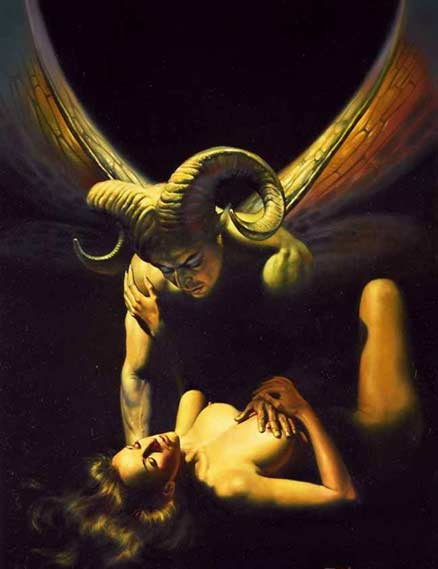
The incubus and the succubus are the inventions of early Christian theologians based on older lore. The incubus is a male demon who appears to women at night and sexually educes them. The succubus is a female demon who appears to men at night and sexually seduces them. There was some debate during the late middle ages about whether or not an incubus could impregnate a woman. Some theologians argued that a demon could not procreate. A widely accepted resolution of the problem was that the demon first seduced a man as a succubus ; after collecting the man's semen, the demon appeared to a woman as an incubus and deposited the semen into her womb.
The Hebrew demoness of the night, Lilith can be considered to be a succubus. (See the full entry on Lilith above.)
The same semi-dream phenomena that gave rise to belief in night attacking spirits also can account for some details in European lore concerning the undead vampires who return from their graves to prey upon their mortal wives, relatives, and neighbors.