Old Faithful is an example of
(a) an aquitard
(b) a geyser
(c) a good wife
(d) an old geezer
Which of the following is not a discharge area for
ground water?
(a) infiltration
(b) springs
(c) streams
(d) wells
Which of the following is located at the top of the zone of
saturation?
(a) fish
(b) an impermeable layer
(c) roots
(d) the water table
A measure of the ease with which groundwater moves through
rock and sediment is
(a) permeability
(b) porosity
(c) soil moisture
(d) specific conductance
Which of the following combines with rainwater to form a
weak acid (like in Coca-Cola)?
(a) carbon dioxide
(b) nitrogen
(c) oxygen
(d) plutonium
Which of the following is not common in a karst
landscape?
(a) blind valleys
(b) disappearing streams
(c) sinkholes
(d) U-shaped valleys
When a glacier retreats,
(a) ice is melting faster than it is accumulates
(b) the glacier slides uphill on water from melted ice
(c) it indicates that the global climate has changed
(d) it depresses the crust of the earth
The main difference between very cold glaciers and warmer
glaciers is that
(a) the base of the colder glacier is frozen to the rock
below but the warmer glacier is underlain by a thin layer of
water
(b) the colder glaciers occur at lower elevations
(c) the warmer glaciers are continental in size
(d) the warmer glaciers occur nearer the poles
Which of the following is not a part of Milankovich cycles?
(a) changes in the amount of carbon dioxide in the atmosphere
(b) changes in the amount of tilt of the Earth's axis
(c) changes in the orientation of the axis with respect to
closeness to the sun (wobble)
(d) changes in how oval versus circular the orbit of the
Earth is around the sun (eccentricity)
Which of the following is the most recent period of
glaciation?
(a) Hadean
(b) Mesozoic
(c) Paleozoic
(d) Pleistocene
The Sahara Desert in northern Africa is largely a result of
(a) a rain shadow
(b) human activity
(c) its bitterly cold climate
(d) its latitude
The water off the coast of South America is normally cold.
In an El Niño year, which of the following does not
happen?
(a) equatorial trade winds slow or stop
(b) rainfall along the coast of South America increases
(c) storm activity decreases
(d) warm water accumulates along the coast of South America
Arroyos (and wadis) carry water
(a) across deltas
(b) during flash floods
(c) in meandering streams
(d) from glacial melting
The threat of a reoccurrence of America's Dust Bowl has been
lessened by all of the following except
(a) changes in agricultural practices
(b) improved soil conservation
(c) irrigation
(d) large-scale corporate farms
Sand dunes that form on a hard surface (such as those in
Qatar that I showed in class) when wind direction is relatively
fixed are called
(a) barchan dunes
(b) longitudinal dunes
(c) star dunes
(d) transverse dunes
Wind-blown sediment, commonly silt-size, such as
is encountered near Vicksburg, MS, is called
(a) drift
(b) loess
(c) till
(d) ventifacts
Which of the following is not a factor in increased
desertification?
(a) deforestation
(b) desalination
(c) overgrazing
(d) overpopulation
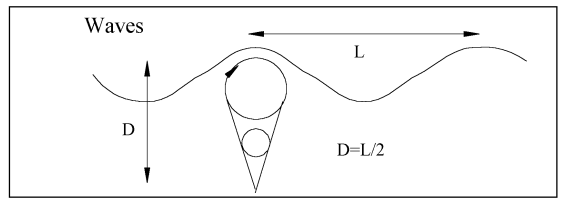
In the figure below, the L refers to
(a) wave height
(b) wave length
(c) wave location
(d) local amplitude
The bending of ocean waves so that they approach the beach
nearly parallel to the shore is called
(a) refraction
(b) a rip tide
(c) swash
(d) wave base
You are swimming in the ocean in front of your resort hotel,
riding the waves. After a while, you look up to see that you are
now down the beach in front of a hotel from where you started. You
were probably transported by
(a) a change in tide
(b) a longshore current
(c) a rip tide
(d) a submarine
Beaches are commonly made of all of the following
except
(a) gypsum fragments
(b) quartz
(c) shell fragments
(d) volcanic fragments
Which of the following is not true about
mangroves? (a) Mangrove roots stick up above the water.
(b) Mangrove roots tend to calm the water and catch fine
sediment.
(c) Mangrove swamps tend to grow seaward.
(d) Mangroves have been extensively cut in South Louisiana
for use as lumber.
A circular reef, often formed on top of subsiding volcanoes
and other oceanic islands, is called
(a) an atoll
(b) a barrier reef
(c) a fringing reef
(d) a lagoon
The rocky coasts in Southern Canada, Maine and New
Hampshire, were formed by
(a) drowning of coasts as sea level rose
(b) glaciation of plutonic rocks
(c) growth of reefs
(d) tectonic uplift
Increased temperature and pressure would convert liquid
petroleum to
(a) coal
(b) gas
(c) oil shale
(d) peat
Which of the following does not contribute to
rainwater being acidic?
(a) carbon dioxide
(b) nitrogen in hydrocarbons
(c) ozone from oil refineries
(d) sulfur in coal
Which of the following is not considered a type of
renewable energy?
(a) geothermal
(b) hydroelectric
(c) nuclear
(d) solar
Another name for the Age of Mammals is
(a) Cenozoic Era
(b) Mesozoic Era
(c) Paleozoic Era
(d) Proterozoic Eon
True/ False: Put A for True and B for
False.
Most caves form in granite.
Caves tend to form well below the water table.
During periods of continental glaciation, sea level rises.
Most scientists now agree that humans have added to global
warming.
The weathering in a desert is primarily chemical.
The upwind slope of a sand dune is steeper than the downwind
slope.
The Gulf of Mexico has two tides per day.
A method commonly used in the Middle East for generating
fresh water from Persian Gulf water is bioremediation.
The Proterozoic was the hottest time in the Earth's history.
The beginning of the Paleozoic is marked by the evolution of
hard parts in marine organisms.
The end of the Cenozoic is marked by the death of the
dinosaurs.
From the online essays.
In the essay, Out from the Ice, Oetzi refers to
(a) a location in Austria
(b) a man frozen in the ice for over 5,000 years
(c) a type of Alpine Glacier
(d) a type of vegetation common to the Alps
In the essay, Global Climate Change, it is stated that
(a) climate has been both hotter and colder in times past
(b) global sea level is dropping
(c) we are now entering a new period of glaciation
(d) all of the above
The essay, Pulling the Plug on Lake Peigneur, told the
story of
(a) the disappearance of Lake Peigneur due to diversion of
rivers that drained into it
(b) the eruption of the volcano whose cone was occupied by
Lake Peigneur
(c) the loss of Lake Peigneur down an oil well that
intercepted a salt mine
(d) massive flooding resulting from the melting of an ice dam
that formed Lake Peigneur
According to the essay, The OPEC Oil Embargo and
Third-World Debt, which of the following is not true?
(a) The embargo led to a reduction on U.S. dependence on
foreign oil.
(b) The embargo resulted in increased oil prices.
(c) The embargo resulted in increased third-world debt.
(d) The embargo was a result of U.S. support of Israel in a
war with its Arab neighbors.
From the slides
The shape of valley shown in the slide is a result of
(a) construction of the dam for the lake shown
(b) a drop in sea level
(c) glaciation
(d) stream-cut terraces
The diagram shown illustrates why
(a) clouds are visible mostly in the daytime
(b) deserts sometimes form in coastal areas
(c) two tides occur each 24 hours
(d) wind in coastal areas tends to shift directions between
the day and night
Shown in the slide is
(a) the area left after the retreat of a glacier
(b) a desert in the Southwestern U.S.
(c) results of acid rain
(d) results of a forest fire
In the photograph shown, the white parts I'll point to are
(a) bacteria
(b) fossils
(c) salt
(d) snow
In the slide shown, the stream is descending the side of the
mountain
(a) along a fault
(b) below a dam
(c) from a hanging valley
(d) in a meandering pattern
The rusted tanks shown are
(a) camouflaged missile sites
(b) oil-water separators
(c) an old refinery
(d) old underground tanks from a service station
The pile of stones that I'll point to represents
(a) an ancient burial ground
(b) a beaver dam
(c) a landslide
(d) a morraine
Footnotes:
File translated from
TEX
by
TTH,
version 2.65. On 6 Dec 2000, 14:45.