Physical Geology

Physical Geology

Test 3

12 Nov 2001

  1. Which of the following types of deformation occurs when rocks fold irreversibly without breaking? (a) brittle (b) elastic (c) plastic
  2. Which of the following is represented by a horizontal line along rock beds or fault planes? (a) anticline (b) dip (c) strike (d) syncline
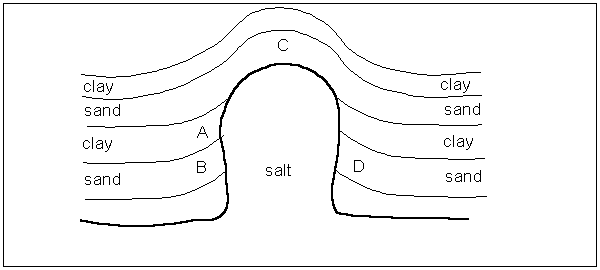
  3. In the figure below, in which location is oil not likely to accumulate? (a) A (b) B (c) C (d) D
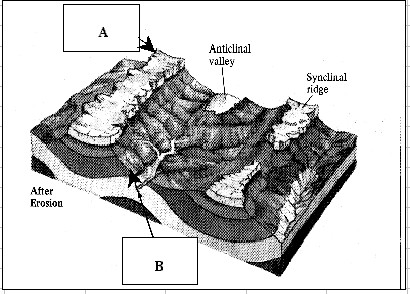
  4. In the figure below, the rocks most resistant to erosion are likely to be found at (a) A (b) B
  5. Which of the following types of faults is most likely to result from tensional stress? (a) normal (b) reverse (c) strike-slip (d) thrust
  6. The European Alps, the Himalayas, the Urals, the Northern and Canadian Rockies, and the Appalachians are all examples of which of the following types of mountains? (a) fault-block (b) fold-and-thrust (c) upwarped (d) volcanic
  7. Which of the following types of seismic waves travel the fastest? (a) P waves (b) S waves (c) surface waves
  8. Which of the following types of seismic waves cause the most damage to human structures. (a) P waves (b) S waves (c) surface waves
  9. How many different seismographs are needed to determine the location of the epicenter of an earthquake? (a) 1 (b) 2 (c) 3 (d) 4
  10. A tsunami is (a) movement along a fault (b) the process by which saturated sediments lose their strength and become like quicksand as a results of earthquake vibrations (c) sloshing around of water in a lake or bay (d) a type of sausage
    Answer (d) cracked me up and I forgot to put the correct answer. During the test I told people to choose (e).
  11. At which of the following locations are earthquakes likely to be deepest? (a) mid-oceanic spreading centers (b) rift valleys (c) subduction zones (d) transform faults
  12. Which of the following is not an indicator of an impending earthquake? (a) bulging of the surface rock (b) changes in groundwater levels (c) increased heat flow at the land surface (d) small-scale tremors (e) unusual animal behavior
  13. The use of seismic imaging for determining the presence of petroleum beneath the ground is the most like which of the following? (a) finding a cavity in your tooth with an X-ray (b) finding a fracture in your arm using an X-ray (c) looking at bloodflow form an aneurysm using an MRI (d) looking at a baby in the womb using ultrasound
  14. By volume, which of the following is the largest? (a) crust (b) mantle (c) outer core (d) inner core
  15. Of the following, who was the developer of modern plate tectonics? (a) Francis Bacon (b) Charles Darwin (c) Terry Pavlis (d) Alfred Wegener
  16. Fossils of mesosaurus support plate tectonic theory for all of the following reasons except (a) the mesosaurus fossils are found in places that would have been adjacent if the plates were joined (b) mesosaurus could not swim (c) today, the mesosaurus fossils are found in Brazil and South Africa, 3000 miles apart (d) mesosaurus fossils are found in coal deposits, now surrounded by ice
  17. What piece of important geologic information was unknown in the early attempts to explain plate motion? (a) the existence of the asthenosphere (b) the existence of the mantle (c) the existence of rocks of similar mineralogy, age, and fossil content in areas that would be adjacent if the continents were adjacent. (d) the existence of volcanoes
  18. All of the following are used to estimate the rate at which plates move except (a) plate movement over hot spots (b) rate of rotation of the Earth (c) satellite tracking (d) tracking of magnetic-field reversals
  19. The Rift Valley in East Africa is an example of an aulacogen. Where is a similar feature believed to occur? (a) along the San Andreas Fault (b) at the Grand Canyon (c) beneath Mt. St. Helens (d) beneath New Madrid and the Mississippi River
  20. Where two continents join (like bones in you head) is called a (a) backarc basin (b) forearc basin (c) subduction zone (d) suture zone
  21. The shield and platform of a continent together form a tectonically stable core of the continent called the (a) coastal mountains (b) coastal plain (c) craton (d) shelf
  22. The supercontinent formed about 225 million years ago from the combination of all the other continents was called (a) Asia (b) Gondwana (c) Laurasia (d) Pangaea
  23. The mechanism through which lithospheric plates move is not yet clear. The first serious model proposed used convection cells to move the plates, but serious questions arise about the occurrence of convection cells within the solid mantle. By another proposed mechanism, if magma wedged itself between plates as mid-oceanic spreading centers, we would (a) expect to see reverse faults, but actually see normal faults (b) expect to see normal faults, but actually see reverse faults (c) expect to see subduction zones, but none occur at mid-oceanic spreading centers
  24. Which of the following is a method for reducing mass wasting? (a) coastal waves (b) construction of terraces (c) roadcuts (d) stream undercutting of banks
  25. Which of the following is the principle (most important) factor in causing mass movement? (a) gravity (b) slope composition (c) vegetation (d) water
  26. During or after the Gros Ventre slide, six people died from (a) a flood that breached the natural dam resulting from the slide (b) being buried under a huge volume of rock that slid across the Gros Ventre River (c) car wrecks while trying to escape the slide (d) carbon dioxide poisoning when the gas was released by the slide
  27. A mudflow due to a volcanic eruption is called a (a) lahar (b) nuee ardente (c) seiche (d) tsunami
  28. The purpose of putting drains at the base of a roadcut is to (a) keep the road from washing out (b) keep water off the road, which make it slick and increase the number of accidents (c) provide drinking water to nearby towns (d) reduce water pressure and thus reduce chances of a landslide
  29. In which of the following parts of the hydrologic cycle is the most water stored? (a) glaciers (b) groundwater (c) precipitation (d) surface runoff
  30. A small stream that branched off the Mississippi River once carried flood waters through Metairie Ridge, Gentilly Ridge, and Bayou Sauvage out to the Gulf of Mexico. This small stream was an example of (a) a distributary channel (b) a drainage divide (c) a tributary (d) a trunk stream
  31. Which of the following units would be appropriate for measuring discharge of the Mississippi River? (a) feet (b) feet per minute (c) square feet (d) cubic feet per minute
  32. For the Mississippi River, base level is determined by (a) the Corps of Engineers (b) the elevation of the Gulf of Mexico (c) the elevation of its source in the Rocky Mountains (d) the type of rock over which it flows
  33. Which of the following stream patterns is likely to form around a volcano? (a) conic (b) dendritic (c) radial (d) trellis
  34. Which of the following is not a way that sediment is transported by a stream? (a) bed load (b) dissolved load (c) suspended load (d) alluvium
  35. As streams spill out of a narrow mountain canyon into the valley floor, they slow and drop out their sediment in a triangular shaped form called (a) an alluvial fan (b) a delta (c) a pediment (d) a scalene triangle
  36. Where the Red River and Mississippi River came together was a big meander. Which of the following happened to it? (a) Captain Shreve cut through the meander to improve navigation on the River (b) a log jam blocked it off and diverted the River. (c) Paul Bunyon's blue ox Babe hooked to the meander and straightened it out. (d) the river changed course during a flood and left an oxbow lake
  37. Which of the following was not in part a result of the 1927 Mississippi River Flood? (a) African Americans in the south left the Republican Party and migrated north (b) Edwin Edwards used federal relief funds to help establish gambling in Louisiana (c) the levee south of New Orleans was blown up, flooding parishes down river (d) the Red Cross fed hundreds of thousands of flood refugees for months True/False: Put A for True and B for False


  38. The most common faults in the Gulf Coast are reverse faults.
  39. The focus of an earthquake lies on the surface of the earth directly above the epicenter.
  40. During and after earthquakes, the most damage to buildings in urban areas is often due to fire.
  41. A seismic gap is an area where S waves cannot penetrate.
  42. Continental lithosphere is subducted at the Ring of Fire (around the Pacific Ocean).
  43. The oceanic crust is thicker than the continental crust.
  44. Mid-oceanic spreading centers are at a higher elevation than most of the rest of the oceanic plates.
  45. A braided stream is likely to form from the outwash from a glacier.


    From the slides: We will view slides together in class. The following questions are based on these slides.


  46. The instruments shown measure (a) chemical concentrations (b) the difference in velocities between P and S waves (c) the magnitude of an earthquake (d) river stage
  47. The area I will point to represents (a) the epicenter of the Northridge earthquake (b) the location of the Port Royal mass movement (c) a major oil field operated by Exxon (d) the New Madrid Fault Zone
  48. In the map shown are (a) a spreading center (b) a subduction zone (c) a strike-slip fault (d) all of the above (e) none of the above
  49. The feature I will point to represents all of the following except (a) an old meander of the Mississippi River (b) an oxbow lake (c) a stream terrace
  50. Shown in the slide is (a) a flood control gate (b) an irrigation canal (c) navigation locks at Old River (d) the Old River Control Structure
  51. Bonus Question: Two cars leave from City X at the same time. Car A averages 50mph on the road, while Car B averages 75 mph. If Car B arrives at City Y two hours before Car A, how far apart are Cities X and Y? (a) 150 miles (b) 300 miles (c) 450 miles (d) 600 miles


File translated from TEX by T TH, version 3.01.
On 12 Nov 2001, 09:47.
Hosted by www.Geocities.ws

1