Physical Geology

Physical Geology

Test 3

Dale Easley

16 Nov 2000

  1. The San Andreas fault is an example of a (a) normal fault (b) reverse fault (c) strike-slip fault (d) thrust fault
  2. The deformation of rocks that are at or very close to the surface is most likely to be (a) brittle (b) elastic (c) metallic (d) plastic
  3. The type of faults most commonly found in the coastal area of the Gulf of Mexico is (a) normal (b) reverse (c) strike-slip (d) thrust
  4. The domes that are commonly found in the coastal area of the Gulf of Mexico are mostly due to (a) normal faulting (b) subduction (c) subsidence (d) upward movement of salt
  5. The Basin and Range Province of the western U.S. is an example of (a) block-fault mountains (b) fold-and-thrust mountains (c) upwarped mountains (d) volcanic mountains
  6. The Ural Mountains in Russia are fold-and-thrust mountains. Though they are now located in the interior of a continent, they mark where (a) two continents collided (b) a subduction zone was located (c) a hot spot is located (d) a new ocean will form as the continent rifts apart
  7. The point on the Earth's surface above where rocks rupture to generate an earthquake is called the (a) anticline (b) epicenter (c) focus (d) syncline
  8. At which of the following locations is an earthquake likely to have the deepest focus? (a) mid-ocean spreading center (b) rift zone (c) strike-slip fault (d) subduction zone
  9. The 1964 Alaska earthquake measured 8.4 on the Richter scale. Several California earthquakes have measured 6.4. How much higher was the reading on the seismograph during the Alaska earthquake as during the California earthquakes? (a) 1 (b) 2 (c) 10 (d) 100
  10. The 1812 Earthquake in New Madrid occurred (a) along the boundary between two continental plates (b) in Spain (c) in the interior of a plate at an old fault (d) near a subduction zone
  11. Which of the following did not happen in the 1906 San Francisco earthquake? (a) highway overpasses collapsed (b) most of the damage was due to fire (c) offset along the San Andreas fault was as much as 21 feet (d) water lines were damaged
  12. Which of the following parts of the crust is the thickest? (a) continental crust at continent-continent collision points (b) oceanic crust near hot spots (c) oceanic crust near spreading centers (d) ocean crust near subduction zones
  13. Which of the following represents the largest volume of the Earth? (a) crust (b) mantle (c) outer core (d) inner core
  14. Which of the following pieces of evidence did Wegner's theory of continental drift not include? (a) animal habitats that correlated across oceans (b) continental fit in terms of the shape of the continents (c) related rocks that correlated across oceans (d) similar languages spoken across oceans
  15. The oldest parts of a continents are (a) continental shelves (b) continental shields (c) coastal mountains (d) coastal plains
  16. Which of the following is not likely to increase mass movement? (a) deforestation (b) drought (c) torrential rains (d) undercutting of banks (e) volcanic eruptions
  17. Which of the following is not likely to set off a mud flow? (a) quickclay during an earthquake (b) torrential rain (c) volcanic eruption (d) frost wedging
  18. The oceans contain most of the water in the world. The second largest volume of water in storage is in (a) atmosphere (b) permafrost (c) polar ice caps (d) rivers
  19. Metarie Ridge, Gentilly Ridge, and Bayou Sauvage represent old high ground that was formed as (a) fill by the Corps of Engineers (b) natural levees of a distributary channel (c) point bars (d) volcanoes
  20. If the flow of the Mississippi River exceeds 1 million cubic feet per second, the Corps of Engineers responds by (a) blowing up the levee (b) issuing evacuation orders (c) opening the Bonnet Carre Spillway (d) opening the Old River Control Structure
  21. The 1993 flood of the Mississippi River was particularly damaging in the Midwestern U.S. because (a) fire had previously destroyed many of the trees (b) homes were built without steel-reinforced concrete (c) the Corps of Engineers failed to open the Bonnet Carre Spillway (d) the water was backed up by flood-control measures in St. Louis
  22. The drainage pattern most commonly found on homogeneous surfaces is (Hint: think of nerves) is (a) dendritic (b) radial (c) rectangular (d) trellis
  23. The Mississippi River almost changing course down the Atchafalaya River is an example of (a) a change in base level (b) the need for the Corps of Engineers (c) stream piracy (d) stream terraces
  24. If a dam is constructed, back of the dam a new base level is created and sediment is deposited. Downstream from the dam, (a) the stream changes course (b) the stream erodes its channel deeper (c) the stream loses its competence (d) the velocity of the stream is decreased
  25. Which of the following is not a way in which a stream transports sediment? (a) bed load (b) dissolved load (c) suspended load (d) stage load
  26. Which of the following is not part of the formation of a delta? (a) As the course of the stream thus lengthens (and the gradient decreases) the stream becomes less efficient in transporting sediment and gradually chokes itself off. (b) Coarse material is deposited first, at the mouth of the stream and its multiple distributary channels. (c) Fine material is carried into deeper water in front of the delta. (d) The delta grows out into the standing body of water, prograding. (e) The inside of the meander has slower water velocity; sediment is deposited in a point bar.
  27. Which of the following does not make flooding worse? (a) dams (b) deforestation (c) farming on steep hillsides (d) urbanization
  28. Which of the following is not part of the interaction between stream evolution and plate tectonics? (a) Higher velocities lead to more scouring, erosion, and downcutting. (b) If the velocity of a stream is slowed, such as when it spills over its banks, it drops out the coarser fraction of its sediment. (c) Increased gradient leads to higher velocities. (d) Uplift leads to steepening of stream gradients.
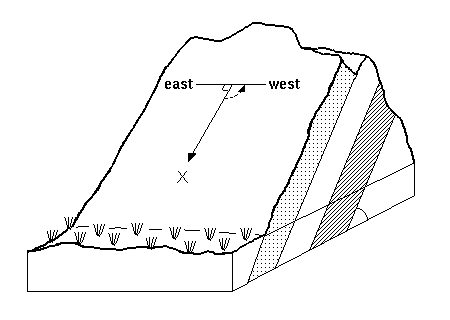
  29. The following figure is from one of the web sites linked to your notes. X indicates the direction of (a) dip (b) infiltration (c) latitude (d) strike


    True/False: Put A for True and B for False


  30. P waves travel faster than S waves.
  31. We need three seismograph readings in order to determine the location of the epicenter of an earthquake.
  32. Near the subduction zone along the coast of South America, the focus of earthquakes is deeper to the east.
  33. P waves can move through liquids but S waves can not.
  34. The maximum size of an earthquake is limited by the number of seismographs needed to measure it.
  35. Wegner's theory of continental drift was initially rejected because he failed to present a plausible mechanism for plate movement.
  36. Most of the world's earthquake energy is released at mid-oceanic spreading centers.
  37. The fastest moving plates travel at a rate of approximately 4 inches per year.
  38. Continents do not subduct.
  39. Gravity is the principal cause of mass movement.
  40. Waterfalls and rapids are usually a result of a difference in erosion rates of rock and sediment forming the stream bottom.
  41. Outwash from a melting glacier often forms meandering streams.
  42. Channels on the Moon shaped like meandering streams indicate that there was once water there.

    From the slides: We will view slides together in class. The following questions are based on these slides.


  43. The mountain shown in the slide was formed by (a) block faulting (b) continent-continent collision (c) folding and thrusting (d) volcanic activity
  44. The wall of the valley shown represent (a) a normal fault (b) a reverse fault (c) a thrust fault (d) a strike-slip fault
  45. The red rocks in the slide shown are (a) an ancient riverbed (b) glacial outwash (c) loess (d) meteorites
  46. The mountains shown in the slide were formed by (a) block faulting (b) subduction (c) folding and thrusting (d) volcanic activity
  47. The point in the slide that I will point to where the bridge failed is (a) an expansion joint (b) a place where unreinforced concrete was used (c) a strike-slip fault (d) where termites ate a board holding the bridge together
  48. In the map shown, the yellow represents (a) marsh (b) natural levee (c) spillway (d) swamp
  49. In the slide, the fault shown is a (a) normal fault (b) reverse fault (c) strike-slip fault (d) thrust fault
  50. In the slide shown, the yellow highlighted in the Gulf of Aden represents (a) a hot spot (b) a new oceanic spreading center (c) the Rift Valley of Africa (d) a subduction zone


File translated from TEX by TTH, version 2.65.
On 6 Nov 2000, 10:04.
Hosted by www.Geocities.ws

1