Music
in the Middle Ages -- Gregorian Chant and Old Roman Chant -- Performance,
Differences, Similarities, and Problems That Faced This Ancient Music
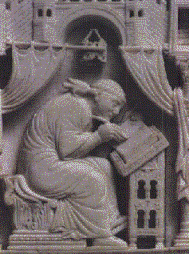
A picture of Pope Gregory I
John
Sharkey
Music
362
October
7, 1999
Dr.
Christopher Corley
Page
1
Music
362
Introduction
The
liturgy is the largest musical and artistic experience possible. Two of
the most popular forms of music in the Middle Ages were Gregorian Chant
and Old Roman Chant. This essay will explain the beginnings of Chant, some
problems that Chant faced in the Middle Ages, show similarities and differences
between Gregorian Chant and Old Roman Chant, and tell about how the music
was involved with the liturgy at that time.
Gregorian
Chant
Also
known as plainchant or plainsong, Gregorian Chants are a single-line melody.
They were named for Pope Gregory the Great, who reigned from 590 to 604
and is generally credited for cataloging the Chants used by the Church
into a definitive body.
The
Chant melodies are written for unison voice and are free from accent. They
avoid wide leaps and dynamic contrasts. Gregorian Chant has been described
as "prayer on pitch", because of its simple qualities and sacred sound.
Missionaries
brought Gregorian Chant to the areas in Europe that were newly converted.
This extended Gregorian Chant's domain until it was a part of every phase
of musical activity in Europe, not only in the realm of sacred music, but
a part of all music.
Old Roman Chant
Old
Roman Chant was the Roman version of Gregorian chant.Old
Roman Chant is a liturgical repertory of melodies. This music has survived
in
Page
2
Music
362
manuscripts,
such as missals and ordinals, since the time of its use. Old Roman Chant
was most popular between the eleventh and thirteenth centuries, but the
Chant can be traced back to at least the eighth century. It is no longer
thought that Gregorian Chant represents Old Roman Chant in the time of
Gregory, but that it originated in the Frankish Empire circa the year 800,
with the introduction of the Roman liturgy there. The Roman tradition continued
to develop until the 11th century, while absorbing many Frankish elements.
There
are several outstanding features that make Old Roman Chant different than
other music. Old Roman offertories have the highest incidence of textual
divergence. This means that the text used in the Chant come in a wide range
of biblical and non-biblical prayers. These offertories vary in size and
in the time of the year that they are used. Many Old Roman offertories
are used to give alms, admiration to God, and thanks to God.
Performance
of the Chant
There
were three different types of performance classifications in the Middle
Ages: antiphonal (alternating choirs), responsorial (alternating soloist
and choir), and direct (without alternation). Text for these Chants were
either syllabic (the singer does not change pitch on a syllable) or melismatic
(a single syllable is stretched through a considerable amount of melodic
motion). Often, Chant reflects post-classical Latin accents of the text.
This principle came to be known as tonic accent. Chant also used a process
where a phrase is adapted, as
Page 3
Music 362
necessary,
to the words of that particular moment in the text. This is called centonization.
Chant's
Problems and Difficulties in the Middle Ages
Chant's
difficulties developed over time. As familiarity with the Church had led
to interference, so, in the Chant world, familiarity with the Chants now
led to a desire for freshness, which resulted in interference with the
traditional rendering of the sacred melodies.
In
the government of the Church at large, many of the problems of this time
were due to the bringing together of sacred music with secular music. This
havoc to the Chant would be due largely to the fact that this new music,
which was a perfectly legitimate and beautiful development, was being brought
together with secular music. Theorists were treating both kinds of music
on the same basis and this became a detriment to the Chant. The confusion
of the spiritual with the secular led to the neglect of the spiritual,
though there was no great upheaval.
The
confusion as to this new Chant led to the neglect of the Old Tradition,
though there was no serious harm to the Chant. In fact, after the year
950 the Chant compositions that were being produced were in part inferior
to the earlier ones as regards to simplicity, naturalness, and warmth of
feeling.
Nevertheless,
Chant continued to hold its ground as the universal musical language of
the Church. Furthermore, it was the monastic foundation that preserved
and fed the sacred fire of Christian tradition. It was also the monastic
Page
4
Music
362
homes
of the Sons of Benedict (these was a group of monks founded by St. Benedict)
that preserved and fostered the sacred Chant. Without these monks the Chant
might have been lost to succeeding generations. And if St. Benedict, through
his Order, can be said to have saved Christianity in Europe, he can also
be said to have preserved the Chant.
Comparison
between Gregorian Chant and Old Roman Chant in the Mass
Old Roman Chant's introits show general melodic correlation to Gregorian Chant. However, Old Roman Chant's offertories have a higher divergence textually.
Old
Roman Chant uses unusually long melismas. This Chant had a tendency to
allow the melismas and phrases to flow over the caesura (a caesura is a
metrical break in a verse, occurring in the middle of a foot and commonly
near the middle of the verse) and link each Chant with the following one.
This makes the chant a constant continuation of the melodic flow.
These
melismas used in Old Roman Chant have no standard melodic formula and these
musical lines are not as clearly outlined as the melodic lines used in
Gregorian Chant. Later, in Rome, Old Roman chant was finally ousted and
Gregorian chant was continued due to its stable, yet flexible, nature.
The
number of Alleluia melodies is much smaller in Old Roman chant than in
Gregorian chant. There are eleven Old Roman Alleluias that use their own
Page
5
Music
362
melodies.
The remaining alleluias utilize seven standard Alleluia formulas and these
Alleluias correspond more or less in their verses. Ten Old Roman alleluias
have a melodia secunda (which is an extension of the jubilus).
There
are a few similarities between Old Roman Chant and Gregorian Chant. In
the offertory, there is a three note neumatic structure over a single syllable
continuously throughout. Similar phenomenon occurs in Gregorian offertory
verses. And, in the antiphon, most standard Gregorian melodies appear in
Old Roman Chant. However, there are still several differences in Lenten
antiphons.
Relationship Between the
Gregorian and Old Roman Melodies
of the Divine Office
St.
Benedict started the Divine Office as a set of detailed regulations to
order every aspect of a monk's day of study and work. The Divine Office
is a set of eight services. Here is the list of services: Matins,
Lauds, Prime,Terce, Sext, Nones, Vespers,
andCompline. Chant was a
major role that a monk must carry out daily. The monks used both Old Roman
Chant and Gregorian Chant.
There
were several differences between the two Chants in the Divine Office. Divergences
of the Old Roman repertory from the Gregorian repertory are much greater
in the Divine Office than in the Mass. Old Roman Chants for the Divine
Office differ greatly from the Old Roman Chants at another occasion. In
responsories, sources contain six hundred and thirty-six Old Roman responsories
(most of this information comes from Old Roman Chant missals
Page 6
Music 362
and
ordinals). These manuscripts indicate that an extensive respond production
in Gregorian Chant did not occur in the Old Roman tradition. This means
that there were additional parts added to Gregorian Chants in the Divine
Office tradition.
There
is a similarity between the two Chants in the Divine Office. Most of the
individual melodic phrases flow directly into one another. Often, the opening
of the second part only completes a cadence of the first part. This holds
true for both kinds of Chant.
Summary & Conclusion
Gregorian
Chant and Old Roman Chant are two of the most important musical entities
of the Middle Ages. These Chants have several differences and similarities
in the Mass and in the Divine Office. The performance of these chants is
versatile, yet simple. These Chants are diverse textually and have some
of the most beautiful and genuine prayers ever created.
I
believe that the church has a great history and I think that many people
that enjoy religious study should become knowledgeable of where the Church
has come from. The Chant is an important figure in Church and should be
cherished by religious figures and the laity alike.
Page
7
Music
362
Bibliography
1.Internet
Source: http://www.sni.net/advent/Popes/ppgr01.htm
2.Internet
Source:http://www.dictionary.com
3.Internet
Source: http://members.tripod.com/~papandr/musicology/oldroman.htm
4.Internet
Source: http://members.tripod.com/~papandr/musicology/grout2.html
5.Internet
Source: http://www.medieval.org/emfaq/misc/gregorian.html
6.Internet
Source: http://www.netacc.net/~bbasile/chantbar.htm
Total
Words:1521