Beethoven: His Biography, His Music,
and Composers that were influenced by him
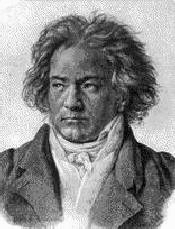
Born: December 16, 1770 in
Bonn, Germany
Died: March 26,1827 in Vienna,
Austria
John Sharkey
Music 265 – Symphonic
Music
Mr. Brye
Beethoven – Music
265
Beethoven’s Biography
Beethoven’s Early Period (1770
-1804)
Ludwig von Beethoven
was born on December 16, 1770 in Bonn. He studied first with his father,
Johann, who was a singer and instrumentalist in the service of the Elector
of Cologne at Bonn, Germany. Ludwig’s father was also an alcoholic and
by 1789 Beethoven supported his family as a musician. At the age of 18,
after his mother’s death, Beethoven placed himself at the head of the family,
taking responsibility for his two younger brothers, both of whom followed
him when he later moved to Vienna, Austria.
In Bonn, Beethoven’s
most important composition teacher was German composer Christian Gottlob
Neefe, with whom he studied during the 1780s. Neefe used the music of German
composer Johann Sebastian Bach as a cornerstone of instruction, and he
later encouraged Beethoven to study with Austrian composer Wolfgang Amadeus
Mozart, whom Beethoven met briefly in Vienna in 1787. In 1792, Beethoven
made another journey to Vienna to study with Austrian composer Joseph Haydn,
and he stayed there the rest of his life.
He pursued his studies,
first with Haydn, but there was some clash of temperaments. Beethoven also
studied with the great composer Antonio Salieri. Until 1794, the Elector
at Bonn supported him, but Beethoven was soon to find patrons among the
music-loving Viennese aristocracy and soon enjoyed success as a piano virtuoso,
playing at private houses or palaces rather than in public. Beethoven made
his public debut in 1795. Around this time his first important publications
appeared. His first publications were three piano trios (op. l) and three
piano sonatas (op. 2). As a pianist, it was reported, he had excitement,
brilliance, and fantasy as well as depth of feeling. Beethoven showed great
feeling during this period because he was writing for the instrument that
he was best at playing. Beethoven has his most original music during this
period. He created the Pathetique in 1799 and Moonlight ('Sonata
quasi una fantasia') in 1801. These works show Beethoven’s innovations
in style and emotional content. These years also saw the composition of
his first three piano concertos, his first two symphonies, and a set of
six string quartets op. l8.
In 1802, Beethoven
realized that his hearing had worsened. For some time he knew that his
hearing was impaired and that it was inevitably going to worsen. In the
fall of 1802, in a village outside Vienna, Heiligenstadt, he wrote a will-like
document, addressed to his two brothers. This document described his bitter
unhappiness over his hearing loss and suggested that he thought death was
near. However, he fought through this depressed time in his life and left
this time determined and very strong.
Beethoven’s Middle
Period
(1804 -1812)
Around 1804, Beethoven
entered a time in his life generally called his 'middle period'. It is
characterized by a heroic tone. This heroic tone is very clearly set in
works such as the Eroica Symphony (Beethoven’s Symphony No. 3).
This piece was to be dedicated to Napoleon and it was also played at John
F. Kennedy’s funeral procession. This heroic tone is also heard in Beethoven’s
Symphony No. 5 (1807). In this symphony, he uses a somber mood in
the first movement often called 'Fate knocking on the door.’ He uses C
minor continuously throughout this piece (Beethoven really stresses this
key!).
He shows this
heroic theme in opera also. Beethoven and his librettists twice revised
Fidelio,
which was deemed unsuccessful at its premiere. The final version
of
Fidelio was completed in 1814. In this opera, the heroic theme
is described clearly by the story in which a wife saves her imprisoned
husband from murder. In the final version, there is more emphasis on the
moral force of the story. Fidelio
deals with freedom, justice, heroism,
and love. Beethoven has three string quartets in his middle period. Beethoven’s
work, op.59, is very heroic in scale and the most popular of his string
quartets from this period. This work, lasting some forty-five minutes,
has great width, and it embodies a sense of triumph as it goes onto a scintillating
finale. Beethoven had a powerful and expansive part of his middle-period.
Some of his most expansive of this time include the Pastorale Symphony
(1808) (Beethoven’s Symphony No.6). In this symphony, he brings
about his feelings and thoughts of the countryside, which he loved. Symphony
No. 7 (1812) is also romantic in nature meaning that it's an expansive
and powerful work.
Beethoven worked
on piano concertos, violin concertos, chamber works, and piano sonatas
during this middle period. Beethoven most famous piano concertos at this
time were
Piano Concerto No. 4, which is lyrical work, and Piano
Concerto No. 5, which is known as Emperor. This piece expresses a heroic
noble quality. He also had several piano sonatas (such as the Waldstein
and the Appassionata) that are extremely popular even today. By
the end of this period, Beethoven was firmly established as the greatest
composer of his time.
His piano-playing career had finished
in 1808 (a charity appearance in 1814 was a disaster because of his deafness).
He had considered leaving Vienna for a secure post in Germany, but three
Viennese noblemen had banded together to provide him with a steady income,
so he remained there.
Beethoven’s Late Period (1812 – 1827)
Many things bothered
Beethoven throughout his life. His hearing bothered him more than anything
else. But, he also found trouble in finding a soul mate. He fell in love
several times, usually with aristocratic pupils (some of them married),
and each time was either rejected or saw that the woman did not match his
ideals. In 1812, however, he wrote a passionate love-letter to an 'Eternally
Beloved’, (probably Antonie Brentano, a Viennese married to a Frankfurt
businessman), but the letter was never sent.
The years after
1812 were relatively unproductive. Beethoven seems to have been seriously
depressed by his deafness, isolation, failure of his marital hopes, and
by anxieties over the custodianship of the son of his late brother, which
involved him in legal actions. However, he fought through these emotionally
frustrating problems to write his profoundest music, which surely reflects
something of what he had been through. There are seven piano sonatas in
his 'late period'. One of his most emotional pieces of this time was the
turbulent op. 106 (called Hammerklavier). This piece is filled with
dynamic writing and uses a harsh fugue. Another standout piece from this
time was op.110. Additionally, this work has fugues and very intricate
writing. Op.110 also uses several instruments in extreme ways.
In 1824, Beethoven
created one of his most famous works, his ninth symphony. This symphony
is also known as the Choral Symphony. This work is done in d minor. This
work has an extended variation-finale and sets a scene for soloists and
a chorus in the last movement known as Schiller's Ode to Joy. This piece
has a group of string quartets along with several other extras that have
never been used by any composer before. This movement is filled with music
that seems to be on a new plane of spiritual depth. It has a sense of abrupt
contrasts and emotional intensity. In his late period, the traditional
four-
movement scheme and conventional
forms are discarded in favor of designs of six or seven movements, some
fugal, some variations, some song-like, some martial, and one that is even
like a chorale prelude. For Beethoven, the act of composition had always
been a struggle. His sketchbooks were filled with music that looks very
tortuous to write. In his late works, the sense of agonizing effort is
a part of the music.
Beethoven’s finale
Musical taste in Vienna had changed
during the first decades of the 19th century. The public was extremely
interested in light Italian opera at this time, especially the music of
Rossini. They were also interested in easygoing chamber music, and other
songs to suit the prevalent bourgeois taste. Yet the Viennese were conscious
of Beethoven's greatness. They applauded the works of Beethoven’s, even
if the works baffled the listeners. Some individuals praised Beethoven
for some of the extraordinary visionary qualities in his music.
Beethoven’s
reputation went far beyond Vienna. When Beethoven passed away in early
in 1827, ten thousand people are said to have attended the funeral. He
had become a public figure, as no composer had done before.
Composers Influenced
by Beethoven
Beethoven influenced
many composers with his music style, harmonies, and melodies. Here we look
at five composers that were influenced by Beethoven: Anton
Bruckner, Gustav Mahler, Franz Schubert, Richard Wagner, and Sir. Michael
Tippet.
Anton Bruckner (1824 – 1896)
Anton Bruckner is
known as the most important composer of church music in the late nineteenth
century. He wanted to restore balance between the classic and romantic
traditions of the symphony. Beethoven influenced Bruckner’s compositions
in several ways. Beethoven was probably responsible for Bruckner’s conception
of heroism and a grandiose flavor that is evident in his music. Bruckner
was most influenced by Beethoven’s middle period. This period was filled
with heroic pieces. Beethoven is also responsible for influence of Bruckner
use of cyclic themes in his symphonies.
Gustav Mahler (1860 – 1911)
Gustav Mahler made
music that was to end the romantic period. He expanded the symphony to
the farthest extremes and was influenced greatly by the music of Beethoven.
In Mahler’s symphonies, he inherited many of the characteristics of Beethoven,
Richard Wagner, and the post-romantic Austrian composer Anton Bruckner.
Mahler used choral and solo vocal music in his fourth symphony. This followed
Beethoven's similar procedure in his ninth symphony. Beethoven popularized
this technique of adding words to the symphony, and, in this case, Mahler
used this technique to get his idea across.
Franz Schubert
(1797-1828)
Schubert’s was greatly influenced by the music of Haydn and Mozart. However,
Beethoven influenced Schubert in a different way. Schubert tried to avoid
the influence of Beethoven on his early instrumental works. This, to me,
means that he was influenced by Beethoven (to avoid a style means that
you have to take the style in account). Beethoven’s music made him think
about how he could differ musically and stylistically.
Schubert wanted a style of his own. He also
believed that he could do more than Beethoven could. Schubert fills his
symphonies and sonatas with expansive melodies and innovative harmonies.
His choice of keys stressed third relationships and showed him to be more
adventurous than Beethoven. He used woodwinds more frequently than Beethoven.
He also fills his works with more lyricism than Beethoven’s music.
Wilheim Wagner (1813 – 1883)
Wilheim Wagner was a German composer, conductor, and essayist. Wagner revolutionized
the concept and structure of opera. He radically altered the way opera
was composed. Wagner believed that drama and music in his operas were equally
important. During his early period of composing, he was greatly influenced
by the music of Beethoven. His early instrumental works relied heavily
on the works of Beethoven. Wagner used Beethoven’s ideas in his use of
melody, tempo, harmony, texture, and orchestration.
Sir Michael Tippett (1905
– 1998)
Sir Michael Tippett is a British composer and one of the United Kingdom's
leading composers with a large body of instrumental and operatic music.
Tippett is known for combining traditional classical music with types of
popular music and folk music. Tippett's early work especially reflects
a deep interest in the music of Beethoven. Beethoven’s music is also an
influence in Tippett’s later works, such as his Sonata for Piano No.
3 (1973).
Summary, Conclusion, & Personal
Reactions
Ludwig von Beethoven
is one of the greatest composers of all time. Beethoven conquered many
forms of music in his life. These forms include the symphony, chamber music,
concertos, sonatas, and choral music. His music excelled in form, melody,
harmony, texture, and orchestration. Beethoven composed nine symphonies:
Symphony Nos. 1, 2, 4, 8 are of the classical style (not as expansive,
more conservative). Symphony Nos. 3, 5, 7, 9 show greater depth and show
Beethoven’s ability to expand the melodic line. It also shows that he had
a great talent for harmony.
Beethoven’s life
is separated into three periods: early, middle, and late. His early period
lasted from 1770 till 1804. Beethoven was a gifted musician as a child
and worked to hold his family together after his father’s alcoholism became
extreme. He began working for the aristocracy and having performances at
their places of residence. His middle period (1804 – 1812) was filled with
music that stresses heroism. In his late period (1812 – 1827), his hearing
loss became extreme and his music became restless. He died in Vienna in
1827. Ten thousand people attended his funeral. Beethoven is considered
one of the most influential composers ever. He influenced great composers
like: Anton Bruckner, Gustav Mahler, Franz Schubert, Sir. Michael Tippet,
and Richard Wagner.
I believe that Ludwig von Beethoven is the greatest composer of all time.
His music bridges the gap between classical and romantic. Beethoven is
in a time of his own. He is neither classical nor romantic. He expanded
others minds and lead the way to new ideas. He was without a doubt a musical
genius. And, the thought that he lost his hearing and continued to compose
is mind-boggling.
Bibliography
1.
Grove, George. Beethoven and His Nine Symphonies. 3rd ed. (reprint)
N.Y.:Dover Pub., (1898) 1962.
2.
Rosen, Charles. The Classical Style; Haydn, Mozart, and Beethoven.
N.Y.:Viking Press, 1971.
3.
Simpson, Robert. Beethoven Symphonies. Seattle: University
of Washington Press, 1970.