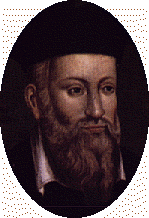
Nostradamus
(1503-1566)
Millions of T.V. viewers across the world watched intently as archaelogists of great renown, accompanied by egyptologists from four continents witnessed the opening of the long-publicized so-called Lost Tomb of Egypt. For the first time since it was built over four thousand years ago, its mysteries and treasures were to be revealed to humanity; a whole chain of events was set in motion that could be of vital importance to the future of mankind. At long last, we are going to find out if this particular tomb located in the Great Pyramid is in fact the one that will solve some of the intriguing puzzles that have racked the brains of many scholars, puzzles not only about lost civilizations like Atlantis and Mu but more importantly the cataclysmic events that are soon to follow the dawn of the New Millennium and what will eventually befall the human race. For it is widely rumoured that a previously unknown gateway will soon be discovered that will lead to a secret chamber containing papyri that contain vital information about humanity's immediate future.
Prophets and soothsayers have for centuries foretold of unprecedented events at the end of the present millennium. None other than Edgar Cayce himself spoke in one of his amazing trances of major findings in Egypt and elsewhere that will finally put all the pieces of the jigsaw puzzle together thereby making historical and cosmological sense of all the events that through countless centuries marked man's passage and evolution on earth. Before Edgar Cayce there have been many great seers and astrologers alike who have accurately predicted several happenings in the lives of people and as a result earned themselves an enviable position in society. But historians will agree that none of them achieves the notoriety and immortality of Michel de Nostre-Dame, known to the world at large as NOSTRADAMUS. Well, who was this man history recalls as the greatest of seers? And what has he predicted that should concern us as we move ever closer to the third millennium?
Nostradamus was born at St. Remy de Provence in 1503, of Jewish blood, but his parents having become Roman Catholics, he was baptized into that faith, which he observed all his life, perhaps overzealously. When he was a small boy, he went to live with his mother's father, Jean de St. Remy, a man of some scientific knowledge, who taught the child Greek, Latin, and Hebrew as well as the use of the astrolabe. Michel's father was also a skilled herbalist and physician and of course he did not neglect to teach his son the precious art of preparing medicines, and unguents, and the virtues of herbs. Michel was a precocious child who showed an early interest in astronomy and astrology above everything else. In those days, medicine and magic were closely related and Michel spent his time calculating the right astrologic moment for herb gathering.
Michel attended the University of Avignon at an age when boys today normally go to a preparatory school. Later he went on to Montpellier, which was then the best school of medicine in France, and perhaps of Europe. Michel wished to become a doctor to help humanity. He took his final degree on October 23, 1529, having already acquired a great reputation through his treatment and successful cure of the plague which ravaged Provence for four years.
Even his enemies admitted that he was a great doctor, but all his skill could not save his wife and their two sons. Within a few years of the marriage in the small town of Agen, she and the little boys died in an outbreak of plague.
For eight years after his loss, Nostradamus, unable to settle in one place, wandered through France, through Italy and Corsica. And as if his sorrow were a catalyst of his inner development, now his clairvoyant gifts began to show themselves. In spite of himself, since he did not wish to incur the adverse attention which he would risk if he became known as a prophet, he could not help making predictions. And as they were realized, a growing number of people believed him to have the gift of foretelling the future.
They did not include the Seigneur de Florinville, at whose castle of Fains Nostradamus stayed when passing through Lorraine. To prove the follishness of such belief, the seigneur pointed out to Nostradamus in the farmyard a black and a white sucking pig. "Foretell their future," he said. "You will eat the black one; a wolf will eat the white one," Nostradamus answered.
To make sure the prophecy was not fulfilled, the seigneur presently told his cook to kill and serve the white pig for supper that night. The piglet having been killed, it was cooked and left on the table ready for dressing. While the cook was out of the kitchen, a wolf cub which some of the seigneur's servants were trying to tame got in and ate the pig.
All roasted pigs being of the same colour, the cook killed the black one and served it at supper that night. The Seigneur no doubt took some pleasure in telling his guest that they were eating the white pig. When Nostradamus insisted that it was the black pig, the cook was sent for, to prove Nostradamus wrong. He confessed that the white pig had made, as the seer had predicted, the wolf cub's meal; the pork they had been eating had been the black pig, which was substituted for its white brother.
While Nostradamus was in Italy, he saw a young monk walking along the road toward him. Nostradamus knelt in the dust before the startled young man, Felice Peretti, who, born of poor parents in a nearby village, had worked as a swineherd before he entered the church. Nostradamus referred to him as His Holiness and those who heard him treated it as a joke. But years later it was remembered, not with laughter, when Felice Peretti, who had been made Cardinal of Montalto, became Pope Sixtus V in the year 1585.
Back in his native country, Nostradamus was told of a search which had been organized for a treasure known to be hidden in a mountain. He made it known that it would never be found until excavations for another purpose were carried out. Some time later, when the ruins of a Roman temple were being dug up, the treasure was discovered.
In 1547 he settled in Salon, practising as a physician, but giving more time to astrology and metaphysics than to medicine. It was a year which was a milstone in his life; on November II, he married again and began to compose his prophecies, which when completed covered seven millennia. The first edition was published in 1555; its title, Centuries, was bald and simple, but the contents were neither. In the preface, Nostradamus says he had decided to "show by abstruse and twisted sentences...so as not to scandalize the public's fragile hearing and write down everything under a figure cloudy rather than plainly prophetic." Whatever else he may have been called, Hostradamus has never been written off as a fool. He very well knew the occupational hazards of a prophet's life in his day; he therefore produced his predictions in a form which would yield little or nothing to cursory reading. The long and careful study necessary for their decoding protected their meaning from discovery except by the understanding few.
After publication of the second edition of Centuries, Nostradamus was summoned to court by King Jenri II, almost certainly because the prophet's fame had reached Queen Catherine. She, who had what has been called "a mania for occultism," would not have been satisfied until she had seen the man of whose predicitions all France was talking. She may also have wanted to compare his forecasts with those of Gauric, called "the most famous astrologer of his time," who had drawn up the horoscope of Catherine and of her father, Lorenzo II.
Gauric had said in 1493 that Giovanni de' Medici, then a fourteen-year-old cardinal, would be Pope; this happened in 1513, when he acceded to the Papcy as Leo X. Gauric's medical skill and prophetic gifts made him sought after in many countries; while he was in Scotland, he was called in to treat the Archbishop of St. Andrews for a complaint, which he cured - only to tell his patient that he would die on the scaffold, as he did.
Gauric prophesied the exact date of the death of Pope Paul III - November 29, 1549 - some years before it happened. When Catherine de Medicis was still only Dauphine of France, he said that the accession of her husband would be marked by a sensational duel and that a later duel would cause his death. The first duel, between Guy Chabot de Jarnac and Francois de Vivonne de la Chataignerie, took place on July 10, 1547; the young king saw Chataignerie killed. As for the second duel, Gauric warned Henri he must avoid "single combat in an enclosed place, especially near his forty-first year." There would be great danger then of being wounded in the head, a wound which might blind him or result in death.
Catherine's purpose in sending for Nostradamus in 1556 may have been partly to get a second opinion on this prediction of disaster for Henri. She also asked him to forecast the future of her children.
He arrived on August 15, having taken more than a month on the way. A striking figure, in his long gown and square cap - the uniform of a doctor - and bearded, he seems to have made a deep impression on Catherine. He was given the current VIP treatment at court, but the 130 ecus he received - 100 from Henri and 30 from Catherine - he apparently thought incredibly paltry. His journey had cost him 100 ecus.
However, in one way and another he did quite well out of his trip. Courtiers and their wives and daughters flocked to him. They paid handsomely for his advice, horoscopes, cosmetic recipes, (a specialty of his), and prescriptions for gout and stones. He was the talk of the town; a widely publicized incident was a late-night visit to him of a page from the Beauveau family, who woke the neighbourhood by his noisy assault on Nostradamus' door. The boy was in despair at having lost a favourite - and very valuable dog -. Nostradamus, not even asking why he had come, called out: "You are making a great deal of fuss about a lost dog. Go and look on the road to Orleans. You will find him there, on a lead." The page rushed off; the dog was found as and where Nostradamus had predicted.
Dealing with Catherine was a very different matter. She had asked him to tell her what was ahead for her children; he had to find some formula which would satisfy her that he had told her the whole truth about them, although in fact he dared not do so. Already in his Centuries, he had obliquely but accurately told their stories; Francois, the thriteen-year-old boy, would be married to Mary Stuart, live with little happiness, and die after reigning for one year; his eleven-year-old sister, who would be the child wife of old King Philip of Spain, would also die young. The girl, then nine, would marry the Duc de Lorraine, and live only into her twenties. The six-year-old Charles would be the ninth French King of his name; his reign would be darkened by the terrors of the Huguenot massacres. Two crowns waited for his five-year-old brother, who in both kingdoms would be unhappy; his end would be assassination. The youngest girl, Marguerite, would be the wife of Henri de Navarre until he discarded her because of her adulteries. The baby of the family, two-year-old Francois, as Duc d'Anjou and titular ruler oof the Netherlands, would be treated as a figure of fun in every European court, Elizabeth of England's "little frog," whom she allowed to consider himself her suitor for reasons of statecraft.
How could Nostradamus pass on his foreknowledge of wholesale tragedy to Catherine? Out of humanity, he could not; out of expediency, he dared not. But there was one element in the future of her sons about which he could speak without causing grief to Catherine or danger to himself. He said, "They will all be kings."
Nostradamus prophesied the death of Henri II in much the same terms as Gauric used. The quatrain relating to it in his Centuries translates:
The young lion shall overcome the old
In war-like field in single fight
In a golden cage he will pierce the eye.
Two wounds one, then die a cruel death.
In the summer of 1559, a three-day tournament was held in Paris, celebrating a double wedding in the royal family, Henri's daughter Elizabeth marrying (by proxy) Philip II of Spain; Marguerite, the Duke of Saxony. The lists had been set up near the Palais des Tournelles, and there, on June 30, Henri rode against the captain of his Scottish Guard, Comte Gabriel de Montgomery. In the third encounter, the jagged point of Montgomery's splintered lanced pierced the king's vizier (which was gilded and, as was the fashion for jousting helms, shaped like a cage) and entered his eye. Apparently a splinter also injured his throat - "Two wounds one."
Ten days later Henri died. Nostradamus foretold the results to France of his death in a quatrain which promised that in the year a one-eyed king reigned (there had never been a one-eyed King of France) "the Court will enter upon very serious difficulties... the Kingdom, put in tribulation, will be split." Troubles and disturbances came thick and fast after Henri's accident and death. There were the St. Bartholomew's Day massacre and the near civil war between Royalists and Legitimists, and Henri III was assassinated when he attempted to surround Paris, which was in revolt in 1589.
Meanwhile, after Henri II's death, although he had ordered that no harm should come to the man who had without intention caused it, Montgomery wisely left France for Britain. But Nostradamus had written of him in the Centuries: "He who fights on martial field, and shall have carried off the prize from one greater than he, shall be surprized by six men at night, naked, without armour, suddenly."
And so fifteen years later, Nemesis caught up with Montgomery. He returned to France to fight with the Huguenots and was captured at Domfront; the terms of surrender were that his life was to be spared. On Thursday, May 27, 1574, he was arrested by six noblemen of the Royal Army while in bed (naked, as was customary then), by express order of Queen Catherine, and delivered to her vcengeance at Caen.
After the death of Francois II (prophesied by Nostradamus), his mother, Catherine, and his successor, the fourteen-year-old Charles IX, while on a goodwill progress through France, visited Salon, the hometown of Nostradamus, in 1564. On a dais, draped with white and purple damask, the chief men of the town, among whom was Nostradamus, received the royal visitors. The chief magistrate read an oration to the king; Charles, not yet having learned statecraft, replied: "I came to see Nostradamus."
That evening Nostradamus was commanded to the royal apartments to cast the horoscope of the young brother of the king, Jenri, then the Duc d'Anjou. One day he would be King of France, the astrologer said. To ten-year-old Henri of Navarre, who was in the royal entourage, Nostradamus foretold that one day he would "have the whole inheritance."
As if it were a spool of film, the future unrolled before Nostradamus. He foresaw and predicted almost every major historical event in France and crises in many other countries through the centuries between his own and the year 3797. Whatever his powers were, they operated independently of space and time.
That milestone in his nation's development, the Revolution, is the theme of a number of quatrains, naturally enough, since he must have recognized its immense implications. He referred to it as "Commun Advenement" (Advent of Commons, or Rise of the Third Estate), in his epistle to his son Caesar. He listed among its results that the "topography of France would be arbitrarily altered," as it was when the ancient provincial division of France was changed into departments with new names; that the tombs of the Franch kings would be desecrated, which also came to pass. And philosophy would replace religion - he was experiencing precognitively the days when the teachings of Voltaire would supersede those of Christ.
Two hundred and thirty years before it happened, Nostradamus foretold the disastrous flight of Louis the Sixteenth from Paris. Louis, the first King of France to hold the title not only by divine right, but also by mandate of a constituent assembly, who was by temperament monkish, as was well known, fled through the night of June 29, 1792, to Varennes, dressed in gray. It was dark in the little town when the royal party arrived; all its members were captured there, taken back to Paris, and later executed.
Nostradamus had said that:
At night will come through the Forest of Reines
A married couple, by a devious route,
Herne, the white stone, the monk in gray, into Varennes,
The elected Capet - the result will be tempest, fire,
blood - and cutting off.
As there is not and never has been a Forest of Reines, some commentators think that probably the word Nostradamus used was not "forest" but fores, Latin for door, referring to the queen's door through which the escape was made. "Herne" is an anagram of reine, or queen. (Nostradamus was devoted to anagrams, and the rules of making them permitten change or suppression of a letter. "Rapis" is his favourite transliteration of Paris.) "The white stone" was a poetical description of Marie Antoinette, who was dressed all in white - and by the time she arrived back in Paris her hair had turned white, "blanchis," as she said herself, "par la douleur." Some historians think that Nostradamus may also have had in mind when he spoke of "la pierre blanche" the famous diamond necklace which made the queen so unpopular. "The monk in gray ... the elected Capet" could refer only to Louis himself.
The ending of the affair was as Nostradamus had described it - destruction, disaster, chaos, then blood and "cutting off" by the guillotine. Tranche was the word he used, meaning a cut, a slice.
In another quatrain, he said that the mob would return to the Tuileries, 500 strong, after their first invasion of June 20, 1792. It is a matter of record that this happened. And at the time this prediction was made and published, the royal residences were Fontainebleau or the older palace of the Louvre. The Tuileries palace did not exist. Catherine de Medicis began to build it in 1564 on the site of a tileworks (Tuileries).
Nostradamus covered the full course of the Revolution in his quatrains, predicting, concerning the execution of Louis the Sixteenth on January 21, that his body (after death) would be covered "with a powder that burns." The king's corpse was taken in a wicker basket to the Madeleine, where it was thrown in a deep pit. Over it was spread a thick pall of quicklime.
The victories of Suleiman the Magnificent, the disasters which followed them, and the treaty between Persia and Turkey of which he gave the correct date (October, 1727) were among the events outside France foretold by Nostradamus. Of England, he said that the "senate (Parliament) of London will put their King to death." The Scots, he added, would basely sell this king to Parliament. His usurper (le bastard) would be almost received as king (Cromwell never achieved a title higher than that of Lord Protector).
Nostradamus found nothing praiseworthy in the dictator. "More like a butcher than an English King," he says of him, "Born in an obscure place, by force he will take his empire. Coward without faith or law, he will cause the earth to bleed. The time approaches so closely that I sigh." Cromwell was born in 1599; Charles I was executed in 1649, to a man whose vision ranged over five centuries or more, England's Civil War and the events leading to it must have seemed to be only just over the threshold of another day.
In his time, Britain was not a major European power; the ordinary man could have seen no reason why she ever should be. Nostradamus, looking down the years, saw her unchallenged ascendancy. "The great empire will be held by England. It will be all-powerful for more than three hudnred years. Great armies will go by sea and land. The Portuguese will not be pleased." The reference to Portuguese vexation is taken to mean that because the growth of England's overseas trade and her control of India virtually closed to Portugal many markets for her exports, she was "not pleased."
The "more than three hundred years" of England's imperial power is thought by some authorities to begin with the passing of the Navigation Act of 1651, which, by ruling that imports could be brought to Britain only in ships of the nation which produced the merchandise, resulted in a rapid expansion in Britain's trading fleet. It laid the foundations of a general growth of economy.
Three hundred years - and a little more - have passed since then, and, in their passing, verified Nostradamus' prophecy. Armies, some of them millions strong, went from Britain, by sea and land. Great power came and went, within the time limit he foresaw.
When he gave dates, Nostradamus was usually exact, which is surprising, considering that the time dimension is meaningless to the clairvoyant. Of Elizabeth I, he said, while her sister was still alive:
The rejected one shall accede to the throne
Her enemies shall be found to be conspirators,
Her time shall triumph as never before,
At seventy she shall surely die, in the third year of the century.
On September 7, 1533, the queen was born. When she died, she was sixty-nine years and six months, in her seventieth year. The date was March 24, 1603.
Nostradamus foretold indirectly the union of the English and Scottish crowns, by saying that "Great Britain, comprising England," would "suffer a great inundation (flood)." In January, 1607, the dikes in Somerset were broken down by the sea; a stretch of country 30 miles long and 6 miles wide was underwater. The Norfolk coast suffered in the same way, but not so extensively. England had become Great Britain in March, 1603, when James I (the Sixth of Scotland) in his person united the crowns of the two kingdoms as successor to Elizabeth, less than four years earlier.
The Great Plague and the Fire of London could not escape Nostradamus' keen psychic eye. Being an ardent royalist, he seems to have considered both in the nature of a judgment on the city - and perhaps the country generally - for having consented to the execution of its king, whom he always spoke of as "the just."
Of the plague he said:
The great plague of the maritime city
Shall not cease till death is avenged
For the blood of the just taken and condemned though innocent,
And the great dame outraged by feigning saints.
And of the fire:
The blood of the just shall be required of London
Burned by fire in thrice twenty and six:
The old dame shall fall from her high place
And many edifices of the same sect shall be destroyed.
("Dame" is Nostradamus' term for a cathedral or Mother Church and obviously refers to St. Paul's.)
Looking on into the eighteenth century, Nostradamus foresaw the rise of Napoleon, whose birthplace and many other details about him are described in the quatrains. What seems to have most impressed Nostradamus about Napoleon's appearance was his short hair, which, in those days of long-haired males, would have seemed unusual. "Teste raze," he calls the emperor, saying, "The man with short hair will assume absolute power for fourteen years." After the coup d'etat of 1799, Napoleon was in supreme control of France until his abdication in 1814.
Nostradamus calls him "an Emperor (of France) born near Italy ... His alliances will be much talked about and he will be more of a butcher than a prince... From a privte soldier, he will become Emperor, valiant in arms but to the Church most tiresome."
His victories and defeats, his escape from Elba, and his landing made near Nice are forecast. Napoleon in fact landed at Golfe-Juan a few miles from Nice.
His exile on St. Helena, Nostradamus describes as "the general who led infinite hosts, ending his life far above his native land among people of strange customs and language on a chalky island in the sea."
On to the 20th century and the eruption of another dictator. "A leader of the Great Germanies will come to give help which is only its counterfeit, or will cause to yield by offering 'protection'. This man will stretch the borders of Great Germanie to include Brabant and Flanders. Bruges and Boulogne. France will be divided into two parts." Hitler and Mussolini (and the place of their meeting, Venice), the chaos of armies retreating from France, are clearly described; the first impact of the German forces, the streams of refugees - all are set out in the quatrains, one of which pictures a bombing raid as vividly as if Nostradamus had been on the spot while it was going on:
Living fire and death hidden in globes will be loosed,
horrible, terrible,
By night enemy forces will reduce the city to powder,
That it is already on fire (incendiaries?) will be
favourable to the enemy.
Nineteen hundred and ninety-nine years and seven months is the date he sets for the coming of the third Antichrist (Napoleon and Hitler, according to Nostradamus, filled this role each in his own time), the "King of Terror." His reign will last twenty-seven years; heretics will die, be taken captive, or exiled. The period will be one of "blood, human corpses, reddened water, hell on earth." He predicts that "a yellow race" will sweep across Europe and that Paris will be destroyed by an aerial attack before the tide of invasion is turned.
This prediction reads almost as if it were Nostradamus' version of the end of the world, the great Armageddon, the final debacle which will destroy the human race and which has been predicted regularly every so often since the history of prophecy began. In many centuries there seems to have been a widespread conviction that the world could not last much longer; perhaps the belief is a shadow in race memory cast by major cataclysms of the past, such as the engulfing of continents in floods, stretching to cataclysms which no doubt must occur in the future. The poles of the globe tilt; the land and water masses shift; mighty stresses and strains build up; vast upheavals occur. Some scientists think we are doing our puny bit to hurry such conditions along by extracting gas from the sea (the North Sea gas project), which apparently causes subsidences of the earth's crust. Recent climatic changes seem to indicate that the earth is getting ready for some major overhaul from agencies beyond our control.
The physical end of the world in 1999 seems unlikely as we are already in its third month and no major cataclysm e.g. global earthquake, a huge meteor hitting the earth, has yet occurred. But prophets often speak in allegories. The end of the world as we know it - the present civilization - is a different matter; it could be that, as some psychics think, a great cycle of evolution has almost completed its span; another is due to begin.
Perhaps that is what Nostradamus saw, clairvoyantly. His predictions were not purely astronomical. Chauvigny, his disciple and biographer, says that Nostradamus' prophecies were made when he was in a state of ecstasy or trance, much like Edgar Cayce when he gave his readings, as it seems they must have been. Horoscopes cannot be set up for the unborn; their names and futures cannot be forecast by astrology.
But according to Nostradamus, the catastrophes and terrors of 1999 are as a dress rehearsal for those of the year 7000. Looking ahead, not a few hundred years, but 6,000, he says that the Gobi Desert will become once more a sea when the land is devastated, and the geography of the world changed by a deluge vaster than that of which the Bible tells.
Nostradamus foretold the date of his own death and its manner. "On returning from an embassy (he went to Arles, as representative of Salon), the King's gift safely replaced, I shall do no more, I shall have gone to God. By my relations, friends and brothers I shall be found dead, near my bed and the bench."
In June, 1566, ill with gout and with dropsy, he said, "My end is near." On July I he sent for a priest to hear his confession, saying afterward, "You will not see me alive at sunrise." On the morning of July 2, he was found dead as he had predicted in the quatrain quoted, between the bench he had had made to help him lever his body, cumbersome with dropsy, in and out of bed and the bed itself.
He is almost always referred to at this period of his life, as an "old man," as if he were an octogenarian at least, but he was not old when he died, at least by our standards. His age was sixty-two years, six months, and seven days. He may have looked like a patriarch and had the solemnity attributed to one, but he could sometimes show a puckish sense of humour, of which his last joke was typical.
Nearly fifty years after his death, the authorities of Salon decided to remove his coffin to a place of greater importance in the church. In the hope that other predictions might have been buried with him, the casket was opened and there, on his breastbone, was a small metal plate, engraved with the date of the exhumation. He had foreseen even that.
We who live in an age of great scientific and technological progress and do not attribute much weight to the predictions of soothsayers and astrologers and dismissing them all as mere superstitions cannot however but show wonder and amazement at how much truth is to be found in the quatrains of Nostradamus. It is uncanny and somewhat ominous that he should have marked out the month of July of the year 1999 as being the "deadline" of some world-wide events of major cosmic significance. And don't you like myself consider yourselves lucky to be living at this specific moment in time when the whole history of mankind is about to turned upside down by the actual shifting of the earth's poles? Just imagine what our last thoughts might be if all these dire forecasts turn out to be true? If given time by the powers that be, we might soon find out for ourselves if Nostradamus was indeed the greatest prophet that ever lived! If nothing happens in July, don't give up hope! There is still Y2K to keep your goose pimples on the rise
!