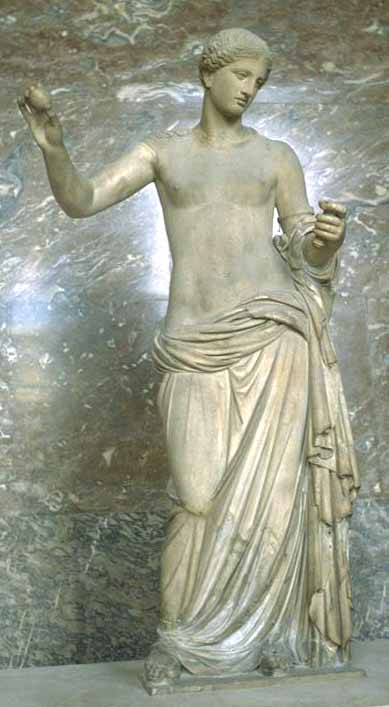
This duality of Aphrodite's nature is splendidly depicted in the myth of the union of her son Eros with Psyche (Soul). The condition for their love was that they could unite only in darkness. When Psyche succumbs to her need to know, she lights a candle and in its light sees her lover in all his glory. And Eros cries out, 'Love cannot live with suspicion,' and flies away. What is suspicion and curiosity at one level is, at another level, the soul's compulsion for light and consciousness, its unwillingness to be kept in the dark in a love relationship. As a result of her costly curiosity, Aphrotide imposes a number of tasks on Psyche before she can be reunited with her lover Eros without any restriction. Her final test is to enter the Underworld and there put into the box that Aphrodite has given her a drop of Persephone's beauty, the soul beauty of the depths. Psyche performs this task with success and is allowed to ascend from secret anonymous love towards personal and divine love merged into one. Psyche's marriage to Eros is the only wedding to be witnessed by all the gods and goddesses on Mt. Olympos. And none other but Aphrodite herself danced at the great feast Zeus three for the union of the two happy lovers.
Aphrodite is the goddess of the elemental mysteries of love as well as of its final unveiling to the light. Socrates was the first to name the two Aphrodites in Plato's book, Symposium:
No one, I think, will deny that there are two goddesses of that name -- one, the elder, sprung from no mother's womb but from the heavens themselves, we call the Uranian, the heavenly Aphrodite, while the younger, daughter of Zeus and Dione, we call Pandemus, the earthly Aphrodite. It follows, then, that Love should be known as earthly or as heavenly according to the goddess in whose company his work is done.
According to Socrates, mortals should pay homage to both goddesses of love. For whoever falls in love and feels the instincts shared with the beasts know full well that they are also shared with the gods. Even the spiritual side of Aphrodite is inextricably connected with the physical side of love, for the goddess was born from the genitals of Uranus, excised by his son Cronos and tossed into the sea. And she emerged, full-grown, into life from the depths of the ocean and the airy foam.
�
And the Hours in their golden diadems
received her with joy,
clothed her in ambrosial garments,
and placed a well-wrought crown, beautiful and golden,
on her immortal head
and flowers of copper and precious gold
in the pierced lobes of her ears.
The heavenly Venus arising from the foam of the sea has provided an unlimited source of inspiration for countless poets and artists from time immemorial and it is likely to be so for many generations to come. But there is no doubt that it is the earthly Aphrodite who, through rapture, magic spells, incantation and desire, has reigned supreme in the lives of men. In the Danaid of Aeschylus, the goddess of love and beauty shamelessly extols her power:
The holy heaven is full of desire to mate with the earth, and desire
seizes the earth to find a mate; rain falls from the amorous heaven
and impregnates the earth; and the earth brings forth for men the
fodder of flocks and herds and the gifts of Demeter; and from the
same moistening marriage-site the fruit of trees is ripened. Of these
shings I am the cause.
Aphrodite (Venus) represents sexuality free of ambivalence, anxieties and inhibitions. In other words, it is natural and quintessential love that is unbridled and is not concerned with the myth of virginity or its loss. She makes love to her young lover, Anchises, in broad daylight, under the mid-day sun. She is the only goddess who takes pride and glories in her nakedness, the only one artists love to portray nude in sculptures. She is also the goddess of all the arts that enhance beauty and the act of love. She arouses the senses with perfumes and incense, love-charms and potions, the use of oils and cosmetics and all the lore of aphrodisiac drinks and foods. The Chinese, who are obsessed with aphrodisiacs from every imaginable source, sometimes going to impossible lengths to obtain them, are the unconscious devotees of the cult of Aphrodite. She is the goddess of the cosmetics industry that has brough unimaginable wealth to many people, the goddess of courtesans and of the courtesan in all women.
The father of psycho-analysis, Freud, qualified the instinct embodied in the earthly Aphrodite as the source of all instinct. He dwells very little on the Urainian aspect of the goddess for modern man tends to concentrate rather on the physical libido for it is more tangible and more compelling. Each archetype, each god and goddess has a dark side, like the Ying and the Yang, but which complement each other. But in Aphrodite, magic brightness merges into swampy darkness. Botticelli's famous Birth of Venus commands our admiration and thrills our imagination while at the same time conjures up the spectre of venereal blight. Socrates' heavenly Aphrodite has for counterpart modern neuroses, power-games, treacheries, all in the name of love. In ancient Greece, she was 'golden', 'glowing' Aphrodite, but she was also known as the 'dark one' with clear reference to the secret source of all pleasure and evil, the dark recesses of the Mons Veneris, that entrap all men, the weak and the mighty alike. She is the 'killer of men', for a touch of modernity one would say tongue-in-cheek, 'the killer of presidents', 'the unholy'. She was closely associated with the Minoan 'goddess of wild things' and the Oriental goddess Ishtar, whose rites at Babylon, Byblos and Bambyce were notorious for the thousands of women who took part in the rites of sacred prostitution in dedicated temples. Even Alexander the Great was not immune to their charms and hundreds of his warriors fell prey to their irresistible appeal. Pindar had a euphemistic term for them; he called them the 'daughters of persuasion'.
Other mythical and historical characters like Circe, Calupso, Cleopatra embody Aphrodite the enchantress, the snare-knitter, the goddess men most fear and yet are inexorably attracted to for their own demise. She promises you her orgasmic ecstasies but usually delivers much pain and sorrow. She presents herself in the guise of a trustworthy friend, of a loving admirer ready to soothe and succour but secretly she is your enemy and only wants to eat you up and lose your soul. Those who try hardest to resist, those who imagine themselves immune to her power, are the ones on whom the goddess' wrath descends most vigorously: 'Do not imagine you can abdicate', W. H. Auden's Venus warns. 'Before you reach the frontier you are caught.' Just read what Shakespeare writes in his immortal poem, "Venus and Adonis"
"Fondling," she saith, "since I have hemm'd thee here
Within the circuit of this ivory pale,
I'll be a park, and thou shalt be my deer:
Feed where thou wilt, on mountain or in dale;
Graze on my lips, and if those hills be dry,
Stray lower, where the pleasant fountains lie."
Unless you are still wet behind the ears you will know what Venus means when she entreats Adonis to 'stray lower, where the fountains lie', and however much Adonis tried to escape her rapturous advances, Fate had already decided an unhappy outcome for him. So, ye men out there who are about to embark on the perilous journey to Aphrodite's favourite retreats, beware you do not lose your souls in the process of whiling away the time in the arms of forbidden love. There is always the morning after to reckon with and the bitter taste of unrequited lustful love.
The myths of Aphrodite are full of retaliations against those who forget her. She punished Daphnis, a Sicilian shepherd who won the hearts of numphs and muses but insisted that love had no power over him; she caused the women of Lemnos, who neglected her, to exude a foul odour which repelled their husbands; and she destroyed Hippolytus. In her opening speech in Euripides' Hippolytus she explains why:
Great is my power and wide my frame among mortals and also in
Heaven. All men that look upon the light of the sun, all that dwell
Between the Euxine Sea and the boundaries of Atlas are under my
Sway: I bless those that respect my power; and disappoint those who
Are not humble towards me. Yes, even the family of gods have this
Trait: they are pleased when people respect them. I shall demonstrate
The truth of this forthwith. Theseus' son Hippolytus, born of the
Amazon and brought up by temperate Pittheus, is the only inhabitant
Of this land of Troezen who declares that I am the vilest of divinities.
He spurns love and will have nothing to do with sex... It is his sinful
Neglect of me for which I shall punish Hippolytus this very day.