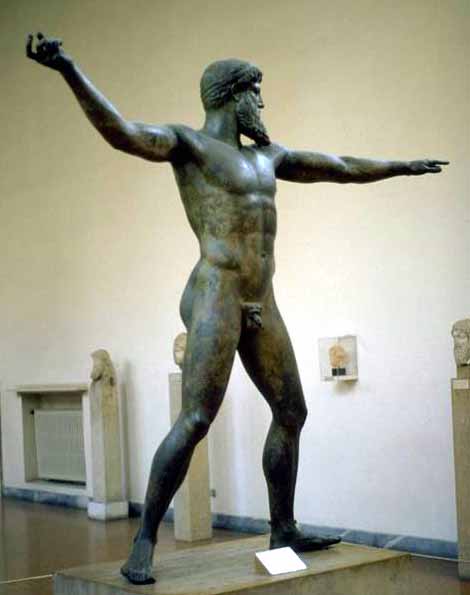
POSEIDON - Ruler of the Oceans
Riding his chariot of horses across the sea, Poseidon, god of the oceans and god of horses, embodies the two age-old symbols of the unconscious: horse and water. Water has always evoked in man the infinite possibilities and infinite dangers of our fluid unconscious. With no determined shape of its own, it is constantly in movement, never changing yet never the same for two successive moments. And the horse personifies in its primitive potency the insctinctive drves of our own raw nature. We have reined the horse, we have controlled or submerged our instincts, but the longing in us to be united with our life-giving power remains unquenchable. Our horsepower does become too little when our cultured, educated heads reject the unconscious power over which Poseidon rules. But the fear that leads us to suppress them is a very real one. Poseidon was the most primitive of the gods, the earthshaker, the god of storms and earthquakes, of the sudden devastation of tidal waters and of the dangers unleashed when the forces slumbering under the surface of consciousness erupt. Poseidon's menacing nature and suppressed savagery find countless expressions in his myths. Angered at Troy, he sends against the city a sea-monster that would break to the surface of the water and devour everything and everyone on the Trojan plain; seeking revenge for the blinding of the Cyclopes, he sends a torrential storm to wreck the raft Odysseus has built to escape from Calipso's island; furious with Queen Cassiopeia for boasting that she was even more beautiful than the goddesses of the sea, he sends a savage beast to lay waste her kingdom of Ethiopia. Monsters and storms are powerful symbols of the turbulence and the dangers of the unconscious. And what Poseidon's myths tell us is that the hero who will save us from its dangers has to dive into the monster, plunge into the sea and, having confronted its dangers, discover its mysteriously creative source and the power of renewal, personified in the myths by a beautiful princess. Troy was saved by Herakles who dived into the monster and came out through its belly, leaving it dead and releasing Hesione, the daughter of the king. Odysseus was saved after swimming in the ocean, the deep, dark, night of the soul, for two days and two nights, until he reached the island of the Phaeacians, and found on the shore the little princess Nausicaa. And Andromeda, Queen Cassiopeia's daughter, who had been offered as a propitiatory sacrifice to the god, was saved by Perseus; he dived at the monster and killed it just as, its huge jaws wide open, it was ready to swallow the chained Anromeda. The beautiful princesses, like the Rhinemaidens' gold glinting beneath the waters in Wagner's 'Ring', represent the supreme value, the creative force, submerged in the subconscious, which is why Poseidon is both the 'loudcrushing Earthshaker' and 'the god of the creative flow'. In many of his myths the emblem of his ferocious power, the trident, is transformed into an agent of creation and generation. He would strike the trident on rocks or dry land and a spring of fresh running water would be released where there was none before. Life and creativity come forth from the same unconscious source that can bring about destruction and dissolution. 'Why did they make birds so delicate and fine as those sea-swallows when the ocean can be so cruel?' asks Hemingway in 'The Old Man and the Sea'. 'The old man always thought of the sea as 'la mar', which is what people call her in Spanish when they love her. Some of the younger fishermen �spoke of her as 'el mar' which is masculine. They spoke of her as a contestant or a place or even an enemy. But the old man always thought of her as feminine and as something that gave or withheld great favours�.' The paradoxical nature of the sea is the paradoxical nature of its god: he is both the avenger and the protector of those at sea. In ancient times navigation of the oceans was a highly risky and dangerous undertaking and, at all times, the journey into the darkness and uncertainty of the unconscious is fraught with the dangers of disintegration. Yet in the same way that venturing into the oceans is essential for survival, venturing into the unconscious is essential for life. 'The connection with the suprapersonal or collective unconscious', wrote Jung, 'means an extension of man beyond himself�a rebirth in a new dimension as was literally enacted in certain of the ancient mysteries�.We can no longer deny that the dark strings of the unconscious are active powers�.The layman can hardly conceive how much hallucinations, moods and decisions are influenced by the dark forces of his psyche, and how dangerous or helpful they may be in shaping his destiny'. The ambivalence is represented in astrological symbolism by the planet Neptune that is said to 'rule' the Twelfth House dealing with the depths of the soul from which come both the oceanic experience of oneness with life and the danger of losing oneself in the ocean of the unconscious, in its vastness and formlessness. Astrologers have associated Neptune with poetry and music, feeling and imagination, and the discovery of the planet in 1846 coincided with the height of the Romantic era. In its positive aspect Neptune leads to the urge to devote ourselves to goals that transcend selfish pursuits and focus instead on the service of the larger whole � the family, the community, the world. It can also come to the fore in the quest for mystical experiences and idealized love and in our absorption in art and religion. In its negative aspect it can bring about instability, the urge to escape from the responsibilities of reality into day- dreams, infantile fantasies or drugs, an obsessive religiosity, or a fanatical pursuit of utopian politics where the idealized ends are used to justify the most cruel means. The extreme ambivalence of the planet and of the god is embodied in Poseidon's son Proteus who has the power to take on any number of shapes and forms. He can transform himself into a lion, a serpent, a panther, a boar, running water, a leafy tree�.Transformation is the essence of the journey into the unconscious and of the extension of man beyond mundane reality and his narrow self. The instinct that drives us to constant change and transformation, however great the dangers and powerful the monsters we encounter along the way, the instinct that Poseidon personifies � the instinct that drives us to wander through endless adventures, as Odysseus was forced to do by the sea god, until we reach Ithaca, the place where we started from, and through transformed eyes, see it again for the first time.Source: The Gods of Greece (Arianna Stassinopoulos)