|
A Divergery of Haiku
Making it new will not guarantee excellence. More likely than not, it will lead to empty
dazzle at best. On the other hand, making it old will guarantee the death of an art. It is
therefore to be applauded that at least a few poets in our country have been unrestrainedly
making it new for the past two or three decades. They've been pretty much invisible,
though. Hence, hardly any of the newnesses they've been responsible for have been
properly named and classified-or even described. The tiny but widely-ranging divergery
that follows, and my discussion of the specimens in it, are my attempt to help rectify that
situation in one precinct of contemporary poetry, the one devoted to haiku (although I
hope that what I say will be much more widely applicable).
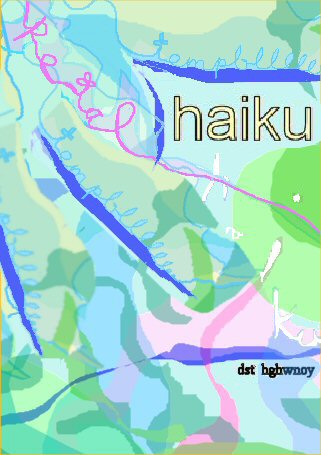
The first specimens in my divergery are a work in color by me (below), followed by a
poem by Basho in the English of Daniel C. Buchanan, and a shorter poem by Jonathan
Brannen.
                              Temple bells die out.
                              The fragrant blossoms remain.
                              A perfect evening!

                               Basho, trans. Daniel C Buchanan


                              Temple Bells

                              a petal
                              a peal

                               Jonathan Brannen
With all of these we are in what I call "kernular poetry," to taxonomize by size, for each
is less than 24 syllables in length. They are also haiku, by my not entirely orthodox
standards. That is, each is a kernular poem that contains some significant particulars of at
least two separable, explicit, concrete images, whose blend or clash persuasively yields
some unstated awareness of Final Things--such as the inevitability of death, or the
permanence of Beauty, as in these petal/ peal specimens (although that is not all that's in
them). I call this blend or clash the poem's lyricule. I suspect it is close to the
term, "haiku moment," that Robert Spiess so frequently and tellingly used. It is also, I'm
sure, close to the "ah" that Robert Bly feels every effective poem should have.
To spare my readers, I will not at this time taxonomize more consequentially, by
techniques involved, except to say that the haiku by Basho is, using my terminology, a
plaintext haiku; Brannen's poem is an infraverbal haiku; and mine is a pluraesthetic
haiku.
The Basho is a plaintext poem because it is unmetrical and has no rhymes but is
otherwise conventional. century. I place Brannen's poem in my infraverbal classification
because it relies to a significant extent on what happens in it below the level of individual
words. In centering his poem on the shrinkage of the word "petal" into the word, "peal,"
(subtracting not only a letter but a syllable), Brannen almost perfectly captures the way, in
the imagination, a petal can shed its materiality to become a form of music.
As for my poem, it belongs to the pluraesthetic class of poetry because it depends
substantially (and explicitly) for its aesthetic effect on more than one expressive modality,
to wit: the verbal, the visual and the mathematical--as opposed to poems made of words only (such as both Basho's and Brannen's).
It has words (some of them not easy to detect), so is verbal. Its colors and shapes, since
they are more than merely decorative (or so I hope) and fused with the other matter of the
poem, make it visual. That it is a long division poem, with "petal" (in cursive script)
being divided into "haiku," and the results of that division, all of which are intended to
evoke significant aesthetic meanings and feelings beyond what the words and graphics
alone can, makes it mathematical.
My poem also contains infraverbal effects. This is in keeping with my practice of using as
many different tactics in a poem as I can (when I'm not trying to use as few as I can).
Here it is hoped that something of "tremble" is in the slow fade of "tempbllllllls ..." and
that "dst hghwynoy" suggests a distant highway that is only barely recognized as what it
is, but has a hint of annoying noise in it.
For another specimen of infraverbal poetry, let's turn to the following untitled poem by
LeRoy Gorman: "onde omb ellelle." This at first is hard to fathom, but since the first
word that "onde" suggests to me is "blonde" and "bomb shell" flows easily from this, I
favor "(bl)onde (b)omb (sh)ellelle" for this. But the deleted b's suggest also "belle." From
this comes, for sordid me, the image of a muchful quivering "bellelle" -and also, from the
pun, the tolling of a bell. As for the missing letters, they suggest to me the fragmental
bombshell-like nature of a male's experience of a sudden blonde: her initial moments are
too dazzling to register on his mind. Which connects us to the Venus of Willendorf and
Fertility--but also to the transcience of all beauty, like the fade of bell-sounds.
An excellent example of an infraverbal poem that fuses words for its main aesthetic
punch is Geof Huth's pwoermd (or one-word poem, in Huthian) "shadow!" I admire it for
the way the word "owl" emerges from the word "shadow" on the page to produce a
juxtaphor, or implicit metaphor, for the way that what the word "owl" denotes emerges
from what the word "shadow" denotes in the world outside the page: suddenly,
unexpectedly, with a subtle change of atmosphere like the change in the pronunciation of
the
"o" of "shadow." There is more: "shadow" is an implicit metonymy for darkness/night--
and an owl is a deadly predator, so you have something passive turning into something
actively evil (from the point of view of mice, at any rate). I like, too, the size of the
scene's increase due to nothing but a single "!" A similarly fine specimen of a fusional infraverbal pwoermd/haiku is Brannen's "oceon," which I will not
comment further on.
Karl Kempton's "far thin gale" nicely represents the the use of infraverbally breaking up
workds ofr poetic effect. A farthingale is a young shoot of a tree, and is best known for
its use as a support for hoops or the like that expanded sixteenth century English skirts at
the hipline. Hence, with just three syllables, Kempton equates a meteorological
excitement with a far-away era--and the skirts its women wore. Another first-rate
specimen of the family is Gorman's weather-broken, "t rain s top spar row," which even
manages to add something of a shipyard to its vividly condensed scene.
That does it for infraverbal poetry, but not for poetry that does unconventional things with
language to make its point. This kind of poetry, most of it popularly called "language
poetry," depends for its aesthetic effect on various "misuses" of grammar, such as variant-
syntax, variant verb-use, and the like. Unfortunately, I've been unable to find any
specimens of haiku based on "misused" grammar, unless we count Gertrude
Stein's
                                    ORANGES

                                    Build is all right.
It's meaningless to me, but it does counter normal grammar with "build."
When requesting language poetry haiku on the Internet, though, I received the following
two poems, the first by Jeff Harrison, the second by Jeffrey Jullich:
                                 The Virginia poems
                        Feared spring squeals but snow wastes snow
                                 Cupid's prospects work


                                 shod a lot of bits
                        lapse sepal alright fork craft
                                 minimum today
I must admit that I haven't made what I consider to be satisfactory sense of either of these
poems, but am fairly sure the first is an example of surrealistic poetry, or poetry that is
conventional in all ways except that objects are shown acting, unpersonifyingly, in ways
we know they can't. Harrison's "Virginia poems fear spring squeals," for instance, and his
"snow wastes snow."
I believe Jullich's poem is non-representational. I decided that after he wrote me a bit
about it. It seems that it, like an abstract-expressionist painting, is not supposed to
represent anything, although no word can help but verbally mean. Rather--and this is my
view, not necessarily Jullich's--its aim is to form a design, the way purely instrumental
music does. Such poetry thus makes use of all the standard methods of verbal melody:
alliteration, assonance, etc.--and infraverbality. As in music, the expressive value resides
in repetition and variation, with a background of emotional tonalities provided by the
sounds (harshnesses versus harmonies, etc.) and hints of the outer world. A person must
dwell in such poems, not merely read them. He must flow with Jullich's shodllot
assonance, lot/bits consonance (picked up again later with right/ craft), lapse/ sepal
anagram, al / al repetition, fork/ craft near-reversal followed by the almost mirror-word,
"minimum"-and who knows what else.
More straightforward examples of Surrealistic haiku than Harrison's are the following
two poems by Wharton Hood, which I won't encumber with explications:
the wind shifts barn swallows
To end this tour of haiku, and my taxonomy, I'd like now to return to the subjects in the
opening poems of my discussion with two surrealistic haiku by Thomas Wiloch, side by side:
                       fatal                    sleight weight
                       moon petal               of

                       kiss                     bell

                      (mystic tea)             (midnight prayer)
With these I close--with the hope that I've said and shown enough to inspire some of you who read this to add to the world's ever-growing divergery of wonderful haiku.
Note: the above is a revised version of my Modern Haiku (Volume 34:2, Summer 2003) essay on varieties of haiku, which was originally an overview of my poetry taxonomy (which I am most grateful to Modern Haiku editor, Lee Gurga, for publishing).
|