|
5 May 2005: Back to Clark Coolidge:
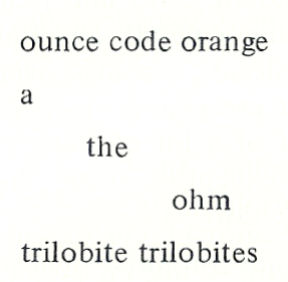
I remain clumped in my headcold, so won't say much more about this yet. I did want to announce a mall discovery of mine that surprised me: to wit, that Coolidge's "a// the" is a 100% Cummingsification. Why I didn't notice this at once, considering that it's the kind of thing I'm looking for, for my Cummings presentation, I don't know. I think Cummings used it more than once. He used it for sure in his grasshopper poem. There, beginning with his sixth line, he speaks proto-languagepoetically of the grasshopper's gath "eringinto(p-/ aThe:l/ eA/ !p:" (italics mine). Broken syntax, but--more important--a focus on inflection, on what it is rather than on its results. Of course, Cummings brings inflection to the fore for the sake of his immediate image whereas Coolidge more emphatically arrests us in considerations of the same inflection for a more subtle aim--which I think he may not have been aware of. In fact, it may exist only for me. For me, it indicates (in Coolidge's poem) the evolution of Man's search for knowledge as it comes to understand, first, general classes of things, then distinguishes final uniquenesses.
Now that I've come this far in unloading my tentative understanding of Coolidge's poem, I may as well go on with it. From the start, I found the poem intriguing. It sounded good (albeit, I find it hard for any text not to sound good to me). Four long-ohs, a couple of en-sounds, the two sss's, the mouthfuls of the juh of "orange" and the mmm of "ohm" . . . I liked its look on the page. But arrangements of verbal sounds can never be enough to make a poem even as much as minor since arrangements of musical sounds can do so much more, and the same is true of visual arrangements of texts compared with illumagery's arrangements of visual elements. Nevertheless, the poem's content seemed . . . semantically meaningful. Not mere dada.
For me to consider a poem effective, I first of all require its verbal content to cohere into a reasonably unified, reasonably completely paraphrasable fore-burden. This one took a long time to do that, and may not yet. But I now read/feel its fore-burden to be "of measurement and the evolution of Man's Search for Knowledge from the present of electricity back into the era of trilobites." Note: it is not the function of fore-burdens to be poems or even entertaining or instructive. Coolidge in his comments on his poem, speaks of "ohm" as a symbol of resistance, so it works here both to connote electricity, and the struggle that the search for knowledge is. "Code" adds suggestions of secrets to revealed, and knowledge to package. I'm sure there's more to the poem, but I don't know whether my interpretation is sufficiently there for every composcipient for it to make the poem a superior poem. It's at least a neat little gadget, though--that I'm sure of, and many poems are much less than that, poems highly praised by stasguards. (br>
Now, off the subject for a trivial observation about ME: earlier, in an e.mail, I think, I used the word "reprove" for the first time, I'm sure. It's a word I've read a lot, but never occurred to me to use. It seemed natural and right today, however--yet still unnatural enough for me to check its meaning in the dictionary to make sure it meant what I thought it does. It did. I wonder how often I, or anyone who has written a lot, uses standard old words like "reprove" for the first time late in life. Certainly, one will use new words for new subjects, and words newly come into vogue (though I tend to resist doing the latter).
|