Blog419
Daily Notes on Poetry & Related Matters


26 March 2005: I just went to Geof Huth's blog to grab a copy of a truly beautiful artwork of his to post here when I saw his latest entry, which is about the Facts on File reference book I contributed to that recently came out. What Geof had to say annoyed me enough to to make me write the following comment to him at his blog--but my cat Shirley jumped on my keyboard before I finished it and deleted it, so I decided not to chide him at his own blog but here. You can read what he said here.

What is so clumsy about "Facts on File Companion to 20th-Century American Poetry, and why begin a review with such a trivial sneer?

How is Jonathan Brannen's "Temple Bells" a "REMARKABLY (my caps) unvisual example of a visual poem? Its key element is the visual disappearance of a letter from the (2-syllable) word, "petal," as it shrinks into the (1-syllable) word, "peal." Without that, it would be a fine but unbrilliant haiku.

What is "cryptic and dismissive" about "--with a side-generation (to the fourth generation of visual poets I discuss in the entry) consisting of such poets as Alan Sondheim, Ted Warnell, Jennifer Ley and Chris Funkhouser doing intriguing things in cyberpoetry," which is the only place in my entry in which I discuss digital poetry--although I go on to opine that not much of note has been done in animated visual poetry but that I expect "an explosion in that and related areas before long," which I wouldn't call dismissive (and it at least mentions something not necessarily digital and with few practitioners).

"The reference to the visual poetry of Kenneth Patchen, a master and iconoclast in the field," is not "relegated to two words: 'concrete poetry,' in my entry, but is a full--albeit short--paragraph long. Yes, you meant the entry on Patchen, but reread your too quickly- written blog entry and you'll see that a reader could easily imagine Patchen's visual poetry only good for two words in the whole book.

Finally, what is "shallow" about my entry on visual poetry? I would be the last to claim my entry was terrific, but it certainly wasn't shallow (especially considering the space constraints). In fact, I'm quite pleased that I was able to say, quote, and demonstrate as much as I did about four fine examples of visual poetry, which puts my entry quite a few levels above anything else ever said about the field in a mainstream reference book.


Here's the image by Geof I wanted to display:
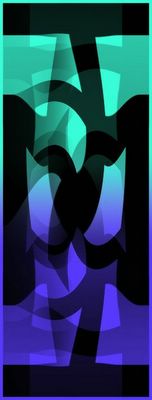


I called it "gorgeous" in the comment I posted to his blog. I was unable to find it verbal, though--in spite of figuring the letters of "HEFT" were in it. I can trace them--but I can trace any other letter I want to, as well. Moreover, so far as I can see, their disfigurement does nothing metaphorical. It results in something wonderful illumagistically, though--improving on the work of Franz Kline, a painter whose work I greatly admire (and whose name I always mix up with that of Mark Rothko, whose work I admire less--and can readily distiguish from Kline's, when I stop to think about it).

I guess I emphasize the advantages of making a visio-textual work's textual truly count because I fear so much at times that my own mathemaku are only pleasant illumages--or possibly interesting word combinations, nicely decorated. Nothing wrong with pleasant illumages or interesting word-combinations, but sometimes I want my work to be more--more, even, than great illumages or word-combinations. I suspect if I succeeded in making a visual poem that was magnificent as both illumage and text, I'd start worrying that its lack of animation kept it from being really important. . . .


PicoSearch
  Help
Site Search by PicoSearch


COMMENTS

Use the box below to respond to this entry. Negative feedback is especially welcome. It will get to me anonymously, so you need have no fear it will result in my using my immense influence to wreck your literary career, if you have one. On the other hand, if you want to hear back, please include your e.mail address with your message.    --Bob


Click SEND to mail response. You will then be shown a copy of what you sent.
To return here, click BACK, which should be at the top of the screen, to the far left.
(Note: it may take a day or several days for your comment to appear at my blog.)


Previous Entry

Next Entry


Blog Home-Page

Hosted by www.Geocities.ws

1