|
13 February 2005: I've been putting together presentations I've been invited to give to the two local classes of homebound kids a friend of mine is teaching a writing course to. That's where yesterday's group of number poems came from. Today, I'm posting a set from a presentation on my own early book of visual haiku, Poemns:
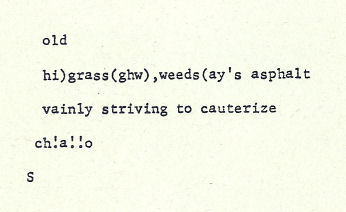
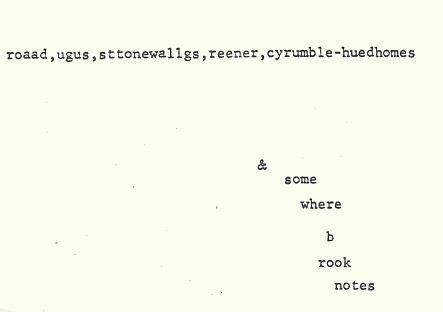
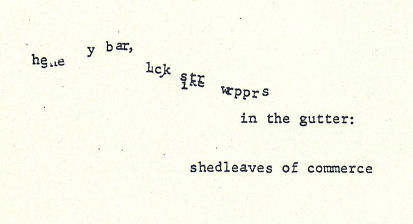
Their titles are "Old Highway," "August Greenery" and "Shedleaves," respectively. Originally, they were titleless. When I stored them on my hard drive off my scanner, though, I had to name them. Or, I preferred to name them rather than go with "Image #1," "Image #2," etc. Much easier to know which was which, that way. Now that I'm making a presentation out of them, I've realized how nice a computer is for giving a poem a title and at the same time leaving it titleless on the page--and I do agree with Geof Huth that some poems can be encumbered by a title. (Except that I think an ingenious title can keep from giving too much away, while simultaneously adding something.) Anyway, thanks to the computer, one can withhold a title for a poem until the frame after it. One could do the same with a book--that is, title a poem on the backside of the page it's on--but it would waste pages as putting it on an extra computer page is a trivial demand on a computer's usually huge capacity to store things. Clicking forward to a title and then, if necessary, back to a poem, is quicker and smoother than turning a page, too.
In any case, I am now giving titles to all my poemns--pleasurably. Productively, too, for trying to find an apt title forces one to truly understand one's poems.
As for the poemns here, I think they're pretty good. I consider each a genuine haiku--with an image and augmenting counter-image. The visual effects are simple, and possibly even semi-creative back in 1965 when I composed these works. They take a tiny step the main inspiration behind them, E. E. Cummings, for some reason never took--the one into overprinting. I don't think he ever used letters that weren't conventionally oriented on the page either--leaning letters or upside-down ones.
|
