26 December 2004: A few participants in the New-Poetry discussion group were discussing the late Jackson Mac Low's chance-generated works (mostly negatively) and one of them happened to mention some novel that used no word with an "e" in it (as a sterile exercise). I commented that I thought "the idea, first used, (to be) fascinating, and the result . . . to have
been an intriguing exploration >of the language." I went on to blurt, "Of course, visual poets have more than a few times composed poems using NOTHING but e's."
"This I gotta see. You have an example?" asked Jason Huff.
I didn't. "I spoke too quickly," I admitted. "I was thinking about the e's. Karl Kempton has done artworks in which he uses e's to make a picture the way pointillists use dots to. I don't consider these works poems because they have no words. Others do consider them poems, though. But, Kempton HAS used the same technique with n's to make what I consider to be a poem--because upside-down n's come together with rightside-up n's in places to say, "nu" or "new," and "un" or "not." His piece, the title of which is "lost," is shown below, first small enough so one can see it whole, then enlarged, so one can "read" it. I discuss it in my Of Manywhere-at-Once. Other single letters can pun out meanings in single-letter poems such as "r" for "are," "m" for "am," "b" for "be" (odd how many letters can speak of being) "i" and "o" for themselves, "u" for "you" and so on.
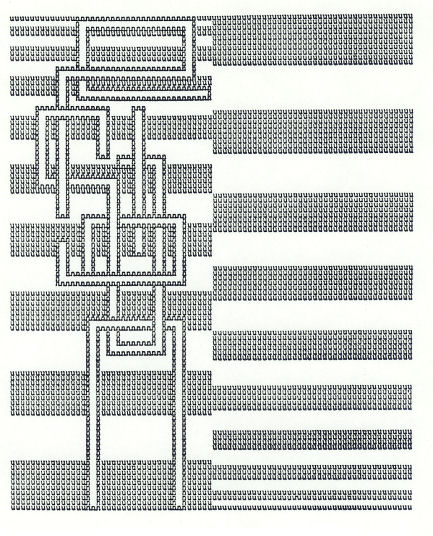

Here's what I said about it in both Of Manywhere-at-Once and an essay of "precincts of the fourth apocalypse" that it's from that I posted as a previous entry:
A second frame from "precincts of the 5th
apocalypse" called, "lost," is divided into two
banded halves whose bands fail to line up--which
certainly gives its protagonist a strong feel of
lostness. He seems to be in a habitat which is out
of synch--or senseless, wrong, alien; indeed, the
figure is going exactly wrong, moving on the left in
a direction exactly opposite to the flow of the
environment on the right.
Actually he's going nowhere at the moment, but
standing befuddledly still, looking simultaneously,
mouth agape, to the right and blankly forward (such
double or multiple actions cubistically possible due
to the schematized abstraction of the figure). He
is at a halt in a locus both up and down or west and
east--schizophrenic, that is.
He is severally-tangled throughout. More
interesting, he is hanging together in a kind of
state of suspense appropriate for one who has
lost his bearings. Kempton deftly indicates this
state by building his man of five discrete pieces of
lines, each of which slides into at least one other
piece but not looking as though capable of holding
anywhere; rather, each piece floats in place, on the
verge of falling into a heap.
An even more beautifully subtle deftness of
Kempton's is his choosing n's to portray his man
with--that is, with the opposite letter of the u's
which comprise the picture's background! That this
use of two typographical characters to draw a
picture happens only this one time in Kempton's
"apocalypse" especially accentuates the man's
"wrongness"--or his environment's.
It also gives a verbal dimension to the picture--
and, in fact, makes a visual poem of it--spelling
"un," a word suggesting disintegration, a coming
apart. At the same time it spells "nu," or "new,"
another word (in its ultimate use as a description
of the never-experienced-before) for "that which is
fearfully disorienting." Meanwhile, the grunted
"nnnn" of the figure against the backdrop of the
similarly elemental "uuuu" grunt of the environment
paints other appropriate effects into the scene,
these ones auditory.
"lost," incidentally, shows how the use of familiar
typographical characters to dot out pictures can
help a reader: it this case, it helps him pick up
the change of the u's to n's more readily than he
would have if the image had consisted of, say,
squiggles rather than letters.
|
|