|
17 November 2004. In his piece of 10 July 2004, which I incorrectly called 7 October 2004, Dan Schneider brought up one of my poems. I'm always glad when someone does that because, among other things, (1) feedback, however negative, and however stupid, will always knock me back to my poem, where I may be able to improve it--as I think I did in this case yesterday (the resulting revision is in my previous entry); (2) I like to know what effect my poems have on others, because they are for others, even if they're for me first; and (3) my critic may say something that will help me. Oh, (4), my critic will also give me something to write about in this blog of mine, something about my poetry, which is clearly my favorite topic here. I meant that as a little joke, but actually it's a Serious Truth, as well, for getting a poet to discuss and possibly defend his work can be of great value to literature.
Schneider compared my poem to one of his so I have them side by side below, as he had them. Incidentally, while Schneider does scrupulously quote me describing my poem as a work-in-progress, he treats it as a final draft, which is a little misleading. (In the blog entry Schneider quoted this poem from, I said of it, "I think (this poem) has a number of interesting elements, but I'm not sure how successful it is, over-all.")
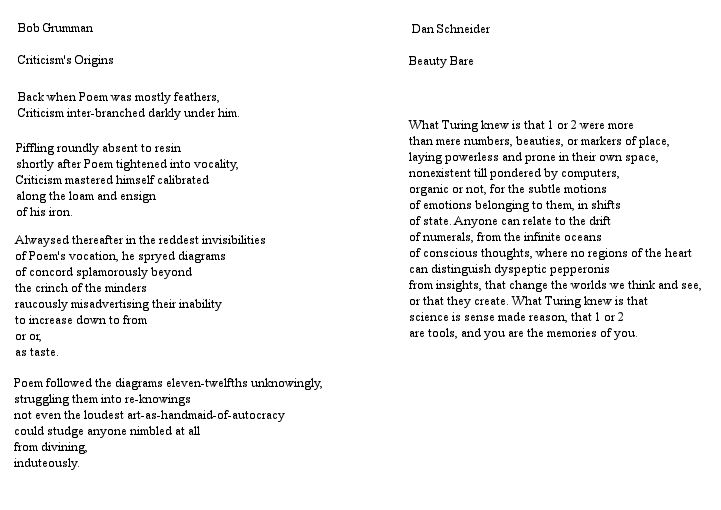
What is bad about this poem, according to Schneider? It has "little that is engaging." Oh. "It lacks music." Oh. (By this he apparently means, from what he says about his own effort, standard melodations, as I call alliterations, consonances and the like such as his poem's "distinguish dyspeptic pepperonis," which Schneider quotes as an example of music. But, of course, my poem has all kinds of musical effects. I particularly like what the d's appropriately do in "could studge anyone nimbled" to suggest an attempt to prevent enjoyment.) Lastly, according to Schneider, my poem's personification and neologizing are clumsy. All I can say to any of this is that I disagree.
Schneider has one other criticism of my poem, that it is no more than a standard poem I've added "a new word or 3" to and "tried to sound dissonant" in. But he fails to support his claim by saying what is standard in the poem. Nor does he tell us why taking a standard poem and adding materials to it, in this case, neologies and dissonance, is necessarily bad, or less than what almost all poets do. I would agree that, in the final analysis, my poem is standard--a statement in free verse. Its point of view, the value of critical sense for a poet, is a little unusual, I think. But what counts in a poem is not its point of view or subject matter but what it does with words.
True, my poem uses neologies--more than three; it also uses a few regular words in a new way. I did try for some dissonance, too, as I almost always do in my Poem poems, for the same reason composers do: to counter the banality of sticking to the right key, etc. But can it be that my poem has nothing else of poetic significance in it? Certainly, it is dominated by intentional "misuse" of the language to say a few minor things in a new way. To make a poem for people capable of "increas(ing) down to from, or or" and provide "re-knowings" to be enjoyed rather than experienced as a duty ("duteously"). But I feel confident it has more things of value in it. I've already given an example of what I consider its melodation. There seems to me to be much other music in it, but I will leave it up to the interested reader to find it. It also has, to my mind, more than one of the "striking metaphors" Schneider claims his poem has and mine, by implication, lacks. For instance, the surrealistic, "along the loam and ensign of his iron."
Since it is a plaintext poem, my effort does not have any of the "striking . . . rhymes" his does, such as, according to him, "subtle motions/of emotions belonging to them" and "in shifts/of state. Anyone can
relate." No reason it should.
I'll give my view of Schneider's poem in tomorrow's entry. All I'll say here about it is that I don't think it very good.
Before closing, I want to point out one thing: that I consider my defense of my poem above the Proper Way to defend a poem. Note that I stay on topic. Note that I don't speculate on my critic's motives or denigrate him, I just report what he has said and reply to it. Actually, I prefer less rigorously focused criticism, myself--and find insults entertaining if not overdone. I feel Schneider overdoes them, though, and at times badly loses focus rather than just occasionally makes an interesting aside. Hence, my attempt to demonstrate as clearly as possible what a focused piece of criticism is. (Note: I revised the above on 23 November.)
As of today, 9 October 2006, he hadn't. Morons never do anything but assert. 
|