|
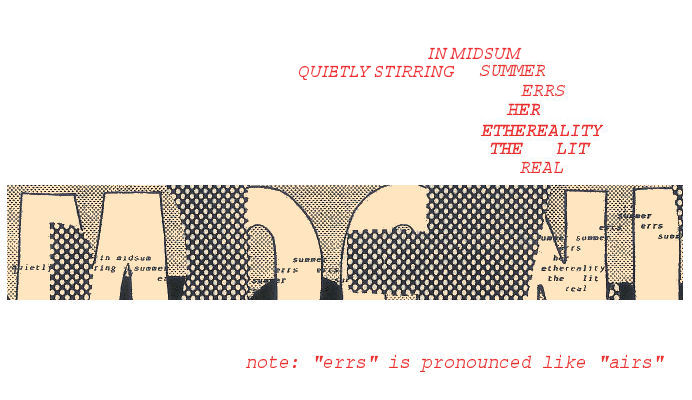
7 November 2004. Well, I did a few hours of work on my presentation yesterday, ending with something like 15 slides, with commentary, all on just one of my visual poems, Homage to Shakespeare, which you can click here to see a small monochromatic reproduction of at light & dust. The final version is also monochromatic, but on a pale brown background.
I was pleased to get the sequence of slides done, but felt my comments were a little too much like similar comments on poems in high school textbooks. Not that that makes them poor, which I don't think it does, but that it may put off the high school students my presentation is for--or not catch their interest as much as I'd like.
I don't consider any of the slides inspired, so will just present one here. It contains an excerpt from my poem, with the hard-to-read text of the poem within that poem spelled out. A fun poem, this poem-within-a-poem, I think. I've always loved the "midsum" image, the idea of summer as a process of addition now halfway toward completion . . . I'm not sure who first used the "disconcealing" device this poem relies on, but Richard Kostelanetz definitely was a leading pioneer in its development. Gotta name it, although I'm pretty sure there is a least one good term for it out there: "columnar disconcealment. "Disconcealment" is one of my very first literary neologies, from the early seventies. It means, simply, the discovery and display of concealed words and near-words, particularly within larger words, E. E. Cummings being its first master.
|