|
Daily Notes on Poetry
11 October 2004. Today, a few poems showing the flow of poetry toward mathematics.
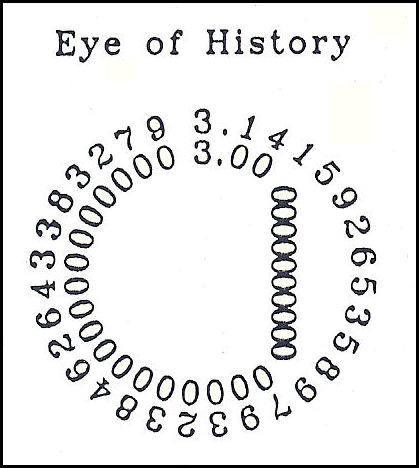
This one, which is by Robert Stodola, is both wonderfully simple and wonderfully sophisticated. A visual poem all of whose words are numbers. On reflection, I would say it shows the flow of illumagery into mathematics, and vice versa--with the two meeting in verbal conceptuality, or poetry.
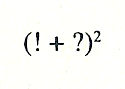
The next poem is "The Birth of Tragedy," by LeRoy Gorman, another all mathematical poem, except for its title.
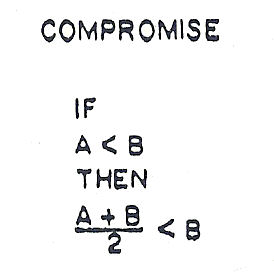
"Compromise" is by Charles S. Allen. Its mathematics, which is correct as mathematics, wryly states that if A is less than B, then adding A to B and dividing the sum by two--or compromising--will result in something that is still less than B. In other words, the better position can only be damaged through compromise.
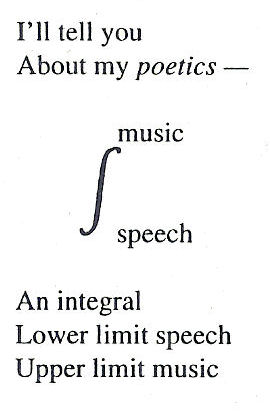
I've probably written about the above here before. It's an excerpt from Louis Zukofsky's A (1969) that not only freshly revoices the commonplace that (traditional) poetry is words and song, but deepens us into an appreciation of the infinite continuum of infinitesimal details of sound and conceptuality it is an expression of (according to the integral sign from calculus that centers it). I mention it all the time because it introduced me to the possibilities of treating words as mathematical terms.
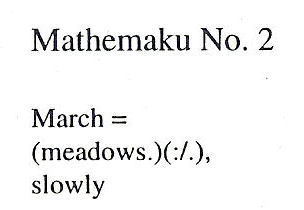
I couldn't present a survey of math poems without one of my own. Hint: to "solve" it, cancel like terms (the periods)--and remember the different grammatical functions of colons and periods.
COMMENTS
Someone sent me a comment on this entry on the eleventh of March, 2006. Nice to know one person, at least, is reading my past entries. But his comment is bothersome. "I don't get it," was all he said. How can I react to that? Moreover, he sent me no return address, so I couldn't find out what poem he couldn't get, nor help him tactfully backchannel. Guessing that he didn't get my mathemaku, I'dd add here that it features an algebraic equation in which the quantity "meadows," with a period after it, is multiplied by a fraction with a colon at the top and a period at the bottom. Ergo, the period in the fraction is divided into the period with "meadows," cancelling it. This leaves "meadows" followed by the colon, or "meadows:"--the poetic idea here being that meadows stopped by a period are becoming meadows with something to follow, "something the follow" being the grammatical meaning of a colon.
I hope the person responding to this entry will get back to me and let me know if I helped him, or--if
not--exactly what he doesn't get.
|