|
21 September 2004. Excerpt from a Taxonomical Essay on Visio-Textual Art, Part 5
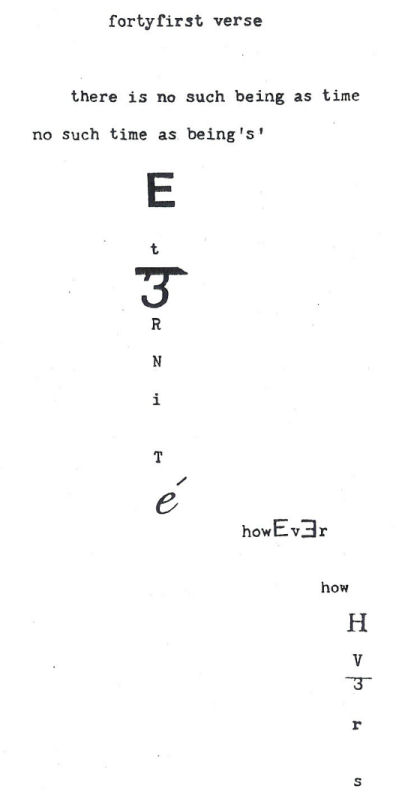
Marshall Hryciuk has with his "fortyfirst verse" composed a highly philosophical poem
that I don't fully follow, but its "E/t" reminds me of bpNichol's "AND" ("et" being Latin
for "and"), and it is clearly about the eternal "and" that existence is, and about how that
eternal existence is, with details about its variety showing in its varied versions of E and
its reverse. The E as 3, twice shown under a short horizontal line, goes on to suggest the
equation, eternity as some kind of arithmetic problem. In any event, the visual elements
seem here more than enough to make Hryciuk's poem a litagraph.
Mark Laba's poem about amnesia is unarguably a litagraph, too--of the first degree, in
fact. Among its juxtaphors, I find the one with the unidentifiable letter or letters (a little
above and to the left of "without") the most absorbing: a mind in fragments around a tiny piece of memory hugely heightened but nonetheless unrevealing. . . .
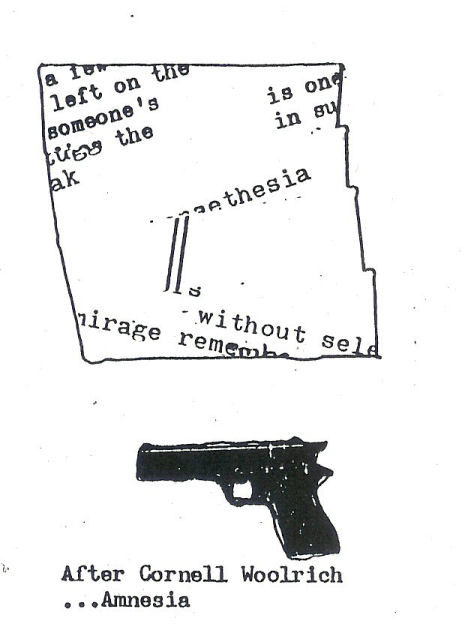
Actually, to be 100% rigorous, I'd have to call the Laba work an iliuscription whose text
is a visual poem. But that seems over-fastidious. Its visual element, the gun, is discrete
but sufficiently emotionally involved with the work's text to count as fused with it. In the final analysis, I deem the work a litagraph. But what about George Swede's "The Party," and LeRoy Gorman's "the birth of tragedy?" 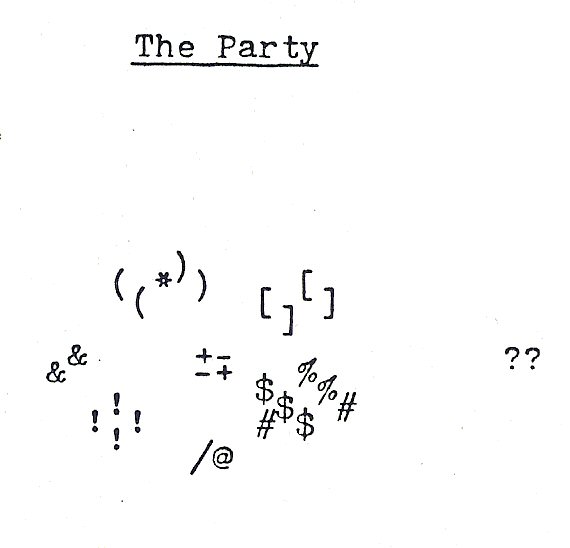
Swede's work has no verbal elements--or does it? Should ampersands, dollar signs,
question marks, and various kinds of other typographical.symbols count as verbal?
It's a hazy taxonomic area different from the one inhabited by UU"s "Short History of a
Love Affair." I would call it a litagraph because I consider the ampersand a word; it
is merely a different spelling of "and." If not for the ampersand (and the equally verbal
plus and minus signs), though, I would lean toward calling the work a textagraph--a
work of visual art, that is, which is composed of typographical elements but is not a poem
because of its lack of words.
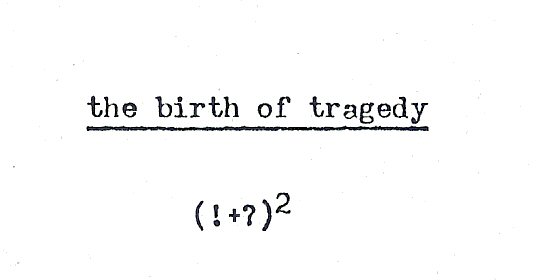
Gorman's poem is easier to assign to a category: it is not a visual but a mataemathical
poem (its "+" making it verbal and therefore a poem rather than an illumage, or work of visual art). Only its
oddness, and its not being easily declaimable (though it can be read aloud with no loss of
meaning) would cause anyone to consider it a litagraph.
|
|
Previous Entry