|
While I am a taxonomaniac, the main purpose of most of my taxonomical essays has been
to showcase specimens of visio-textual art. This essay is no exception.
At first, I was going to scour my entire collection of such art for works to
use. Since a conference (in 1997) at Edmonton, Canada, was the original target of my essay, though, I wanted to
make sure Canadians were well-represented. Hence, I began with my copies of the
Toronto-based Industrial Sabotage, one of the three or four best magazines of burstnorm
poetry in English over the past ten years or so that I know of. Soon I was grabbing so
many excellent specimens by Canadians that I decided to limit my selection to work by
Canadians only, and to work from Industrial Sabotage only. This had the advantage of
showing how taxonomy would work with a population too small to allow me simply to
pick works it could readily deal with. (Not that laziness and the disorganized condition of
my collection weren't also factors!) Later I did add something by Canadian Damian Lopes
that is not from Industrial Sabotage; otherwise, all the poems I picked were by
Canadians, and from Industrial Sabotage.
The poem by jwcurry below (actually a translation) is as good a one to start with as any, for it sums up
what a litagraph (as I call what most others call visual poetry for reasons I won't go into here) is at its purest:
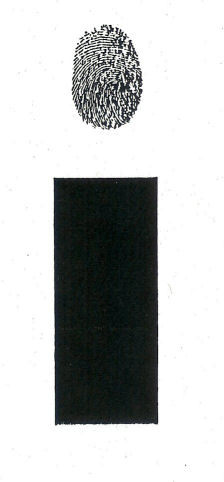
1. It combines the LITerary and the GRAPHic.
2. Its literary and graphic elements can't be separated from each other.
3. Its graphic element acts as a juxtaphor (i.e., implicit metaphor) for its literary element, and vice versa. The candle
curry's i looks like therefore equals the letter i, or identity. Also, with interesting tension,
the fingerprint, a mark of uniqueness, equals assembly-line dot-of-an-i. More complexly,
if also more subjectively, the i equals a smudgily fingerprinted, candle-tenuous work of
art. All this equaphoric (or figurative) richness makes the work, in my book, a litagraph of the 1st degree, litographs of the 2nd degree being those whose visual matter is
not of any significant equaphorical consequence.
|