|
30 July 2004. Back to essays. The one below is over ten-years-old. It was originally printed as a Score Review (no. 27) by Crag Hill's Score Publications. I have significantly re-written it, to update its terminology but also, I hope, make it easier to understand.
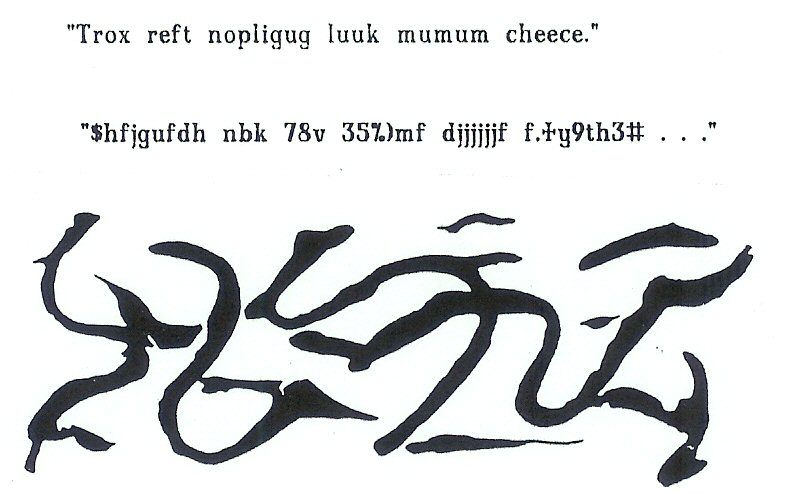
alien word whose meaning awaits
Since none of the three pseudo-languages contains comprehensible words, none qualifies,
in my taxonomy, as literature. The first kind, as the only kind that can be spoken,
could be called, when oral, a kind of minilexical music. Here I am chiefly concerned with
what it is on paper, though. On paper, it seems to me a form of textagraphy--or a
combination of text and visual image with the latter the more aesthetically important. It is
textual because it contains elements of language; it is graphic (illumagistic, to be precise) because it seems mainly
something to look at--it has no lexical meaning. The second of my pseudo-languages is
also textagraphy--but not minilexical music, for no one could declaim or sing it
without adding arbitrary sounds to it. I pigeonhole these two works yet further into one of my two subsets of textagraphy, the one I call "textagraphic portraits of language," which is for works that look like or in some way suggest language, but aren't, because they do nothing lexical.
The third of my examples above might be pure illumagery,
because it has no real elements of language. Because of its appearance and title, this piece qualifies for my "portraits of language" category, too. It has the further virtue, as such a portrait, of having "letters" that do something
metaphorically significant, like wriggle hither and thither like a living organism, or mind-sprouts
swirling, with intention, toward some life as a word. Or is the subject a group of dancers who will
succumb, finally, to verbality, when their dance ends? In either case, the piece contains
enough that (with the assistance of the piece's title) is about language to make it textagraphic.

If garbled words start making sense the result is an infraverbal poem--if the
nonsense elements yield some consequential metaphorical effect. That's what happens in
the excerpt just above from De Villo Sloan's fascinating So?, which uses nonsense words
turning into sense as a metaphor (in my opinion) for the Creation of the Universe. Otherwise, mixtures of
garble and coherence are just literature with nonsense elements.
As for a passage in a language that seems imaginary but isn't--a cryptogram, say--if its
reader is aware that the passage stands for actual words, then the passage is literature,
pure literature-unless the encrypting causes a significant metaphorical effect . . . as in the
following:
                                     to the treehut;
                               then, alone, writing his way
  	                                 into b tfdsfu xpsme . . .
That, an early haiku of mine (which readers of my blog will remember from at least one other entry of mine), tries to metaphor a boy's leaving everyday reality for a secret
world the way ordinary words leave normal sense when they become coded--and the boy's
thus discovering into language, and himself--and existence--and becoming an Artist
creating something counter. The haiku Is therefore an example of alphaconceptual poetry.
Writing their way into even more secret worlds is no doubt the reason others have created
completely undecodable pseudolanguages like the ones previously discussed. All power
to them--but from a stringent taxonomical point of view, what they are doing is not
poetry.
This is not to write off the pseudo-lingual. What they're achieving might be better than
poetry. It is not being irrelevantly fussy about terminology, either. Clear terminology is
simply understanding made communicable, and paths into the possibly new marked for
later explorers--to make fresh paths from, if they're genuine explorers, not rely
exclusively on.
See my entry for 11 May 2004 for my chart of kinds of visio-textual art if (like me) you haven't committed it to memory yet.
|