A Brief Artist's Statement by Bob Grumman
I consider myself fundamentally a poet although my works have become almost more visual than verbal of late. I was around 19 when I first began composing serious conventional poetry, and in my mid-twenties when I started doing visual poetry, inspired by the work of E. E. Cummings. Visual poetry, to give a rough definition, is poetry with a visual component that is as meaningful as its words. To reduce such a poem to its words would be to pretty much destroy it.
I didn't get any of my visual poems published for some twenty years, mainly because few editors and publishers were interested in them. Over the past fifteen years or so, I've gotten them into a number of small journals here and overseas. Some have made it into anthologies, as well. I'm still quite obscure, but there have, been two or three entries on me in reference books such as Richard Kostelanetz's Dictionary of the Avant Gardes. (It's only a coincidence that Richard is a personal friend of mine.)
In hopes of reaching a wider audience, I began trying to get into visual art exhibitions three years ago. I've now had work in several visual poetry group shows, including one last year at the Diana Lowenstein Gallery in Miami.
As you will quickly see, my present works are unusual, even for visual poetry, for they include mathematical elements. It was some thirty years ago that I made my first mathematical poem, but made only three or four others in the next twenty years. A friend who publishes tiny collections of poems invited me to send him five or six poems to publish. I had nothing on hand at the time but my few math poems, so made one or two more and sent them off. That was enough to get me much more involved in the form. Just about all my poems now are mathematical--by which I mean that they carry out mathematical operations. In fact, almost all of them do long division.
They take a lot of getting used to. I've several times written explanations of them. A common result is that I end up confused, myself. Nonetheless, I'll try again, using my "Final Exam, Long Division Problem No. 9" as an example. (Note: below is a partial copy of that poem, with two graphics shown in black and white that are no longer in it.) One is supposed to take this literally as a long division problem: how many times does "rain" go into the weird text in what I call "the dividend shed"? My poem claims "library" times. That is, multiply "rain" by "library" and you will get something close in value to the distorted text. According to the poem, you should get a., b., c. or d. The remainder will be "or" on its side and peculiarly-printed.
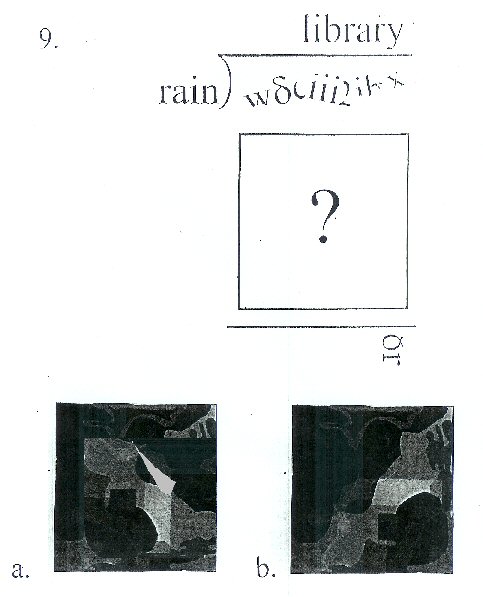
What I hope is that the reader/viewer will at once like the work's visual elements, and be amused by the set-up, but also be curious enough by the strangeness of what's going on to spend some time drifting with the words. I hesitate to state any of the poem's "meanings" because there are (I hope) many--or, I should say, it has a cluster of inter-related meanings. And everyone will get different impressions from it. It's also hard to describe a meaning without making it seem arbitrary or trivial or flat-out nuts. I'll give it a try here, though: the key to its main meaning, for me, is the distorted text, which begins as a spelling of "woods," but goes loony. I see it as a kind of forest of confused, confusing text that beckons one to explore it. One is given rain to divide it with, or break it down into understandable smaller parts, but one needs to multiply rain by something to make it work: "library" or books. The result? One of the four possible "solutions" given--plus the unconventional "or" (because the best solutions in art always have an "or"). There's much more to it, or so I fervently believe.
My other mathemaku work similarly. The object should not be to understand them, but to let them break you out of the everyday into who-knows-what, pleasurably.
|