The Sun Football Annual, 1974

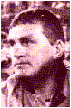
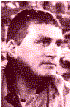
A question that will never be answered is: What would have been the future of English football if Jimmy Adamson had been team manager of our national side? In October 1962 he was offered the prize position by the Football Association, although hyis name was not among the 59 applicants. His brief answer was, "I do not feel I am fitted for the job."
It is now history that Alf Ramsay took over as England�s manager, won the 1966 World Cup and became Sir Alf Ramsay. Adamson stayed at Turf Moor, Burnley, a club he started serving as an office boy in 1946. Unlike Ramsay, Adamson never won a full England cap, although he did win England Youth and �B� caps as well as playing for the Football League. Like Ramsay, he won a First Division championship medal. In season 1961-62, Jimmy skippered the Burnley side that lost to Tottenham in the 1962 F.A. Cup Final and was named �Footballer of the Year� for 1962. Two months after collecting his reward, he went to Chile as assistant and coach to manager Walter Winterbottom with England�s 1962 World Cup squad.
Adamson was born at Ashington, birthplace of the Charlton brothers and was a wing-half out of the classic mould � without doubt the best uncapped half-back of this period. As Burnley chairman Bob Lord said, "Jimmy was one of the most cultured and consistent players produced by England. His ability to read a game and assess situations was unmatched by any wing-half of his era."
A natural step when Jimmy neared the end of his playing days was his appointment as Burnley player-chief coach, the position he assumed in September 1964 under manager Harry Potts. In February 1970 he became team manger, with Harry Potts moving up to general manager. "Becoming manager of Burnley was something I have always wanted, my ultimate ambition. It has never been my desire to leave Burnley," said Jimmy.
But life turned sour on Jimmy that summer. Just before the 1970-71 season opened, he made a statement that was to rebound on him in the months to follow. "Burnley will be the super-team of the 70�s. We will take over from Leeds and Liverpool. I can see nothing but success for us in the years ahead. Potentially we are the best young outfit in the country. It�s impossible to set a time limit, but in the near future this side will explode on the First Division."
Nine months later Burnley were relegated to the Second Division after 24 years in the First Division; it was the club�s first relegation for 41 years. A year later, a crowd of 200 at Turf Moor were chanting, "We support Burnley, not Adamson." Burnley had failed to win promotion back to the First Division at the first attempt, and they had just sold Ralph Coates to Tottenham for �190,000. Burnley supporters were used to seeing their star players transferred. They used to say, "This is not a football club � it�s a supermarket."
Protests at the sale of star players was nothing new. When that ace ball-juggler Jimmy McIlroy moved to Stoke City in 1963, the club faced protest marches and petitions. McIlroy was one of the many players whose name could rank in a soccer Debrett.... John Connelly, John Talbut, Alex Elder, Willie Irvine, Willie Morgan, Gordon Harris, Andy Lochhead, Brian O�Neil, Sammy Todd. And after Coates� transfer, Burnley fans saw the departure of Steve Kindon and Dave Thomas.
But now the tide was turning. Adamson bought Paul Fletcher from Bolton, Alan Stevenson from Chesterfield and picked up a real bargain when Everton placed England�s 1970 World Cup star Keith Newton on the free transfer list in the summer of 1972. All three players justified Jimmy Adamson�s faith in his own judgement. Stevenson won 5 England Under-23 caps in Burnley�s promotion season and emerged as a goalkeeper of the highest class. Fletcher was top scorer in the club with 15 League goals and Newton added the experience and his unlimited skill at full-back.
Burnley stormed back into the First Division as champions of the Second Division at the end of the 1972-73 season. They even sold star winger Dave Thomas for �170,000 to promotion rivals QPR in October 1972. The Rangers finished only one point behind Burnley, but the rest of the Second Division were left trailing 11 points and more behind. Adamson was confident of the future of Burnley Football Club, and in December 1972 repeated his statement that Burnley would be the team of the 70�s. As Burnley shook the First Division with their fluent football last season, who could deny that Adamson the player had arrived in the top class � both as manager and tactician � and that this time his boast would not come true?
Back to
Index pageForward to
next article