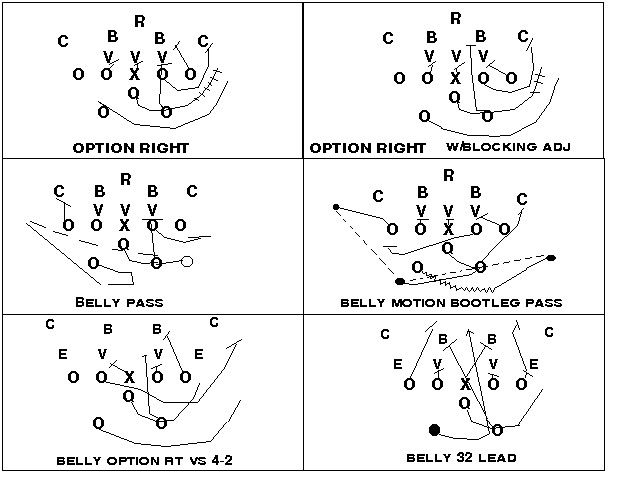

Belly Option
Principles of the Belly option.
Quarterback.
On
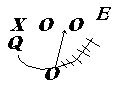
the outside belly we prefer the reverse pivot. It is easier for the
QB to get depth into the backfield when he reverses out.
The first step on
an option right is deep left. This step is to be as deep as possible and
straight back. As he takes this step, he is to snap his head toward the
fullback to locate the faking pocket. His second step with his left foot
foot should be made directly at the fullback. This step should be taken
while going away from the L.O.S , but it is an adjustment that that is
essential to create the meshing of the two. As he nears the Fullback, he
reaches back at arm's length and places the ball in the faking pocket.
At this point, while
the QB is momentarily motionless, the ride begins. To extend the length
of the ride as long as possible, the QB should take a balance step toward
the dive hole with his left foot. When the fullback has gone beyond his
reach, the ball is pulled out and the QB gains momentum by stepping with
the right foot toward the 6 gap. This step puts the QB in motion and gets
him to move directly toward the inside of the defensive end. When the ball
is removed from the fullback's pocket, it is brought directly to his chest
and held tightly in both hands, so that it is in full view of the defensive
end.
The QB is to maintain
this 45 degree course toward the flag until he is attacked. Many times
the crashing end will commit to the fullback's fake. In these instances
the QB is to keep on the flag route until someone forces him to pitch.
If the end goes for the running back, the QB will keep the ball looking
to lateral later. If the end challenges the QB, he is to pitch the ball.
The pitch is made with both hands in a basketball pass fashion; two hands
from the chest stepping toward the pitchman. The lateral should be a dead
ball toss, rather than a n end-over-end flip that is difficult to handle.
The QB is permitted
no fancy faking - no fake pitches , steps , or head nods. Fancy footwork
merely wastes time.
FULLBACK.
His feet should
be 4 1/2 yards from the line. His first step at the snap is on a 45- degree
angle toward the dive hole with his near foot. He squares up to the hole
and should run hard and low, making as big a faking pocket as possible.
He is to try and make eye contact with the linebacker or the player with
dive responsibility. He must be tackled on every play. When the QB removes
the ball, he is to drop his outside shoulder and barrel into the dive hole.
If the linebacker doesn't tackle him, he tries to intersect the safety
or corners angle of pursuit.
TAILBACK.
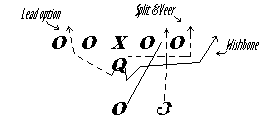
When you run
the option, your tailback may line up either in the I or as the offset
halfback. If you don't have a fast tailback, it's better to run from the
I . The I enables a tailback with average speed to get in front of the
QB for the option, but if this same back ran from the halfback position,
he would not be able to reach the 45- degree angle necessary for a successful
option.
Train your tailbacks
to catch the pitch in the same fashion they would catch a pass. They should
catch it in both hands. They are to look the ball into the hands and not
into the belly. The biggest problems occur when the tailback is looking
at the tacklers while the pitch is in the air. You can usually count on
a fumble when this happens. after he catches the pitch, he is to continue
the same route, which is a 45 degree angle toward the sideline. The pulling
guard will block anything that obstructs the running lane. When the guard
commits on the block, the tailback is to cut off his hat. This is the only
cut you should expect the ball carrier to make.
As Coach Troy always replies
to me " I have shown you the safe, I'm not going to give you the keys.
" I have tried my best explain the major components and movements
to this series. You will have to adjust something's to fit your style and
players. There has been some seasons we didn't use a pulling guard due
to talent. Or we had to put in a counter step for the tailback so the pulling
guard would be at the point of attack ahead of the ball carrier.
Here are a few belly plays
but as you can see the possibilities are endless. We also split the ends
to get better angles against the 3-4.
If
you have any question please don't hesitate to E-mail me.
Coach
AL ( Coachers)