
MISCELLANEOUS MACCLESFIELD TOWN
|
The 1971 edition of Penguin's Encyclopedia of Places states that the municipal borough of Macclesfield has been an "important centre of the silk industry since the mid-18th Century," which explains the football club's rather more original nickname 'The Silkmen'. Macclesfield Town were the very first winners of the FA Trophy when they defeated Telford United 2-0 way back in 1970. The Trophy phased out the old FA Amateur Cup which had been contested since 1894, as the Football Association suspected that some of these 'amateur' clubs were paying their players. The new competition would allow chairmen to legitimately offer bonuses to players as incentives, and of course now we see that half of the Conference are fully professional outfits, so playing in an 'Amateur' Cup would be a contradiction. Interestingly, the winners of the last FA Amateur Cup in 1974 were Bishop's Stortford, whose captain in the 4-1 win over Ilford was none other than our assistant manager John Still.
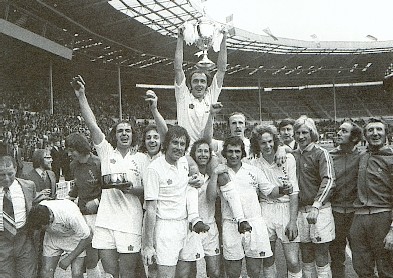 John Still (holding the plinth, left) celebrates with his Bishop's Stortford teammates after winning the 1974 FA Amateur Cup Former Manchester United star and current Northern Ireland boss Sammy McIlroy was appointed manager in 1993 and guided the club to its greatest moments during his seven year reign. In 1995 his Cheshire charges romped to the Conference title, at one stage leading the league by a sensational 22 points. Sadly their Moss Rose Ground was deemed unfit for the Football League (saving bottom club Exeter City's bacon), which was very frustrating seeing as Chester City had played there for two seasons at the turn of the 1990s while the Deva Stadium was built, but thankfully the required upgrades were done in time for Macc's 1997 Championship triumph. Defender Efetobore Sodje became Town's most expensive signing when he signed from Stevenage Borough for £30,000 as the club prepared for its first League season in August 1997. Sodje had been a Rovers transfer target at that time, but we did manage to buy Barry Hayles from Boro and reaped the rewards. 'Efe' in fact scored his first League goal faster than Hayles, as Barry's opening day goal for Rovers against Plymouth in the 41st minute was beaten by Sodje's seventh-minute strike at home to Torquay - Macclesfield's first goal in the Football League. He moved to Luton on a free two years later before joining current club Crewe in the summer of 2000 after a brief spell at Colchester, and his good form in Division One earned him a call-up to Nigeria's 2002 World Cup squad in Korea and Japan, where he played against both Argentina and England. The club's longest serving player is John Askey, who at 38 is now finding more time for coaching the reserve team than for his rare substitute appearances. Signed from Milton United during the 1985-86 season, John was a flying winger in his prime but more recently he has been pushed further up front. Despite enjoying nearly 20 years' service at Moss Rose, Rothmans' Yearbook only recognises Macclesfield's statistics since joining the league and so 33-year old defender Darren Tinson currently holds the appearance record with 218, although Askey's 29 league goals means he is number one in the goal charts, slightly ahead of current Rotherham star Richie Barker. Listed as one of the Conference's star names in the 1991 Non-League Football Fact Book is Derek Parlane, who turned out for Macclesfield at the end of the 1980s. His league career took in spells at Rangers, Leeds United, Manchester City and Airdrieonians and he won 12 caps for Scotland in the 1970s. Another international to play for the Silkmen is Peter Davenport, who strangely also turned out for Airdrie as well. He made his name at Nottingham Forest in the early 1980s, earning a solitary England cap against the Republic of Ireland in 1985 before Manchester United paid a princely £750,000 for his services in March 1986. Middlesbrough signed him for the same fee two and a half years later and he played at Wembley in the 1990 Zenith Data Systems Cup when they lost 1-0 to Chelsea. Spells at Sunderland, Airdrie, St Johnstone and Stockport looked to be the end of his League career as he joined Southport in 1995, but he fired Macclesfield to promotion in 1997 and signed off as a League player to become assistant manager and later the main team manager upon McIlroy's departure in 2000.
|