An early start Gichin Funakoshi So Nei Chu Mountain Training Bulls, Challengers, and the Godhand Oyama Dojo Bobby Lowe The beginning of Kyokushin The End?
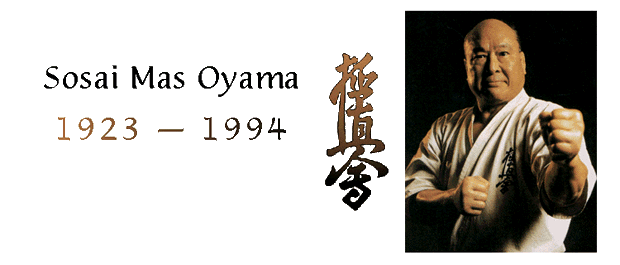
Masutatsu (Mas) Oyama was born Yong I-Choi on the 27th of July, 1923, in a village not far from Gunsan in Southern Korea. At a relatively young age he was sent to Manchuria, in Southern China, to live on his sister's farm. At the age of nine, he started studying the Southern Chinese form of Kempo called Eighteen hands from a Mr. Yi who was at the time working on the farm. When Oyama returned to Korea at the the age of 12, he continued his training in Korean Kempo.
In 1938, at the age of 15, he traveled to Japan to train as an aviator, to be like his hero of the time, Korea's first fighter pilot. Survival on his own at that age proved to be more difficult than he thought, especially as a Korean in Japan, and the aviator training fell by the wayside.
He did however continue martial arts training, by participating in judo and boxing, and one day he noticed some students training in Okinawan Karate. This interested him very much and he went to train at the dojo of Gichin Funakoshi at Takushoku University, where he learned what is today known as Shotokan Karate. Information about this can be obtained from the CyberDojo home pages.
His training progress was such that by the age of seventeen he was already a 2nd dan, and by the time he entered the Japanese Imperial Army at 20, he was a fourth dan. At this point he also took a serious interest in judo, and his progress there was no less amazing. By the time he had quit training in Judo, less than four years after he had started, he had achieved the rank of fourth dan in Judo.
The defeat of Japan and the subsequent indignity of Occupation almost proved to be too much for Mas Oyama, who nearly despaired. Fortunately for all of us, So Nei Chu came into his life at that time. Master So, another Korean (from Oyama's own province) living in Japan, was one of the highest authorities on Goju Ryu in Japan at the time. He was renowned for both his physical and spiritual strength. It was he who encouraged Mas Oyama to dedicate his life to the Martial Way. It was he too who suggested that Oyama should retreat away from the rest of the world for 3 years while training his mind and body.
When he was 23 years old, Mas Oyama met Eiji Yoshikawa, the author of the novel Musashi, which was based on the life and exploits of Japan's most famous Samurai. Both the novel and the author helped to teach Mas Oyama about the Samurai Bushido code and what it meant. That same year, Oyama went to Mt. Minobu in the Chiba Prefecture, where Musashi had developed his Nito-Ryu style of swordfighting. Oyama thought that this would be an appropriate place to commence the rigours of training he had planned for himself. Among the things he took with him was a copy of Yoshikawa's book. A student named Yashiro also came with him.
The relative solitude was strongly felt, and after 6 months, Yashiro secretly fled during the night. It became even harder for Oyama, who wanted more than ever to return to civilisation. So Nei Chu wrote to him that he should shave off an eyebrow in order to get rid of the urge. Surely he wouldn't want anyone to see him that way! This and other more moving words convinced Oyama to continue, and he resolved to become the most powerful karate-ka in Japan.
Soon however, his sponsor informed him that he was no longer able to support him and so, after fourteen months, he had to end his solitude.
A few months later, in 1947, Mas Oyama won the karate section of the first Japanese National Martial Arts Championships after WWII. However, he still felt empty for not having completed the three years of solitude. He then decided to dedicate his life completely to karate-do. So he started again, this time on Mt. Kiyozumi, also in Chiba Prefecture. This site he chose for its spiritually uplifting environment.
This time his training was fanatical — 12 hours a day every day with no rest days, standing under (cold) buffeting waterfalls, breaking river stones with his hands, using trees as makiwara, jumping over rapidly growing flax plants hundreds of times each day. Each day also included a period of study of the ancients classics on the Martial arts, Zen, and philosophy.
After eighteen months he came down fully confident of himself, and able to take control of his life. Never again would he be so heavily influenced by his society around him. (Though it is probably safe to say that his circumstances were also probably never again as traumatic!)
In 1950, Sosai (the founder) Mas Oyama started testing (and demonstrating) his power by fighting bulls. In all, he fought 52 bulls, three of which were killed instantly, and 49 had their horns taken off with knife hand blows. That it is not to say that it was all that easy for him. Oyama was fond of remembering that his first attempt just resulted in an angry bull. In 1957, at the age of 34, he was nearly killed in Mexico when a bull got some of his own back and gored him. Oyama somehow managed to pull the bull off and break off his horn. He was bedridden for 6 months while he recovered from the usually fatal wound. Today of course, the animal rights groups would have something to say about these demonstrations, despite the fact that the animals were already all destined for slaughter.
In 1952, he travelled the United States for a year, demonstrating his karate live and on national televison. During subsequent years, he took on all challengers, resulting in fights with 270 different people. The vast majority of these were defeated with one punch! A fight never lasted more than three minutes, and most rarely lasted more than a few seconds. His fighting principle was simple — if he got through to you, that was it.
If he hit you, you broke. If you blocked a rib punch, you arm was broken or dislocated. If you didn't block, your rib was broken. He became known as the Godhand, a living manifestation of the Japanese warriors' maxim Ichi geki, Hissatsu or "One strike, certain death". To him, this was the true aim of technique in karate. The fancy footwork and intricate techniques were secondary (though he was also known for the power of his head kicks).
It was during one of his visits to the United States that Mas Oyama met Jacques Sandulescu, a big (190 cm and 190 kg of muscle) Romanian who had been taken prisoner by the Red Army at the age of 16, and sent to the coal mines as a slave labourer for two years. They quickly became friends and remained so for the rest of Oyama's life, and Jacques still trains and acts as advisor to the IKO(1) to this day. You can read a short biography of his on this site or read his autobiography at http://donbas.com.
In 1953, Mas Oyama opened his first "Dojo", a grass lot in Mejiro in Tokyo. In 1956, the first real Dojo was opened in a former ballet studio behind Rikkyo University, 500 meters from the location of the current Japanese honbu dojo (headquarters). By 1957 there were 700 members, despite the high drop-out rate due to the harshness of training.
Practitioners of other styles came to train here too, for the jis-sen kumite (full contact fighting). One of the original instructors, Kenji Kato, has said that they would observe those from other styles, and adopt any techniques that "would be good in a real fight". This was how Mas Oyama's karate evolved. He took techniques from all martial arts, and did not restrict himself to karate alone.
The Oyama Dojo members took their kumite seriously, seeing it primarily as a fighting art, so they expected to hit and to be hit. With few restrictions, attacking the head was common, usually with the palm heel or towel-wrapped knuckles. Grabs, throws, and groin attacks were also common. Kumite rounds would continue till one person loudly conceded defeat. Injuries occurred on a daily basis and the drop out rate was high (over 90%). They had no official do-gi and wore whatever they had.
In 1952, Mas Oyama gave a demonstration in Hawaii. A young Bobby Lowe saw him and was stunned by the power Oyama demonstrated. It was not as though Bobby Lowe was inexperienced in martial arts. Though still quite young, his achievements to date were not much less than those of Mas Oyama himself. His father had been a Kung Fu instructor, and he had participated in any fighting art he could find. By the age of 23, he was yondan in judo, nidan in kempo, shodan in aikido, and a highly regarded welterweight boxer.
It was not long before Bobby Lowe became the first Kyokushin uchi deshi or "live-in student" of Mas Oyama's. He trained daily with Mas Oyama for one and a half years. Eventually, an uchi deshi's time became "1000 days for the beginning". These uchi deshi became known as Wakajishi, or the "Young Lions" of Mas Oyama and only a few of the hundreds of applicants were chosen each year for the privilege of training full time under the Master.
In 1957, Bobby Lowe returned to Hawaii to open the first School of Oyama outside Japan.
The current World Headquarters were officially opened in June 1964, where the name Kyokushin, meaning "Ultimate truth" was adopted. From then, Kyokushin continued to spread to more than 120 countries, and registered members exceed 10 million making it one of the largest martial arts organisations in the world. Among the the better known Kyokushin yudansha (black belts) are Sean Connery (Honorary shodan), Dolph Lundgren (sandan, former Australian heavyweight champion), and President Nelson Mandela of South Africa (Honorary hachidan), and most recently (June 1988), the Australian Prime Minister, John Howard (Honorary godan).
Sadly, Sosai Mas Oyama died, of lung cancer (as a non-smoker), at the age of 70 in April 1994, leaving the then 5th dan Akiyoshi Matsui in charge of the organisation. This has had many political and economic ramifications throughout the Kyokushin world, which are still being resolved. In the end, the result may well be a splintering of Kyokushin, much like Shotokan now appears to have done, with each group claiming to be the one-and-only true heir of Mas Oyama's Kyokushin, either spiritually or even financially. It has even been suggested, not entirely in jest, by one Kyokushin writer in Australia (Harry Rogers) that maybe Oyama created the turmoil on purpose, because he didn't want Kyokushin to survive without him! It is however reasonably certain that all Kyokushin groups, regardless of their ultimate allegiance, will still maintain the standards set by Mas Oyama.
Maybe a Kyokushin diaspora will be a good thing, since in all good families, some of the children eventually do leave home and start their own families. Some of the splinter groups may remain faithful to the Kyokushin principles, such as Hanshi Steve Arneil in Great Britain did in 1991. Many others, such as Shigeru Oyama in the U.S., have taken it further by developing their own style based on Kyokushin.
Sosai Masutatsu Oyama
Cinema has Dumb and Dumber.
Bodybuilding has big, and bigger.
And the martial arts has tough, and tougher.
And Masutatsu (Mas) Oyama, founder of kyokushin karate, may be the toughest martial artist
of all time.
This is a man who tested his strength by fighting
raging bulls bare-handed. It was a mismatch from the get-go for the bulls, not for Oyama.
He literally tore the horns off some of the angry animals, and he killed one of the beasts
with a single punch to the head.
Oyama was a living legend until he passed away April 26, 1994, at the age of 71. He could
fight and defeat a bull or another man with little problem; they were tangible opponents
that appeared before him. But lung cancer was a hidden enemy, sneaking around inside
Oyama's body and tearing it asunder day by day. He couldn't beat the disease with his
fists or his feet. Nor could he devise a strategy to ward it off. For years, the cancer
ate away at his insides without him even knowing it was there.
His death was met with sadness in not only kyokushin
circles, but the rest of the martial arts community as well.
"There's never going to be anyone like him again. There never has been, and there
never will be," said kyokushin instructor Jimmy Nishimura. Oyama was indeed one
of a kind. He was born in Korea in 1923 and began studying kempo karate at age 9. He moved
to Japan five years later and attended a military academy, where he studied shotokan
karate. He enrolled at Takushoku University in Tokyo and was accepted as a student at the
dojo (training hall) of Gichin Funakoshi, the founder of shotokan. He trained with
Funakoshi for two years, then studied goqu-ryu karate for several years with a senior
student of the system's founder, Chojun Miyagi.
At age 25, Oyama put his mental/spiritual training to a big test, journeying to Mount
Kiyosumi in Japan's Chiba prefecture, where he spent 18 months living a Spartan and
secluded existence. During that time, Oyama practiced karate for seven hours each day,
performing 100 kata (solo fighting sequences) each session. He split rocks with his bare
hands, used trees as makiwara (punching posts) and sometimes hammered his head against
stone. He further tested his character and mental strength by meditating under icy
waterfalls.
When he returned to civilization, Oyama's reputation grew with each bullfight and each
challenge match, as he defeated wrestlers, boxers and judo stylists alike in
no-holds-barred bouts. He was an equal-opportunity fighter, taking on any man from any
combat system who wished to challenge him.
Oyama's kyokushin system began to take shape about this time, as he formulated his
fighting methods and philosophy. Kyokushin personifies the true budo (warrior ways) code
of ancient Japan. Although, in modern times, there is no longer a need to carry a sword
for protection, kyokushin karate recreates the warrior ethic of living by the unspoken law
of the sword. Rather than expecting his disciples to sacrifice their lives, however, Oyama
emphasized a way of thought that represented the budo ideal. He believed students would
find strength through self-denial and self-discipline.
As effective and brutal as kyokushin is as a self-defense system, it is not without its
character-building qualities. Oyama made sure to include in his art the elements of
courtesy, respect, wisdom and humility. Without them, Oyama believed, a fighter cannot
possibly know when it is and is not appropriate to use his martial arts skills. Such a man
is little more than a brute who lacks control, he claimed. "Karate begins with
courtesy and ends with courtesy," Oyama once said.
Oyama did not fight to make a name for himself, but rather his system of combat. By
fighting, he gained couragea characteristic Oyama claimed enabled individuals to seek
justice. According to Oyama, you could not be a true martial artist unless you had
encountered and overcome some sort of danger.
Before passing away, Oyama built his Tokyo-based International Karate Organization,
Kyokushinkai, into one of the world's foremost martial arts associations, with branches
across the globe. In Japan, books were written about him, feature-length films splashed
his colorful life across the big screen, and comic books recounted his many adventures.
And now, so too does Black Belt magazine pay homage to Oyama, selecting him for its 1994
Honorary Award, given posthumously to those deserving martial artists who, although
legends, are no longer with us.
from 1994 Black Belt Magazine Honorary award