"Courtesy Bicyclist Magazine, Petersen Publishing Company" and feaured in the May 1997 issue.
By Patrick Brady
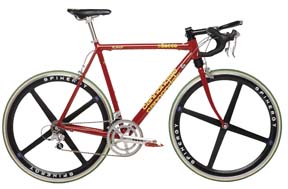
By now you've seen the ads. The Saeco team riders, guys such as Mario Cipollini and Silvio Martinello, are walking down some backstreet in Italy dressed in tailored Italian suits, but Cipollini has a Cannondale in tow instead of a briefcase. This is the bike they'll be taking to work this year. On the surface the bike is pretty straightforward: The frame is the new CAAD3 aluminum frame built up with Shimano's 9-speed Dura-Ace, and it rolls on a set of Spinergy wheels.
You might have guessed that no ordinary U.S. aluminum bike (if there is such a thing) could go into Italy and replace an Italian steel bike as the ride for a professional team. Cannondale went all out for this and still came up with a bike that, at $2699 ($3499 as tested), isn't outlandishly expensive.
Our test bike varies a little from the bike currently available. First,
our bike subscribes to the Silk Road frame design-it has a Headshok, Cannondale's proprietary suspension fork. Secondly, our bike came with a Cinelli Eubios bar and Spinaci bar extensions. Finally, our bike's decal scheme won't be exactly how this comes out of the box. The Cannondale and Saeco decals will be the only ones factory installed with a clear coat over them, while the
other sponsor decals will be available in a stick-on pack. According to Steve Cuomo, formerly Cannondale's bicycle product manager, a team replica bike will probably be offered in July as part of Cannondale's '98 line. It will be nearly identical to the bike I rode.
CAAD3 frames are all built in Cannondale's Bedford, Pennsylvania, facility using tubing custom drawn for them by Alcoa. This frame is identical in materials and construction to the frames the Saeco team is riding this year. Cuomo says it is important to Cannondale that its sponsored riders ride the same frames its customers ride.
The Saeco-Cannondale Team bike caused quite a stir when it was unveiled at the 1996 Interbike show.
The bike's look is striking. When it was unveiled at the Anaheim show, my eye was immediately drawn to the down tube and the double decals that adorn each side. They helped to make the incredibly large diameter of the down tube immediately apparent, but on closer inspection, I noticed the swaging that made its diameter grow substantially where it joined the bottom bracket. At the head tube/down tube joint, the tube has a diameter of 1.5 inches and it swells down its length until it reaches its maximum diameter of 2.25 inches at the bottom bracket.
Joints between the tubes are characterized by smooth curves more reminiscent of fillet brazing than the bike's real construction method-TIG welding. Once welding is complete, workers use hand grinders to take material from the weld. After the general form is gained, the frame is then hand sanded to its proper curve. Cuomo claims the smooth finishing increases the life span of the frame since it removes material that would otherwise serve as a stress riser.
Our 58-centimeter (center to center) test bike was sized with a 57.5-centimeter top tube and an 11-centimeter stem-not a bad position for me. The 73.5-degree seat angle made it easy for me to find the saddle's setback from the bottom bracket, and with a 73-degree head tube angle I found the steering to be confident and assured in a traditional Euro sort of way. The bottom bracket height for this bike was 27.4 centimeters and the chainstays were a shortish 40.6 centimeters, a combination which gave the bike an agile nature without disturbing the stable steering.
In keeping with the pro caliber ride, this bike was spec'd with Shimano's 9-speed Dura-Ace group. This was my first opportunity to spend some quality miles riding with the new levers and the extra cog, and I thoroughly enjoyed it. My biggest criticism of STI levers has concerned the small upshift lever. For '97, Shimano has more than doubled the surface area available for your finger to kick the chain down a cog in a sprint.
The ergonomics of Shimano components is usually first-rate and Dura-Ace didn't fail in this regard. I quickly discovered my favorite hand position on this bike was on the brake hoods, which fit my smallish hands extremely well. The operation of the components on the road was every bit as smooth as you've come to expect from Shimano's top-drawer group. The cranks and bottom bracket spec'd are CODA with 39- and 53-tooth chainrings. Downshifting worked fine, but without the sculpted profiles of Shimano teeth, upshifts required a bit of finesse.
The Spinergy wheels I rode are available as an upgrade to the standard package which would otherwise include Dura-Ace hubs and Mavic rims. For an extra 500 smackers, you can get one of the most popular carbon wheels on the market and go for the full-on team look.
I'm sorry to report one of my favorite features of this bike was the 15 millimeters of travel found in the Headshok. Sorry because it won't be available on the '97 bike but it will probably be available on the '98. Even with the suspension locked out, I found this to be the best-riding Cannondale I've ever been on.
Like all Cannondales' bikes I've been on in the past, this machine was unyielding in the bottom bracket; I could hear flex in the Spinergy wheels before I could make the front derailleur rub. This bike wouldn't be my first choice for a long road race or a century-my personal taste still leans toward steel, since I prefer a bit more compliance throughout the frame. Thinking back on the roads I raced on in New England-broken pavement, short but steep hills and drag race sprints-this Saeco's strengths will see it find a welcome home on racecourses.
Cannondale, (800)BIKE-USA, (203)544-9800, www.cannondale.com