"Courtesy Bicyclist Magazine, Petersen Publishing Company" and feaured in the December 1996 issue
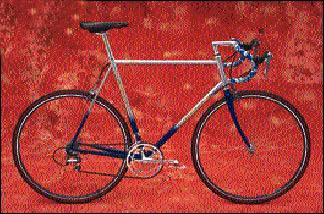
When Trek acquired LeMond bicycles, both companies benefited. LeMond finally got the production and support his bicycles have needed and deserved, and Trek got the rights to a brand that could carry the sort of prestige on road that its off-road machines are known for.
I've read about LeMond's opinions on frame design and bicycle fit since the late 1980s, and I'd always wondered what one of his frames would ride like. Knowing that his personal dimensions are substantially different from my own, I was also curious to find out if his opinions on design and fit would be applicable to me.
Scarcely a mile had disappeared under my wheels before I began to notice just how different this bike felt. Thanks to a seat tube angle slacker than any I've ever run across (72.5 degrees) and a top tube and stem combination that left me unusually stretched out (a 59-centimeter top tube with a 12-centimeter stem on our 59-centimeter size frame), I found myself able to shift my position on the bike based on riding terrain. Part of LeMond's philosophy concerning bicycle design is that a longer top tube will leave a rider more room to move around and, thus, you should shift your weight backward or forward on the bike depending on riding conditions.
I certainly had ample room to move as I saw fit. Big-ring cranking on the flats resulted in me sliding forward on the Selle San Marco Scocca Dynamica saddle (not the most comfortable saddle for this sort of use). LeMond's experience predicts this as a common occurrence and is part of the reason the seat tube angle is so slack. My first rides suggested that my position on this bike wasn't as good as it could have been. The reason was easy to find: LeMond's femur is long--more than half the length of his leg--whereas my femur is less than half the length of my leg. In other words, I don't have a lever long enough to utilize that position as well as he could.
With the aid of a plumb bob and a tape measure, I brought the saddle forward 4 centimeters and into a position no longer radically different from my normal one. My ability to sprint on this bike improved dramatically once I could feel the saddle between my legs. I noticed on climbs my cadence tended to drop less than on previous rides. Thanks to the long top tube and the 25.5-centimeter seatpost, this bike should accommodate quite a range of riders. While I don't have the skeleton to utilize the Zurich's real talent, I was able to distinguish it as a race-ready ride. This bike, like the Sampson Classico, also uses a carbon-fiber fork that helps deliver crisp, precise steering. While the handling on this bike was quick, I wouldn't say it's twitchy; the bike was well-behaved on descents and, thanks to the carbon fork, soaked up enough road shock to smooth out rougher pavement.
The parts selection for the Zurich came from Shimano's Ultegra group. As befits a bike of this quality, the Ultegra componentry is reliable and light enough to prevent anyone from thinking this bike is a handicap. However, LeMond's personal equipment preferences don't end at the frame. His preference for longer cranks and a wide bar show up here with 172.5-millimeter arms and a 44-centimeter-wide Cinelli handlebar. LeMond's personality permeates this bike at every turn. This is a solid bike at a reasonable price that anyone could go race.
The inevitable question of which bike I liked best cannot be easily answered. This coming weekend I'll be riding and I don't have a new test bike to log miles on. That means I get to pick one of these to ride just for fun. The choice would certainly be easier if I had to buy one. Given that the Carrera is the most pricey of the bunch at $2700 (as built with Chorus components), I doubt I could buy it unless I got lucky with a Lotto scratch ticket or bought just the frame. The Serotta, while not cheap, is a little more affordable at $2200 (again, this is also available as frame only). The Sampson (also available as just a frame, but tested here as a complete bike) actually strikes me as the best deal--for $200 more than the LeMond you get one of the best carbon-fiber forks on the market, Spinergy wheels and some of the best workmanship available, period. For those, however, who need to know what the master rode and whether it is placebo effect or inspiration that makes us ride better (and for those longer in femur or torso than I), the LeMond offers a good ride at the most affordable price in this test. Which bike will I take out this weekend? It's a toss-up between the Serotta and the Carrera; I'll admit to leaning toward the Carrera because it's Campy equipped, but I won't be surprised if I put in another ride on both.