|
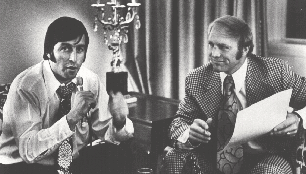
Oakes' prize interview remains the legendary Bobby Hull, the ex-NHL Chicago Black Hawk superstar who quickly became known as the "Golden Jet" when he jumped leagues to ink a then unheard of $2.5-million contract with Winnipeg. The WHA owners pooled the money in their pockets to give Hull a $1 million signing bonus.
"When they signed him, it was like they were bringing in royalty," Oakes recounted with a gleam in his eyes. "That gave the league credibility."
The two hooked up in the Hotel Vancouver the evening prior to the Blazers' first-ever home game.
"It was a call-in show and we left it open-ended. It went on for three or four hours," Oakes recalled, the excitement after two and a half decades still evident in his voice.
Oakes called Hull a phenomenal sales person for the game of hockey.
"In his time, he was the best public relations salesman that any sport has ever had," Oakes recalled. "He had so much charisma. He was the last man to leave the locker room and stayed to sign autographs. He was the perfect hockey ambassador for kids. If it was in the media age of today, he might be compared to someone like Tony Gwynn (of the Padres). That's 25 years ago when we weren't nearly as sophisticated as today."
Hull racked up 638 points on 303 goals and 335 assists in 411 WHA games, finishing as that league's second-highest goalscorer (next to Quebec's Marc Tardif). Hull led the Jets to two of their three Avco World Cup trophies and holds league records for most goals scored in one season with 77 (1974-75) and playoff goals with 43. Oakes still gets shivers when recalling Hull's exploits on the ice.
"Whenever we ever played the Jets in the WHA, I used to feel a weird apprehension when he would shoot the puck, because a lot of goalies were still playing bare-faced. He shot so much and so hard, no one ever knew where it was going, not even himself sometimes. There were no regulations on the curvature of the stick in the WHA. He had a real banana. It was wicked."
Oakes recalled with fondness the presence of Hull, at left wing, alongside "Swedish Express" line mates Ulf Nilsson, at center, and Anders Hedberg, at right wing. If that line wasn't the best in pro hockey in the mid-1970s, Oakes said he couldn't recall any that was.
"That line was the equal of any in the NHL," said Oakes with an air of pride in his voice. Oakes knows what he's talking about. While he was with the L.A. Kings, he had the opportunity to witness the magic combination of the fabled "Triple Crown" line of Marcel Dionne, Charlie Simmer and Dave Taylor.
But Hull remains the pinnacle and basking in his presence was an electrifying experience, Oakes noted.
"I wasn't so overwhelmed that I didn't do my job but you could easily have been," Oakes related. "What I enjoy about my job as a broadcaster is the opportunity to get to know these star athletes. It's really interesting to get into them and see what makes them tick."
While the WHA's brand of hockey was less appreciated in a U.S. sports marketplace too often obsessed with major league labels, Oakes said the league received a widely positive response north of the border.
"In Canada, it was not regarded as a renegade league," Oakes professed. "They appreciate good hockey there."
And good hockey the WHA was. Built on the foundation of superstar caliber players like Hull and Howe, the rival league also sought out rising young talent. Where the NHL feared to tread in signing underage junior players, the WHA went after that aspiring talent with a passion. The WHA also did not restrict itself to North American borders, either, scouring Europe for likewise exceptional overseas talent. It should be noted that Wayne Gretzky played his first professional game at the age of 17 with the WHA Indianapolis Racers.
"It was an exciting league to be connected with," Oakes explained.
Certainly amazing by the standards of today's high-profile, high-priced and generally self-centered athletes.
Almost orphaned at times because of the extravagant dreams of under-financed owners, the WHA was a league in constant turmoil. The season before Oakes joined the Mariners, that franchise had to play out its season without an owner -- one of many which encountered acute financial problems in an era when major corporate sponsorship was a fantasy. Players banded together for the love of the game and played out the season for any playoff monies.
"The guys played about the whole year without a paycheck. I had a lot of admiration for them. It was incredible," Oakes recalled.
Oakes spent the 1977-78 season in Chicago broadcasting NHL Black Hawk games. "The big story every game seemed to be whether Bobby Orr would play or not," Oakes offered. A programming decision at the station saw Oakes move on once more. It was back to the minors and San Diego. This time with the San Diego Hawks of the second-year Pacific Hockey League.
It proved a homecoming in more ways than one for Oakes. Not only was he back home with his family of five daughters and wife Jean but also with much of his hockey family from the Mariners and Gulls. With the WHA downsizing toward eventual assimilation into the NHL, the Hawks managed to sign many popular and familiar faces from the Mariners, and also a couple ex-Gulls, still in playing shape.
Among those back were Joe Noris, Kevin Devine and Ray Adduono from the Mariners and Willie O'Ree -- Mr. Legend himself, now into his 40s -- from the original Gulls. It seemed to be a marriage made in heaven -- the best of both hockey worlds and initial fan and media response was fantastic. The Hawks drew over 8,000 people to their home opener against the Spokane Flyers.
Despite offering a high-caliber of play -- the Hawks were just a tick below the WHA level -- the league quickly sprang leaks and became insolvent and folded after the 1978-79 campaign with the Phoenix Roadrunners declared the league's final champion upon cancellation of the playoffs.
Following the demise of the Hawks and the PHL, Oakes found himself in St. Louis, where he was teamed with the late Dan Kelly, regarded as one of the best hockey announcers of all-time.
But fate once again intervened. The sport that somehow wouldn't die sprang up once again in "America's Finest City."
When the International Hockey League awarded an expansion franchise to San Diego for the 1990-91 season, Oakes was there as the team's radio and television broadcaster. There had been an 11-year lapse since his voice had last graced local airwaves but the electricity once again filled the building when the San Diego Gulls, Edition II skated onto the San Diego Sports Arena ice. He called the team's first two seasons, both on radio and television.
This city's love affair with hockey, however, was always with the original Gulls, and Oakes has many pleasant memories of the "good old days," as he likes to call them.
There was the moment, he reminisced, when 10,000 fans sang "happy birthday" to him during intermission at a game, replete with a large birthday cake on the ice.
"Moments like that you don't forget," he said.
Despite his past affiliations with pro hockey in San Diego, the 1995-96 WCHL team was the first to hang a championship banner in the San Diego Sports Arena.
"This is a good caliber of hockey. For those sports fans who haven't seen this team play yet, they should come and have a look. I think they'll be surprised," he said.
With a strong link to the sport's past and introducing a new generation of San Diegans to pro hockey, Oakes' audience has responded to this latest Gulls' squad by setting league attendance records. The Gulls own the WCHL's 10 largest crowds in league history. A sellout crowd of 12,940 greeted the two-time Taylor Cup champions on opening night of the current 1997-98 season.
Is the WCHL the last stop for hockey in San Diego? Or are there greater things in store for Gulls' fans in the future?
"I always believed we were programmed to be in the NHL one day. We may never be," Oakes admitted with a somewhat forlorn look. "We're a hell of a hockey town but we seem to be of an acquired taste."
|
|