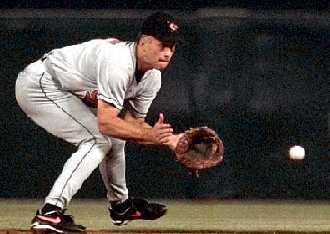
Fielding
General
Fielding is a skill that is often overlooked by young players as it is perceived as not as fun as hitting and pitching. Many games are won or lost by fielding, especially the close one's. Nothing frustrates a pitching staff more then having to throw more pitches then necessary due to shabby fielding. One key is to always be ready, alert and aware of the situation. Always know how many outs there are, where the runners are, what is the score, what inning it is, what to do with the ball if it comes to you (both in the air or ground). You must be aggressive defensively. Go after the ball, don't wait for it to come to you.
Ready Position
As the pitcher goes into his windup, each infielder should get into what is called the ready position. The ready position involves spreading your feet slightly wider then shoulder width, so that you can take off in any direction. Weight on the balls of your feet. Bending at the back with your seat down with your hands in front of you with the glove facing out.
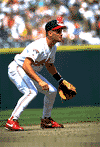 Omar Vizquel in the ready position.
Fielding Ground Balls
When fielding groundballs in the infield, go to the ball, don't wait for it to come to you (unless it is a hard line drive). Just prior to arriving to the ball, you'll want to 'breakdown' which means get into the ideal fielding position which involves, bending the back, with your seat down, glove and throwing hand extended out and down in front you so that you can see both the ball and the glove (see the picture of Cal Ripken Jr. at the top of this section). You'll want to field the ball in the center of your body. Once you gather the ball up, you will bring both you glove and throwing hand to your chest area and begin to align your throw up by turning your front shoulder and hip to the direction to which you will be throwing. Swing your throwing arm straight back and point ball away from target with fingers on top of ball. The throw should come over the top and almost complete a full circle. Try to grip the ball with a four seam grip, as it will go straighter. Follow up your throw with your body towards the target, to ensure accuracy and to preserve the health of your arm and shoulder.
Fielding Pop-ups
When fielding pop-ups, it is important to remember which positions have priority over other positions. When two or more positions could potentially field the popup and both positions call it, the priorities are as follows:
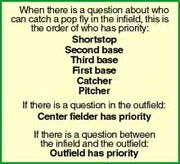
You will want to determine based on the arc of the ball where you think it will come down, and then get there as soon as possible. Run on the balls of your feet, otherwise the ball will have a bobbing effect. Always use two hands when catching a popup. Catch the ball at about eye-level. Most importantly, communicate, communicate, communicate. Don't say, I got it, I got it, You got it. Use the phrase Ball, Ball, Ball, to call it. Don’t wait to see if someone else is going for the ball first before attempting to field the ball, go for it, if someone else has priority they should call you off.
Outfield

The ready position for the outfield is similar to the infield but only about half the crouch and bend. Weight should also be on the balls of your feet. You should be ready to 'take off' at the crack of the bat. You should try to catch fly balls with two hands at about eye-level, with a slight bend at the elbows. You should cushion the ball as it lands it your glove, don't stab at it. When running after a fly ball, avoid running with your glove extended up into the air until you arrive near the ball, as this will only slow you down which may prevent you from getting to the ball.
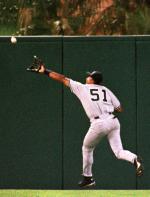 Bernie Williams extending at the last moment.
On high pop-fly's, you'll want to circle the ball so that you are facing towards the infield, so that you can make the quick throw into the infield. Proper outfield play involves a lot of running. On almost any ball hit, every outfielder should be moving somewhere, either to the ball, backing up another outfielder, backing up an infielder who is fielding the ball, or backing up an infielder who may have the ball thrown to him. On that particular play. Again, you must always be aware of the situation, outs, runners, score, what to do with the ball if it is hit to me. Know before the ball is hit, so that you don't have to think about it as the ball is approaching you.