Drills
Hitting
Tee Work
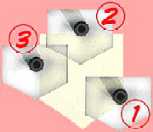
Hitting off a tee is still one of the best ways to work on and develop the proper swing. Even the pro’s continue to hit off a tee to work on their swing. Since there is no pitcher and the ball is stationary, the swing itself gets the full attention. You can practice using both hands in the swing or using only the top or bottom hands only. Also you can vary the tee location to coincide with outside pitches (1), pitches down the middle (2) and inside pitches (3).
Soft Toss Drill
Soft toss is done with two people. The batter sets up about 6-8 feet (or more if in a full cage) in front of a screen or net The other person (the Tosser) kneels safely to the side of the screen/net and will toss the balls to the batter for the batter to hit into the screen/net. The tosser wants to use an underhand motion where he brings the ball back slightly, indicating to the batter to ‘load’ and then begin his toss, aiming for the front knee or thigh. You can vary speed and location of the tosses to simulate pitches.
Watch the Ball
Watch the ball involves three players and helps in keeping the batters eye on the ball. You have a pitcher, a catcher and the batter. The pitcher pitches to the catcher while the batter simply watches (Does not swing) every pitch all the way into the catchers glove. This helps in picking up the ball from the pitcher as well as keeping your eye on the ball all the way through.
Fence Drill
This can be done individually by the batter. It helps in developing a short, compact swing and prevents the long looping swing which takes too much time. It involves placing the knob of the bat on your stomach and moving towards a fence/net until the tip of the bat barely touch’s the fence/net. Next from that location take your swings using a compact short swing. If your swing becomes too long then the batter will have too much contact with the fence/net. If the batter uses the correct swing he should have little if any contact with the fence/net.
Hip Turn Drill
The hip turn drill helps in developing proper hip rotation needed for a good swing. It can be done individually or as a group. The player takes a bat and places it behind their waist with their hands holding near the ends of the bat.. Next, throw an imaginary pitch at the batter and have them take a stride and swing with the bat behind them. They should finish with the hips properly rotated with their back hand out over the plate area.
Situational Live Batting
This can be done either in a cage or field using a live pitcher . This will practice every element of hitting. What this involves is giving the batter various situations before every pitch to improve their decision making process. For example, tell the batter that the count is 3-0 and see if he chases a pitch slightly out of the strike zone. Or tell them that the count is 0-2 to see if the let a close one go by. Or tell them runner on 2ed with no outs to see if they hit the ball to the right side to move him over.
Bunting
4 Corner Drill
A good team drill to develop bunting. Place a bunting at each corner of the infield using each base as a home plate. Next have a teammate or coach kneel about 20-25 feet directly in front of each batter and throw them pitches to bunt. Players should place the bunts down the lines. Rotate bunters after 5 bunts each. Have the first two bunts go towards the thrid base line, the next two bunts down the first base line and the last bunt be a squeeze
Bunting Team Game
Another good bunting drill that is both fun and competitive for the players is the Bunting team game. Split the team into two groups. Form a rectangle on the third base side using some rope as a ‘Target’ area in which to bunt the ball into. Next give each player in each group two bunts each. The team with the most bunts in the target area wins. Have a reward for the team that wins such as only having to run one lap around the field instead of the two for the losing team during conditioning.
Fielding
Soft Hands Drill
This drill can be done with either two individuals or within a team setting. It helps in developing soft hands while fielding ground balls. It is performed by rolling ground balls to the player, who then catches the ball without a glove on. They will be forced to utilize a soft hands technique to prevent the hands from hurting. Start with nice easy throws and get progressively harder.
Catch and Tag
Involves a catcher, firstbase, secondbase, shortstop & thirdbase. Used to strengthen the arm, improve throwing and proper tag placement. Start by having the catcher throw to the firstbasemen at the bag who make a imaginary tag and then throws to the secondbasemen at the bag who make a tag. He then throws to the thirdbasemen who makes a tag and throws to the catcher who makes a tag, who then throws back to the thirdbasemen who makes a tag, and throws to the shortstop who makes a tag and then throws to the firstbasement who makes a tag and then throws back to the catcher who finishes with a tag. This can be repeated 2-3 times.
Lateral Movement Drill
This drill helps develop the fielders lateral movement toward the ball. Ideally, you will split into two groups with one group near second base and one group near shortstop. Have two shaggers to which the fielders can throw to near the pitchers mound. Start by rolling ground balls to the left or right of the fielders and have them take a rounded path to the ball while staying low, field it, and toss the ball to the shagger near the mound. Rotate after each throw.
Relay Throw Relay
This is a fun and competitive way to develop the proper execution of a relay from the outfield. Split the team into groups of 3. Each group will consist of an outfielder, infielder and catcher. Have each groups catcher spread out and stationed along the firstbase line. Have the infielders spreadout near the edge of the outfield and have the outfielders spread out in left field. Start with a ball in each outfielders glove and yell go. Each team will then throw the ball into the infielder and then the catcher to see which team finishes first. Bad form will probably result in either a missed or delayed throw. Rotate positions if desired.
Grab and Throw
This drill helps in developing the proper throwing technique needed for infielders. It usually involves 3 people. A thrower, a ball holder & Someone to catch the throws (can use net). It starts with the ball holder placing a baseball in their extended hand right (about lower chest height) behind the thrower. The thrower then gets into a throwing position with his front shoulder/elbow pointed to their target and their throwing hand about ¼ inch from the ball that is being held in the ball holder’s hand (the ball should be placed in the hand so that upon grabbing it will be a four seam grip). The thrower then grabs the ball and makes a quick throw to either the catcher or net. Repeat multiple times and rotate.
Loose Ball Drill
This drill teaches the proper form in making the play on a bobbled ball. Start by rolling the ball to the fielder and have then catch it and immediately drop the ball 3-4 feet in front of them. Have the fielder then go after the ball with his right foot (for right hander) planted immediately behind the ball with his left side already pointed towards the throwing target. After throwing and getting back in position, repeat three more times with the loose ball to be to the left side of the fielder, the right side and finally behind them. Each time they should place their throwing side foot directly behind the loose ball. This will place the fielder in the optimum throwing position and will help ‘make up’ some of the lost time due to the bobble, which will be needed due to the advantage shifting from the fielder to the runner on most bobbles.
Catcher’s Bunt Fielding Drill
This helps improve the catcher’s ability to field bunts. One method involves placing three balls out 15-20 feet in front of home plate, one down the third base line, one towards the mound, and one towards the first base line. Have the catcher get into his normal position and then yell bunt. The catcher then proceeds to field the first ball and throws to first. Repeat with the other balls. This drill can also be done by tossing the balls out from behind the catcher towards third, first and the mound as well.
Catchers Signs Mirror Drill
This is a drill that can be done at home in a mirror by the catcher to practice giving signs so that the opposing team cannot see his signs. The Catcher should get at an angle similar to that of the third base and first base coach. If properly given, only the middle infielders and pitcher should see the catchers signs.
Pitching
Balance Point Drill
This drill is a simple but important one in developing good balance in your pitchers. Have the pitcher begin his windup and then freeze once he gets to the balance point. He should be able to hold that position for at least 8-10 seconds. If he cannot, then he is not balanced enough and will develop control or arm problems. This can be practiced at home in a mirror as well.
One by Four Drill
This drill helps develop a straight forward motion from the pitcher towards homeplate. Start by placing a one by four piece of wood on the mound pointing towards homeplate. Have the pitcher start from either the stretch or the balance point on one end of the wood and have him throw a pitch. If he goes in a straight line his lead foot should land on the wood. This can be done with tape or this rope as well.
Arm Slot Drill
This drill encourages a high arm slot, desired for protection of the arm and increased velocity. Start with the pitcher in the following position. Front (glove side) shoulder and elbow facing target, throwing arm back and up (elbow at approx. 90 degrees) with ball in hand touching the fence behind him with his hand above the head. Next step is to complete the throw. Throw multiple times to help develop some muscle memory with this higher arm slot.
Whipping Drill
This drill is useful in discouraging a sidearm motion. It involves two people. One pitcher and one glove holder. You start with giving the pitcher a piece of cloth that has been cut approximately 1 inch by 20-30 inches (an old towel works nicely) and with his throwing hand facing palm up, drape it over his middle finger and then make a fist. You then have the glove holder placed about 8-10 feet in front of the pitcher with his glove extended out towards the pitcher no more then 3 feet off the ground. You then have the pitcher go through his throwing motion with the piece of cloth instead of a ball and he tries to ‘whip’ the glove. It will be easy to do with an overhand motion, but difficult with a sidearm motion. This also encourages a nice follow-through.
Baserunning/Conditioning
Ball Relay
This drill works on both Baserunning, while working in some conditioning as well as being fun and competitive for the players. It is basically a relay race around the bases with the ball replacing a baton. Start by splitting the team into two groups with one group starting at second base and the other at homeplate. Give the first runner of each group a ball and have all the other runners backed up at least 5-6 feet from the base/plate. Have the first runners start at their base/plate and then yell ‘go’ and each runner has to then run the bases and upon returning to their home base/plate, hand the ball (cannot throw) to the next runner, who proceeds to do the same. The first team to finish wins. Try to split the teams equally based on speed. Reward the winners.
Miscellaneous
All Around Game
A good team drill that only takes up only about 10 minutes of time, but covers fielding, throwing, bunting, hitting and running is the all around game. What this involves is splitting the team into two groups. It will require 3 coachs/adults (one to pitch, one to play 1B, and one to throw grounders/popups) . It is a timed relay type game with the winning team having completed the ‘course’ in the shortest time. The first player on team one starts by having a ground ball thrown at him at shortstop, he must field it cleanly and make an accurate throw to first. If he does not field it cleanly or makes a bad throw, he must take another one until he does field it and throw it cleanly. After fielding and making a clean throw the player is then given a pop-up to catch and throw to first. Again, he must call-it, catch it cleanly and make a good throw. If not, give him another until he does. Once he completes this, he races in to the home plate area, grabs a bat (already layed out) and a coach will throw him pitches. The batter has to lay down a good bunt (down either line), the batter will continue to receive pitches until he lays down a good bunt. Once he does, he then gets to hit away. If the batter hits a fair ball, he then has to run to first and upon hitting first base, the next person on his team will receive their ground ball to field cleanly and throw to first and the entire process is repeated for all team members. Each team is timed from the time the first ground ball is thrown until the last batter hits firstbase. If one team has one more player then the other then one player will have to complete the course twice. This is a fast moving game that the players should love and it should take anywhere from 7-14 minutes depending on the skill level of your team. Again, there should be a reward for the winning team.