|
The Optical Telegraph
Ever since Samuel Morse invented the electrical telegraph in the 19th century, instantaneous communication has been possible between distant points but for the previous few thousand years of civilization, the speed of communications was pretty much restricted to the speed with which a messenger could travel. Distant communications were slow and expensive.
In ancient times the Greeks used visual signals like smoke or fires to communicate but the message had to be established beforehand and the signal could only be a confirmation of it (yes/no). The sight of the Spanish Armada was signaled by fires to London and even two thousand years after the Greeks the Americans were using visual signals to warn that the British were coming: one if by land and two if by sea.
Towards the end of the 18th century the needs for communication were growing rapidly, especially for military communications. Naval ships were developing codes with flags to the point that admiral Nelson just before the commencement of the battle of Trafalgar could hoist signals that said "England expects every man to do his duty" rather than the simpler codes used until then (retreat, attack, fire, etc).
So, for more than two thousand years of European history, communications were by written messages carried by a messenger. For important messages (which meant pretty much state messages) a network of posts was established where the riders could change horses for fresh ones and continue on their journey.
There are occasions in history when there was a need for something which could not be resolved with the technology that existed at the time and so, new technology is developed to resolve the problem. This was clearly the case with the chronometer. Since the great voyages of exploration in the 16th century, there was a need felt to be able to determine geographical longitude at sea. The progress in astronomical knowledge had led to the point where one could determine longitude at sea provided one had an accurate time piece. And, so, for a couple hundred years, most European nations were eagerly trying to develop an accurate chronometer that could be taken to sea. An Englishman, John Harrison, is credited with building the first chronometers.
But there are other occasions when the technology to do something is there but the need is not felt for such development. Today, if the technology exists, immediately some company would create the need in the public for a product that would use such technology. But this was not always so. Generations lived like generations before them and did not feel much need to innovate.
But the 17th century was seeing growing empires and larger military campaigns that required better coordination and this brought the need for better and faster communications. As we shall see, the technology used to resolve this need was already two thousand years old. It was just that no one had thought of putting it to this use.
|
El Tel�grafo �ptico
La invenci�n del tel�grafo el�ctrico por Samuel Morse en la primera mitad del siglo 19 hizo posible la comunicaci�n instant�nea entre puntos distantes pero durante milenios de civilizaci�n la velocidad de las comunicaciones era la velocidad con la que pod�a desplazarse un mensajero. Las comunicaciones eran lentas y caras.
En la edad antigua los griegos ya utilizaron se�ales visuales como fuegos o humos pero el mensaje deb�a estar acordado de antemano y la se�al solo pod�a confirmarlo o negarlo. Siglos m�s tarde cuando los ingleses avistaron la gran Armada espa�ola desde Plymouth transmitieron el mensaje a Londres con fuegos. Incluso dos mil a�os despues de los griegos los revolucionarios americanos utilizaron fuegos para avisar de la llegada de tropas inglesas: uno si por tierra, dos si por mar.
Hacia finales del siglo 18 las necesidades de comunicaci�n crecieron r�pidamente. Los buques militares desarrollaron c�digos m�s efectivos de modo que el almirante Nelson, al comenzar la batalla naval de Trafalgar, pudo enviar su conocido mensaje de "Inglaterra espera que cada hombre cumpla con su deber". Hasta entonces las se�ales eran mucho m�s sencillas y solo permit�an mensajes b�sicos (ataque, retirada, abrir fuego, etc.).
De modo que durante m�s de dos milenios de historia europea las comunicaciones eran por medio de mensajeros. Para mensajes importantes (pr�cticamente limitado a mensajes de estado) se establecieron postas donde los mensajeros cambiaban sus caballos por otros frescos para poder continuar su camino.
Hay ocasiones en la historia en que exist�a una necesidad que no pod�a ser resuelta con la tecnolog�a existente en ese momento y, como consecuencia, se desarrolla la tecnolog�a necesaria para resolver el problema. Un ejemplo es el cron�metro. A partir del comienzo de los grandes viajes de descubrimiento en el siglo 16 los marinos sintieron la necesidad de poder determinar la longitud geogr�fica. Los conocimientos de astronom�a llegaron al punto en el que era posible determinar la longitud si se dispon�a de un cron�metro preciso. Como consecuencia, durante doscientos a�os la mayor�a de las naciones europeas dedicaron considerable esfuerzo al desarrollo del cron�metro marino. Un ingl�s, John Harrison, construy� los primeros cron�metros marinos.
Pero hay otras ocasiones cuando existe la tecnolog�a pero no se siente la necesidad. Hoy si existe la tecnolog�a, las empresas crean la necesidad, pero esto no siempre fue as�. Las generaciones viv�an como las generaciones anteriores y no sent�an la necesidad de innovar. La estufa es mucho m�s eficiente que la chimenea pero solo se divulg� en el siglo 19 a pesar de que la tecnolog�a necesaria exist�a dos mil a�os antes.
Pero en el siglo 17 los crecientes imperios y sus campa�as militares crearon una necesidad de mejores y m�s r�pidas comunicaciones. Como veremos la tecnolog�a usada para resolver esto estaba disponible desde hac�a dos mil a�os pero a nadie se le ocurri� usarla para este fin.
|
|
At the end of the 18th century Claude Chappe, a Frenchman, invented an optical system for communications on land. It was the first visual system of communications that permitted the transmission of true articulated messages. Rather than using fire or smoke or even flags, Chappe designed a mechanical system of movable arms which was positioned on the roof of a building so it could be seen from a distance.
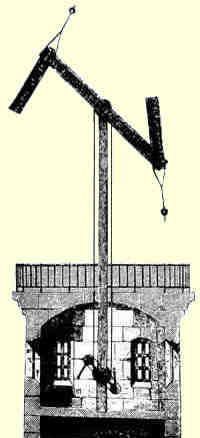
A central arm could be rotated to assume any number or positions and it had an articulated arm at each end which could also be set to any number of positions. This gave enough combinations to cover the Roman alphabet, numbers and other signs. What was truly ingenious was that the arms were moved by some levers located inside the building below and connected by way of wires. (See illustration). The arms above replicated the positions of the levers below. A lookout with a telescope in the room would observe the previous tower and call out the signal while an operator would replicate it in this tower and, in this way communicate it to the next tower.
|
|
A finales del siglo 18 un franc�s, Claude Chappe, invent� un sistema �ptico de comunicaciones terrestres. Fue el primer sistema que realmente permit�a la transmisi�n de mensajes complejos. En lugar de utilizar fuego o humo, Chappe dise�� un sistema de brazos mec�nicos m�viles y que se posicionaba sobre un edificio de modo que pudiera observarse a distancia.
Un brazo central puede girar y adoptar un n�mero de posiciones y dispon�a de un corto brazo articulado en cada extremo. Combinando todas las posibles posiciones se tienen suficientes s�mbolos para representar el alfabeto romano, los n�meros y otros s�mbolos. Lo realmente ingenioso es que los brazos se mov�an por medio de palancas situadas dentro el edificio y conectadas por medio de cables. (V�ase la ilustraci�n.) Los brazos arriba replicaban las posiciones de las palancas abajo. Un observador con un telescopio observaba la torre anterior y cantaba la se�al recibida y el operador la reproduc�a en esta torre comunic�ndola de esta forma a la torre siguiente.
|
|
Towers were situated on hilltops and were spaced depending on the terrain and prevailing weather conditions but let us say that about 8 - 10 miles (12 - 15 Km) is a good average. They did not wait to receive a complete message to retransmit it but rather worked the message as they received it. By doing this messages could cover great distances at speeds much greater than a man could achieve on horseback.
The first chain of towers was established between Paris and Lille and the first message received in Paris in 1791 was "Conde in our hands, the enemy has surrendered". Experienced operators could transmit messages over a distance of 600 miles (1000 Km) with a delay of 30 minutes. The word "telegraph" was coined and the success was immediate. Napoleon covered France with a telegraph network and other European countries soon followed. Other systems of optical telegraphy were developed. The systems that used shutters rather than arms were technically superior (at least in my view) but Chappe's system was the one most extensively used. In Spain the principal sea ports were connected to Madrid and soon the entire peninsula was communicated but the era of the optical telegraph did not last long. After its invention, in the next fifty years, Europe was covered with a network of optical telegraph but in 1837 Samuel Morse invented the electrical telegraph and in a few short years it completely replaced the optical telegraph. In my travels in Spain I still often see these small towers for which one could not imagine their purpose since they barely have any living quarters. They are isolated on mountaintops and many of them have geodesic markers on top as they are convenient to use for geodetic measurements. They look like little light houses moved from the sea but at one time they provided essential communications. Today the optical telegraph is forgotten and few people know it ever existed. When I travel and see a little tower on a mountaintop I invariably ask those with me what it may be or have been and I always get the most imaginative suggestions but none ever comes even close to reality.
|
Las torres se situaban en cimas y se espaciaban dependiendo del terreno y condiciones meteorol�gicas predominantes pero digamos que la media era de 12 a 15 Km. Los operadores no esperaban a recibir el mensaje completo para retransmitirlo sino que lo iban transmitiendo seg�n se iba recibiendo. De este modo los mensajes pod�an cubrir largas distancias a velocidad mucho mayor que un hombre a caballo.
La primera cadena de torres se estableci� entre Par�s y Lille y el primer mensaje recibido en Par�s en 1791 dec�a "Cond� en nuestro poder, el enemigo se ha rendido". Operadores expertos pod�a transmitir mensajes a una distancia de 1000 Km con un retardo de 30 minutos. Se acu�� la palabra "tel�grafo" y el �xito fue inmediato. Napole�n cubri� Francia con una red de este tel�grafo �ptico y los dem�s pa�ses europeos pronto hicieron lo mismo. Se desarrollaron otros sistemas de tel�grafo �ptico. En mi opini�n los sitemas que utilizaban ventanas en lugar de brazos eran t�cnicamente superioires pero el tel�grafo de Chappe fu� el m�s utilizado. En Espa�a los principales puertos de mar se unieron con Madrid y pronto toda la pen�nsula estaba comunicada pero la era del tel�grafo �ptico no durar�a mucho. En los cincuenta a�os que siguieron a su invenci�n, Europa se vi� cubierta por una red de tel�grafo �ptico pero en 1837 Samuel Morse invent� el tel�grafo el�ctrico que en pocos a�os sustituy� completamente al tel�grafo �ptico. En mis viajes por Espa�a suelo ver a menudo las peque�as torres cuyo prop�sito ser�a dif�cil adivinar ya que casi carecen de espacio habitable. Est� situadas en lugares remotos y aislados, a menudo en picos de monta�as y hoy muchas tienen se�ales geod�sicas situadas encima ya que su situaci�n las hace ideales para este fin. Parecen peque�os faros trasladados desde el mar a la monta�a pero en su d�a fueron importantes sistemas de comunicaci�n. Hoy el tel�grafo �ptico ha sido olvidad y poca gente sabe siquiera que existi�. Cuando en mis viajes veo una torrecilla en un alto siempre pregunto a los que me acompa�an que ser� y las respuestas que me dan son de lo m�s imaginativas pero nunca se acercan a la realidad.
|
|
Links: Swedish Museum of Communications Swedish Museum of Communications Another page
Swedish Institute of Technology in Electrum
|