
The first Equus, the genus of our modern horse stood about 13.2 hands (54 inches), the size of a pony. It had long legs, a rigid spine, a long nose, and a deep jaw. It also had a slightly larger brain than Dinohippus. Although Equus has a stout hoof, it still contains the genes for the vestigial toes. When expressed, these arise as small bone splints.
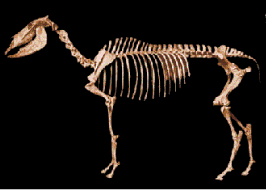
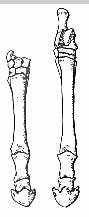
The gap behind the front teeth has grown larger. The teeth of Equus are very high-crowned and continue to grow constantly; the surface is worn away by grinding.

During the first major glaciers, which occurred in the late Pliocene period, certain equines migrated to different parts of the world. Some entered Africa and evolved into the modern zebra. Others spread across Asia, the Mideast, and northern Africa as asses and onagers, which are wild asses of central Asia. Some even went to South America. Still others spread across Asia, the Mideast, and Europe and became Equus caballus, the modern horse.
Equus spread from America to Europe and Asia by crossing existing land bridges. For unknown reasons, when the glaciers left and the land bridges disappeared near the end of the Pleistocene Epoch, the horse became extinct on the continent of North America. Scientists theorize that this may have been caused by climate changes, competition, and/or failure to adapt. Others think that it was due to some fatal disease or parasite. Whatever the reason, the equine population was not reestablished until the arrival of the Spanish conquistadores less than 500 years ago.
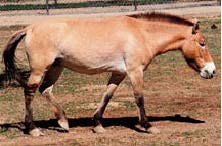
The oldest horse, that still exists today, is Przewalski's horse. It was discovered in 1879 by the Russian Captain Nikolai Mikailovich Przewalski, who sighted the horse on his journeys through the remote valleys of Mongolia. It resembles many of the animals appearing in the cave paintings at Lascaux, France and is believed to be an ancestor of all living equines. These wild horses stand twelve to fourteen hands high (48 to 56 inches) and are dun, with black points. Threatened by extinction, they now exist only in captivity.
There were three principal types of primitive horses that became the basis for the breeds of the world. The first was the Asiatic Wild Horse, which still exists in zoos. The second was the Tarpan, a lighter and more refined horse that lived in Eastern Europe and the Ukrainian Steppes. The last was Equus silvaticus, a slow-moving horse of the northern European marshlands from which our draft breeds derived.