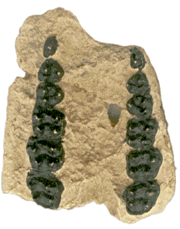
The first trace, of the first horse, was found by a brickmaker in Suffolk, England, 1838. While digging in his backyard, he found a small tooth. Later, he found a piece of a jaw with a tooth attached. Scientists from the London Geological Society thought it to be that of a monkey, and came up with many theories, from "England was long ago a jungle with monkeys chattering and screaming in the trees" to "gypsies traveling through England years before had lost one of their monkeys." A few months later, a second jaw was found in southern England, with the entire set of teeth intact. The monkey idea was discarded and the creature was given the name Hyracotherium, also known as Eohippus.

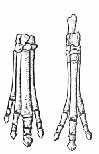
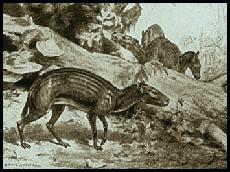
Eohippus was a descendent of the Condylarth, a dog-sized, five-toed creature that lived about 75 million years ago. It lived during the early Eocene period, which took place 50 to 60 million years ago. Eohippus, which means "dawn horse," stood about twelve to fourteen inches at the shoulder and weighed about twelve pounds. It looked nothing like a horse. It had an arched back, short neck, short snout, short legs, and a long tail. Its color probably most resembled that of a deer, a darker background with lighter spots.