History
THE EMERGENCE OF A RUGBY TRADITION AT ST HENRY'S COLLEGE
For the rugby enthusiast who delves into the School's archives, there are many interesting facts to be
discovered. Among other things, he will read how the loose-head and tight-head props came to be used in the scrum He will read of the earlier Springbok teams in which not one ot the forwards weighed more than 90 kg. He might not be seeking anything in particular, but will discover how Marist Schools in South Africa contributed their share, including 1 5 Rugby Springboks to SA rugby history, as well as oven 1 60 provincial players. Furthermore he will learn that there is, in its own right, a proud rugby tradition at St Henry's College. He will discover, for example, that the origin of the name by which Marist rugby teams became known - The Amalekites - came from none other than Mr Skonk Nicholson, the doyen of Natal Schools Rugby. He will also find other interesting rugby bric-a-brac; that there were only two players in the rugby history of the College to have represented another school (David Kerr and Basil Emery represented the St Charles 1st XV on tour to the Transkei in 1935); that there were only ever four Rugby Caps awarded (in 1936) to A Craigie, L Rault, L Faola and R Braude; that the 1937 1 st XV topped the U/17 Durban League; that the 1947 1st XV was the most admired team in the College's history; that the College's first warcry was composed in 1 951 by R Seymour, one of the 1 953 1st XV; that the 1 969 1st XV was regarded as the the most successful in the history of the College; that the nickname 'The Blue Train' emerged in the early nineties; and the new rugby badge - the St Henry's Lion - originated in 1993.
While the College's archives provide an insight into our rugby heritage, they are nonetheless patch~ and often non existent. What follows then is a potted-pen summary of some of the rugby highlights at the School. It does not seek to provide a detailed picture of the rugby tradition. Rather it is a reminder to the current and future generations of players that there is a tradition that exists, and that all who board the 'Blue Train' should do so with a sense of pride, and with the awareness that they are contributing to that tradition.
The Golden Jubilee publication (1979) records rugby's beginnings thus:
The progress in rugby was slow and there were many setbacks. This was the last form ofsport organised at St Henry's during those early years, but owing to its appeal to the average boy it proved to be the most attractive of all. In the first season in the League in 1932, the U/13 side headed the log in a tie with DPHS, and in the same season, our U/14 side came second to DHS. A feature of our play in those days was our hard-working forwards and creative backs.
The last words expressed here were to become synonimous with our rugby: tenacious, dogged and committed forwards, flair amongst the backs.
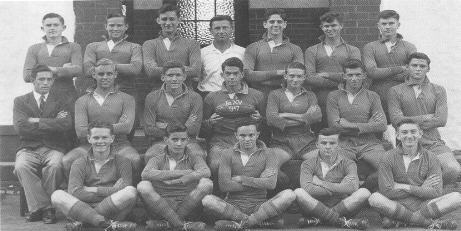
The Thirties were characterised by a number of excellent results, notably the 1937 1st XV: 12 wins out of 1 3; 268 points for; 32 against. It is not however till 1 944 that St Henry's gained the distinction (for we were still a small school then) to have 2 members of the 1st XV gain selection for Natal Schools, namely R Esnouf and I Lyle. Another Natal Schools' player from arguably the best ever St Henry's 1st XV - that of 1947 - was N Rault. It was this team that beat all Durban schools, including DHS (for the first time) and Glenwood, lost only one match to Maritzburg ColIge, and clinched the 1947 Gilbert Cup. Apart from Rault, P Tuohy and 6 Robertson were selected for Coastal Schools and J Pershouse, future Natal and Springbok baseballer, was also a member of this team.
Back: K.Lupton-Smith; L. Hale; C. Clarke; Br. William; N. Rault; D.Thompson; A. Lupton-Smith.
Middle: A.Pereira; B.Hansen; P.Tuohy; G.Robertson; J. Pershouse; E.Berkowitz;I.Shephard.
Front: J.Matthews; 6. Pereira; i. Walker; D.Shelton; J. Loncarich.
The Record - This team beat every Durban School and lost only one match to Maritzburg College.
Jock O'Connor, former St Henry's student of the early 50's, has helped to fill in the some of the gaps of our early rugby history for the years 1 950- 1954. During this period, he recalls, the College played DHS, Glenwood, Port Natal, Mansfield, Durban Tech (now George Campbell) and Northlands (from 1953) - then the only high schools in Durban - as well as St Charles and Kearsney. The records which exist - although sketchy - record that the Amalekites always gave a good account of themselves.
During the period 1947-53 the late Brother William was the 1st XV Coach. A well known figure to subsequent generations of students who dared to venture into his science lab, the legendary Br William was at the heart of the early rugby successes of St Henry's. In 1954 Br Willaim transferred to St Charles' College, and Br Ezekiel replaced him.
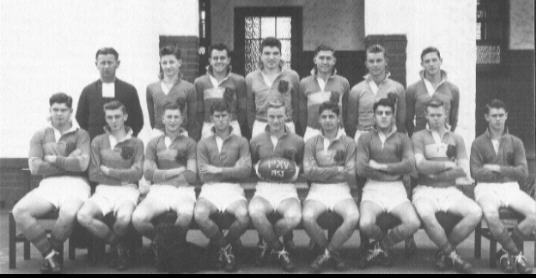
Back:Br.William; N.Begerley; R.Seymour; L.Tonnetti; W.Ashworth; L.Gibson; G.Maitre
Front:T.Rock-Perring; R.Lavoipierre; T.Dunnington; S.Koenig; L.Wilson(c); C.Metcalfe; G.Basel; E.Barth; R.Nell.
The outstanding players who spring readily to mind from this period were; Benny de Beer, a flank forward (1950); Slim Walsh, a reliable full-back (1950/1); Duncan Johostone, a formidable prop (1950/1); Manrico Barbieri (1952) who was unlucky not to be selected for Natal Schools, and Derek Fraser, captain of the 1952 1st XV. Cohn Wilson, Roger Lavoipierre, Ray Nell, Ed Barth and Gaeton Koenig were the stars of a very talented 1953 team; and Rock-Perring, the la~ Leo Gibson and Tex Seymour were the stalwarts in the '54 combination. 'Rock' in fact played for the 1st XV for three successive years and was a formidable place-kicker. Had he made the effort to get himself fit, he could have played for Natal Schools at prop. Undoubtedly the most talented player of the period 1950-54 was Gaeton Koenig. In 1952, during his Std 9 year, he represented Natal Schools at full-hack. In 1 953, he was dropped from the Coastal Schools XV in favour of the Glenwood full-back, and consequently was not considered for Natal Schools. Ironically, shortly after the Coastal Schools XV was announced, St Henry's beat Glenwood 3-0 thanks to a sound performance from Koenig who outshone his Glenwood counterpart. A few years later, Koenig - a brilliant all-rounder - represented South Africa at tennis in the Davis Cup.
There is very little rugby material available from 1955-58, hence it has not been possible to record any of the achievements or the achievers of these years. It appears as if cricket was more popularly supported than rugby during this time. Fortunately, it was possible to conduct an interview with Br Marcellin, probably better known to the rugby fraternity as Paul Dobson, who coached the St Henry's 1st XV in 1959, 1960 and 1961. He recalls with incredible clarity the rugby and the outstanding players of this era. In his eyes, the real stalwart for these years was Anthony 'Joppy' Hortop who played fly-half and captained the 1961 1st XV, and who apart from captaining the Natal University 1st XV after leaving school, was selected for Free State U/20 while still in the army, and later also represented the Natal Duikers. After hanging up his boots, he has excelled as 1st XV Coach at Glenwood High School since the 70's. Other players to receive mention and who impacted positively on the game during the Marcellin years were: Brian Privett at lock (1961/2 and captain in '63); John Vos, Pat Guilfoyle, a pacey wing; Craig Kenton, a fiery hooker; Lawrence Gibson; and by far the best tight forward of this time, a lad by the name of B Ambrosini who played prop.
Rugby from 1962 appears to have been somewhat topsy- turvy. From 1962-64, where there are yearbook reports available, it appears that the teams enjoyed very moderate success overnll, but a number of quality players emerged during this period, namely H Maingard (Captain in 1962); P Swanson (1 963) who was later capped for Transvaal and South Africa (1970); P Emery (1963); B Quirk, a reliable, tough and inspiring scrum-half (1964 Captain) and his outside half B Martin; M Pithey, who was selected for the Durban Schools' XV as hooker (1964); and D Loynes, a talented lock (1964). The Pack of archival material intrudes again for the years 1 965- 68, although Mr A Akal (current principal) and Mr D Cohen (Old Boy and 1st XV Coach in the 80's) were able to fill in some of the space for these years because they were of this vintage. Mr Akal recalls the prowess of fullback D Millard (1966) who went on to represent Natal U/20 and Natal 'B" G Griffin (1966), D Asherson (1965/6); B Swanson (1966/7), brother of Springbok Peter Swanson; B Hatch, an incredibly tough and quick flanker who captained the 1966 team; and B Gray, a rather robust centre (1967/8). There is little evidence available concerning the 1 967 year, but the statistics available tori 968 appear to indicate that rugby was alive and well. Jhe 1968 XV, under the leadership of I Johnson, could claim victories over Pinetown, Northlands, St Charles, St Davids and Campbell, a share in the spoils against Westville and very close losses to DHS and Glenwood. It is with the 1969 1st XV, under the captaincy of B Prior, that St Henry's rugby emulated the successes of the late 40's and early 50~s. This team is arguably regarded as one of the most successful in the history of the College, beating Glenwood (8-5), OHS (13- 12), St Charles (14-8) and drawing with Northlands (11-11). Amazingly the College had no Natal Schools reps in this year, although Z Binikos (fullback), H Callagnan (wing), P Grant (fly-half), B Anderson (hooker) and B Harvey (scrum-half), who were members of the '69 team, all represented Natal U/20, while P Grant and C de Witt were capped for Natal. Most of these players played for the Marist Old Boys Club and were instrumental in it winning the Wylie Cup and being promoted to the 1st Division. R Prior, Captain of the 1969 XV, recalls that the team had an excellent team spirit and were tenacious in attitude. He further recalls that Br Anthony Swanson, 1st XV Coach from 1 968-73, was largely instrumental in the success of the '69 side because of his insistence on fitness.
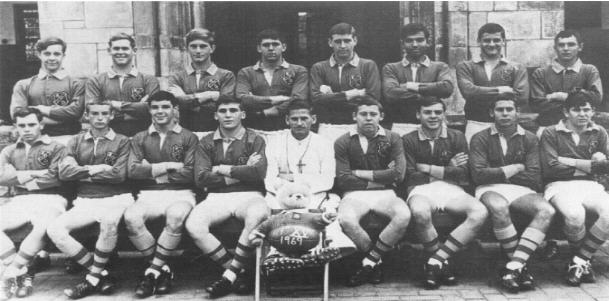
Standing:G.Fowles; M.Hough; K.Thwaites; P.Campbell; D.Robert; J.Wolmarans; H.Callaghan; Z.Binikos.
Sitting:D.Absolom; B.Anderson; P.De Marigny; Br.Anthony; B.Harvey; C.De Witt; N.Mendonides; P.Grant.
Rugby in the Seventies experienced a somewhat roller-coaster ride, according to those entrusted with its advancement, The years 1 970-72 produced nothing exceptional, but Br Anthony recalls John Edington's 1973 XV as a team of commited and tenacious tacklers, with J Edington himself in the vanguard. This team defied all its critics by recording 8 wins, 4 narrow losses, and 2 draws. In 1974, Br Anthony left the College and Br Brendan took over the helm for the years 1974-78. The
'74 Team under the captaincy of No.8 Glen Hawkins, who was selected for Natal Schools, enjoyed a highly successful season, winning 9 out of 14 fixtures, drawing 1 and losing
4. Of the 4 losses, it is interesting to note that 3 of them were lost by 1 point. M Rudolph and R Booth were other outstanding players in this team - both, in Brendan's opinion, were distinctly unlucky not to gain higher honours - and the enigmatic fullback M Kalanowski (1973/4) who, on his day, could turn any game on its head with his enterprising and adventurous spirit. The 1975 team, Brendan recalls, was not at all successful, but he has high praises for its captain, N Summerford (1973/4/5). The following year, 1976, Steve Fagan was selected for Natal Schools at prop, and the team itself boasted the likes of the quickest and deadliest flanker in the history of the College, P Flanagan. Highlights of this year were the 1 point loss to DHS (15-16) in a highly tense and exciting affair and the comprehensive beating of Northlands (22-12). The 1977 side won 10 out of 1 5 fixtures and boasted the likes of fullback A Holman who went on to represent Natal and SA at hockey; captain and centre T Robert; devastating crashtackler M Scott and outstanding lineout forward Gary Lawrence. While the 1978 1st XV produced average results, it had the distinction of providing the College's last two Natal Schools' players to date viz, Ivan Woods (prop) and Tim Campbell (fly-half), captain and vice- captain respectively. Furthermore, I Campbell and Les Howard, who was also a member of the 1978 team, went on to represent Natal at U/20 level, while B van Horen (also 1978) represented Natal Duikers.
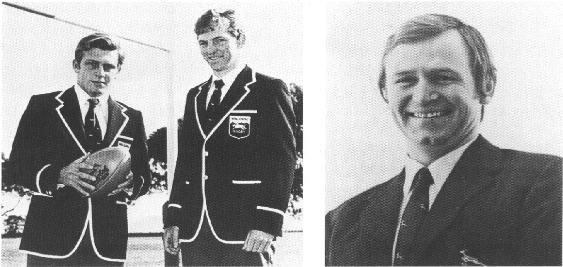
Left:The College's last two Natal Schools' Reps : I.Woods and T.Campbell
selected for selected Craven Week in 1978.
Right:St Henry's Old Boy P.Swanson
selected for Tvl and SA, 1970.
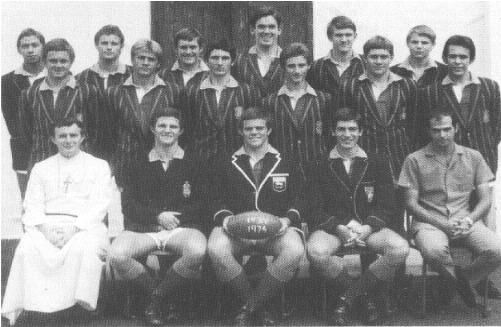
Back:L.Bowles; B.Gray; D.Taylor; P.Judge; R.Ryan; M.Kalinowski.
Middle:C.Forrest; C.DeWitt; N.Summerford; C.Brown; S.Fagan; A.Jardin
Front:Br.Brendan; M.Rudolph; G.Hawkins(c); P.Voogt; Mr.A.Akal
Dave Cohen assumed the mantle of coach in 1979 and coached the 1st XV in the 1 980's, except for the years 1982 and
1985, when Mark Godfrey and A Akal filled the position respectively. The 1st teams ofthe 1979,1980 and 1981 appear to have struggled, winning only 7 fixtures and drawing 2 overall. The yearbook reports of these years point to the high incidence of injuries during this time which disrupted most attempts at continuity. It also appears as it the teams of these years were bedevilled, often to the point that no consecutive game was played with the same combination. The reports also point to forwards who were most capable of winning primary phase possession, but lacked speed to the breakdowns. D Cohen recalls the likes of C Bromfield (1978 and Captain in 1 979), C Setzkurn (1978/79) and C Maxwell (1979/80), a fine winger who went on to distinguish himself at club level; and prop U Savage (1980/81). The 1982 team fared a little better winning 5 out of 13, but coach M Godfrey notes that the players in this team promised much, but did not realise their potential fully. With the 1983 and 1984 teams, the results proved to be much better. The late Andre Terhlans who died tragically in 1994, captained the 1983 team, and in the opinion of coach D Cohen, he was an outstanding player and leader who could have played at a higher level if it had not been for a motorbike accident at the height of his rugby season. K Hennessy captained a lively 1984 side, and besides the captain himself who represented Natal U/20 and who was recently selected for the American Eagles (1996), Dave Cohen recalls fly-half M Martin who also represented Natal U/20; and the elusive fullback, I Ferreri, as players of note. The 1985 team was described by the coach for that year, A Akal, as enigmatic. The team never won a game the whole season, and appears to have lost most of them by a few points in the last 10 minutes. Stalwarts of this team were the mercurial scrumhalf R Laudenberg, and very reliable fullback J Collingwood. The team of 1986 fared little better in terms of results, but the captain and No.8, P Howells, was an outstanding player who was capable of playing at the highest level. M Hislop's 1987 team had a fairly successful run, and boasted arguably the most potent frontrow of the 80's, namely C Mellem, S Sutton and R Rodolo. S Sutton played in the final Natal Schools' trial and was distinctly unlucky not to gain a Craven Week Cap, while R Rodolo went on to play club rugby at the top level and win a cap for Natal B. This team also boasted the likes of lock F Esnouf (tipped to play Natal Schools in 1988), scrumhalf P Askew (1987/88) and fly-half C Akal (1987/88). The 1988 team was incredibly lively and robust, and enjoyed an incredible run of 7 victories against good opposition, followed by a series of 6 defeats. Lock F Esnouf was the most prolific try-scorer in this side, and while not receiving any higher honours, went on to distinguish himself for Natal University at flank in the U/21 Division. D Cohen also rates No.8 M Jubb, P Askew, C Akal and inspiring captain T Delderfield as players of note in 1 988. Rugby at 1st XV level in the Diamond Jubilee year (1989) was essentially a return to the lean.years of the early 80's, and the only really interesting fact to emerge from this year was Captain A Quintal's 55 caps for St Henry's - probably a record! D Cohen notes that during the 80's, St Henry's was playing the bigger and more traditional rugby schools in Durban, namely DHS, Glenwood, Westville, Beachwood and Northlands. While we had always played these schools since the 40's and 50's, they have all undergone an incredible growth, while we have essentially stayed the same. Old Boys who watch the current crop of Marist 1st XV players, and are highly critical of their performances, tend to forget that these schools often have in excess of 1000 boys, and not the 450 of the 50's and 60's. Furthermore, in the 80's, and preceding years, St Henry's had in excess of an 80% rugby participation, with 4 Open teams, 2 Colts teams, and very often three U/14 and three U/13 teams. With the negative media publicity concerning rugby injuries and foul play in the late 1980's and early 90's - often largely unfounded - and the whole new malaise of professionalism, the post matric saga and the 'win-at-all- costs' syndrome - the College, in 1996, fields only 3 Open teams, 2 Colts teams, and one U/14 team in the senior level; a less than 50% participation rate.
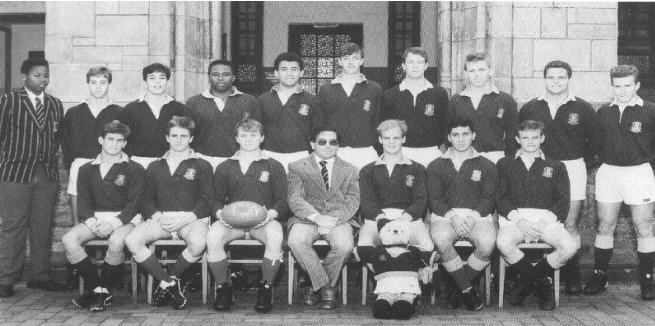
Back: George Rodolo (linesman); Andrew Doig; Craig Akal; Richard Rodolo; Sheldon Vetter; Kazek Trofimczyk;
Francois Esnout; Gary Beaton; Christopher Mellem; Stanley Sutton.
Front: Peter Askew; Roy Summerford; Mark Hislop (captain); Mr. D. Cohen; Darren Parfitt (vice-captain); Antonio Quintal; Trevor Delderfield.
The young 1990 1st XV experienced a topsy turvy year, but it was undoubtedly a watershed year, for most of this team formed the nucleus of the highly successful 1991 team, which won 1 0 out of its 13 fixtures. The 1991 team was undoubtedly the most talented XV of the 1990's, and boasted arguably the most talented player of this era, captain and fly-half Mark Vorster, who must have counted himself very unlucky at not gaining a Craven Week Cap after he had done everything (and more!) expected of him. Besides Mark, the team boasted the likes of fullback A Posemann, centres P Cruickshank and K Richard, and outstanding No.8, T Kelly. The 1992 Team was not a team of stars, but it had a tine captain in hooker C Maidens and an incredible dynamic which saw it win 12 out of 14 fixures. Players of note in this team were the frontrow of N Reinhardt, G Maidens and C Norris; No.8 F Akal; flanker A Vlotman; mercurial scrumhalf A Cocciante, wing S Skordis and fullback S O'Connor. The 1993 Team, under P Xanth is' leadership, was a young side, but nonetheless produced 10 wins in 13 outings. There were no stars in this side either, although prop C Norris - who has subsequently rendered excellent service as assistant coach to the 1st XV since 1 994 - lock D Askew and No.8 D Colloty formed the nucleus of a very competitive pack. A number of the young 1993 backs were to prove their worth in the highly talented 1994 1st XV (which won 12 out of 14 games) under the leadership of J Redfern. Fullback W Smith and scrumhalf C Skordis were tipped to contest for Natal Schools honours, and it is a travesty that they were not even selected for South Durban Schools, for they made a mockery of the selection at the zonal trials. Apart from these two players, the '94 side boasted players of the calibre of wing P Pepper; a highly penetrative centre pairing of B Horsley and J Redfern; and a dynamic loose- forward trio of L Horsley, S Makhanya and M Cele. This team broke new ground in that it was the first ever St Henry's 1st XV to participate in the Independent Schools' Festival, held at Kings- wood in Grahamstown for the 1994 year. The young 1995 Team (11 of its regular players were in std 9), under the captaincy of Mfundo Cele, experienced a disrupted season which saw all ot its senior, and a number of its junior players succumb 10 injury in one torm or other. M Cele was one of the stalwarts of this team, and when not dogged by injury, his leadership was inspirational. Other players of note in the 1 995 team were M Bowles who was selected for the Natal U/i 7 XV at centre, and flank L Horsley. With a core of players back for a bumper 1996 season, much is expected of the 1996 1st XV. Only time will tell.
Quo Vadis, St Henry's Rugby? The first half of the 90's decade has been good for our rugby, but there are a number of disturbing phenomena manifesting themselves in schools' rugby, symptomatic of a deeper malaise. It is a sad reality that schools' rugby in the 1 990's is characterised by the 'monster' of 'winning is everything'- it is now possible to buy, rent, import or 'integrate' players - all in the name of education. Unfortunately, to allow the game to be hijacked by individuals with their own hidden agendas and little moral sensibility may result in the demise of what traditionally has become associated with schools' rugby - freedom, creativity, realisation of potential, camraderie - and it is conceivable that the 'monster' that many educational institutions are frolicking with could yet turn on its creators.
In reflecting on the school's rugby histor~ two things become obvious. Firstl~ a number of the College's better junior rugby players leave before they begin senior school for other schools
- for a whole litany of reasons - and often make the grade in terms of Natal Schools selection; and secondly, it is a sad fact that the College's players have repeatedly been overlooked in the selection process over the years. Disappointing as this is, in the final analysis the success of schools' rugby lies in the number of players who continue to play the game after they leave school - and who play at a higher level. Our rugby history is littered with many players who have done so, suggesting that rugby has succeeded and it is surely this that matters most of all.
Please Note : If there are any Old Boy/Parents/Friends of the College who should read this article, and have any extra information to contribute, or can find errors in the information provided, I would appreciate it if you could contact me.
JW Holt
MIC Rugby 1996