March 1997
Boldly
Beautiful
Yelena Grosheva's
rare blend of grace and risk creates an exciting style of
gymnastics
By John Crumlish
SHE shared celebratory kisses with her golden Russian teammates at the 1994 Goodwill Games, and crestfallen hugs over a collective Olympic silver in '96. Jubilantly vocal in victory and tragically tearful in disappointment, Yelena Nikolayevna Grosheva has always illuminated her competitive forbearance with flushes of passion, resilience and beauty.
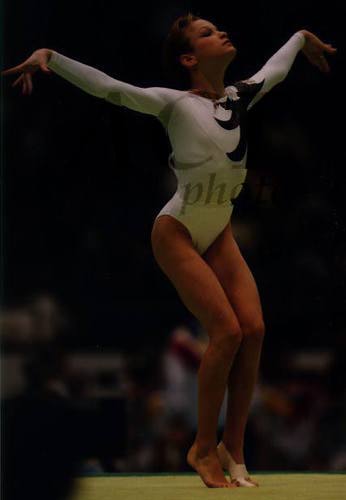 Born April 12, 1979, Grosheva
flashed into international prominence when she won the
all-around bronze at the '94 Goodwill Games, perplexing
audiences then and since with her aggressive yet utterly
lady-like repertoire. To date, the serene blonde has graced
three world championships (she was a two-event finalist in
'95) and one Olympic Games (vaulting finalist).
Born April 12, 1979, Grosheva
flashed into international prominence when she won the
all-around bronze at the '94 Goodwill Games, perplexing
audiences then and since with her aggressive yet utterly
lady-like repertoire. To date, the serene blonde has graced
three world championships (she was a two-event finalist in
'95) and one Olympic Games (vaulting finalist).
Grosheva has always subtly heralded her gritty, provocative style with an emphatic pre-routine salute, and fans and judges continue to salute in return.
IG shared some candid time with Grosheva during the Cup of Buratino in Novgorod, Russia. Even slouched in a hooded "Nirvana" sweatshirt, Grosheva was assertive and genteel as she chatted about gymnastics, beauty and both.
IG: How did you make it to the national training center Krugloye from your hometown of Yaroslavl?
YG: The coaches would invite some of the junior girls to Krugloye, to watch what was going on and also to evaluate them. Then they took some of the best ones. They looked at some of the girls and said, "We want them!" My coach, Alexander Timonkin, came with me.
IG: Was the transition from the junior to senior team as smooth as it appeared? You went right from the Junior Europeans to the '94 Brisbane worlds.
YG: Actually, the transition was very, very hard because you were always worrying whether they would pick you for the senior team or not.
IG: At the Olympics, your team seemed to be much more composed on the awards podium than just a few minutes earlier, when the results were posted. Did coach Leonid Arkayev give you a pep talk, or did you, as a team, rally yourselves?
YG: We were crying, but there was not much we could do. We actually approached Atlanta not really expecting much, or a medal at all. At first, Arkayev was like, 'Wow, a silver or a bronze would be great.' But then when we won compulsories, he was saying, 'OK, you have a chance! You have a chance!' We, too, believed we had a chance, but you know, it just didn't work out. Still, a silver medal is very good. I felt the judges were more honest during the ['92 Olympics in] Barcelona than in Atlanta. The judging was a bit peculiar at times.
IG: A lot of gymnasts consider the Olympics to be the ultimate experience. Would you consider continuing in the sport even after you felt you'd reached your physical peak?
YG: I think if I keep working hard, I can still do better. Also, because of the new age rule, we don't have many girls who are old enough to compete as seniors yet, so we are kind of "forced" to continue (smiles). But I think I would like to continue anyway.
IG: Do people comment on your classy salute - perfect hands, wrists, chin? And, have you 'learned' this salute?
YG: (laughs heartily) No! It just happens that way...
IG: Your performances have always been seriously feminine, even when you were younger. Have you and your coach concentrated on showing the 'young lady' in a gymnast, and not just the trickster?
YG: I myself have worked on this, because my coach is a man and couldn't really tell me how to be graceful (chuckles). So, I did it myself!
IG: As for tricks, you used to throw a layout-full on beam, but we haven't seen it since '94...
YG: It's such a risky trick that we didn't want to perform it in the Olympic team competition, because the risk of falling was too great. But I'm going to throw it in future competitions!
IG: What has been your most difficult time in gymnastics?
YG: The period around the pre-Olympics - this was about six months before the Olympics. My foot really hurt, things weren't going right and I didn't think I'd made the team. I went home and just sat around and didn't train. I was really depressed. At the end of January I went back to Krugloye, and things obviously got better because I ended up on the Olympic team. It was just kind of a bad phase in which I was doubting myself.
IG: What has been your most satisfying time in the sport?
YG: Right after the Olympics. I was really happy to have won a medal, and to realize I'd taken part in something so important - something to be proud of. It was a nice feeling to have people at home congratulating you.
IG: How do you handle circumstances beyond your control, such as unfriendly crowds, judging and injuries?
YG: You just have to forget it! Don't pay attention to the crowd or the judges, and just pay attention to your routines - what you came to do. If you start looking around at the crowd and the judges, nothing is going to work out. As for injuries, you just have to be patient!
IG: If you, as a gymnast, had the authority to change anything about the rules, what would it be?
YG: I would give more points for beauty, elegance and artistry, and not so much for difficulty. Gymnastics is going to turn from being a beautiful sport into a circus, with everyone doing so many tricks. The new Code of Points is horrible, so I would change it to reward beauty.
IG contributor John Crumlish lives in Los Angeles. He thanks Beth Squires for interpreting.