The Effect of Prior Experience, Gender, and Age
on the Identification of Sexual Harassment
Roxanne M., Tanya S., and Jane C.
Introduction
Although numerous definitions of sexual harassment exist, they all tend
to share the same key characteristics: the offender has power over the
victim, the behavior is unwanted (as perceived by the victim), there is
some negative harm or outcome, and the occurring behavior has a sexual
component which can vary (McKinney 1992). Within the parameters of these
criteria, a wide range of behaviors can be viewed as sexual harassment.
These behaviors can be conceptualized as falling on a continuum ranging
from fairly mild to severe (Adams, Kottke, and Padgitt 1983). McKinney
(1990) has classified behaviors on this continuum into eight categories.
These are sexist comments, undue attention, verbal sexual advances, body
language, invitations, physical advances, sexual propositions, and sexual
bribery. Classifications like this are useful because it allows us to determine
where agreement and lack of consensus exist in the labeling of behaviors.
The variable that is most predictive of whether or not someone will label
a behavior as sexual harassment is the gender of the labeler. Numerous
researchers have found that men are less likely to consider a behavior
to be sexual harassment, are more likely to be flattered by sexual overtures,
and are more likely to think that a behavior that they do consider to be
sexual harassment would nonetheless be flattering to a woman (see Riger,
1991). Some of the gender related findings have been explained using attribution
theory. Pryor and Day (1988) have found that when evaluated from the victim’s
perspective, more behaviors are likely to be labeled sexual harassment
than when evaluated from the other perspective. Because women and men are
likely to take different perspectives when evaluating behaviors, they label
those behaviors differently. However, using attribution theory alone does
not help explain all of the research on differences in labeling sexual
harassment. For instance, while this theory can explain between gender
differences, it does not explain within gender differences as well.
One factor that helps to explain the likelihood of men and women taking
the actor’s or victim’s perspective is prior experience with sexual harassment.
It has been established that women are much more likely to be victims of
sexual harassment than men (e.g. Fitzgerald and Hesson-McInnis, 1989; Konrad
and Gutek, 1986). We hypothesize that a person who has been a victim of
sexual harassment is more likely to take the victim’s view, regardless
of gender, than one who has not ever experienced sexual harassment.
A second question must be raised when considering the current findings
on the labeling of sexual harassment. As cited above, women are more likely
to say that a behavior is sexual harassment than men, and we believe victims
would similarly be more likely to label a behavior sexual harassment than
non-victims. Does this increased tendency to label a behavior sexual harassment
imply that the labeling is inaccurate? We do not believe that this is necessarily
the case. However, no study of which we are aware addresses this issue.
We believe that prior experience with sexual harassment will sensitize
a person to the subtleties of a behavior, and enable them to categorize
a behavior more accurately.
Our Hypotheses
Consistent with prior studies, women will be more likely to label a behavior
as sexual harassment, and label it accurately, than men.
Faculty will be more likely to label a behavior as sexual harassment, and
label it accurately, than undergraduates, having been in the work-force
with more opportunities for exposure to sexual harassment.
Victims of sexual harassment will be more likely to label a behavior as
sexual harassment, and label it accurately, than non-victims.
There will be an interaction between the severity of the behavior depicted
in the scenario and the labeling of the behavior by different groups: greatest
variation in labeling will be seen for the least severe behaviors.
Method
Participants
All of the personnel listed as faculty outside of the psychology department
in the Binghamton University telephone book, N = 295, were emailed
a request to complete a short, anonymous survey on sexual harassment on
the Internet. Two days after the original mailing, a longer explanation
of the purpose of the survey were emailed to faculty because of faculty
distress. Several faculty members as well as representatives of the Faculty
Senate had called the Chair of Binghamton University’s Human Subjects Research
Committee expressing concern that the survey was an administrative initiative.
The faculty were reassured that the survey was not connected to administration.
Finally, one week later, faculty were emailed a second notice reminding
them to complete the survey. A total of 42 faculty, or 14 percent of those
receiving email requests, completed the survey. Thirty-eight percent of
the faculty were female and 33 percent of faculty had some prior experience
with sexual harassment. Sixty-three percent of female faculty and 18 percent
of male faculty had experienced sexual harassment.
Undergraduate students (N = 105) were recruited from the Psychology
Department subject pool to complete the survey, also over the Internet.
Forty-nine percent of the students were female and 29 percent of the students
had experienced sexual harassment. Fifty-three percent of female students
and 6 percent of male students had experienced sexual harassment. (See
Figure 1)
Materials
An eight item scale developed by the researchers was used. McKinney’s (1990)
classification of sexual harassment behaviors was used to develop the scenarios.
Fifteen advanced undergraduate students then independently evaluated the
scenarios to determine how closely each scenario reflected McKinney’s definition.
Scenarios were changed until the students agreed upon the classification
of each scenario. The scenarios were also categorized into mild, moderate,
and severe by the raters. Participants read each scenario and assigned
them to one of four categories: no sexual harassment was depicted, or mild,
moderate, or severe sexual harassment was depicted. The reliability of
the scale, estimated by Cronbach’s alpha, was .71.
Results
A 2 x
2 x 2 x 3, Gender x Victim Status x School Status x (Level of Scenario)
analysis of variance was conducted. The results of the ANOVA are presented
in Table 1 below (see Table 1). There was a trend
for males to rate the scenarios less severely than females (F =
3.39, p = .07). Prior personal experience with sexual harassment
interacted with gender (F = 3.90, p = .05) as follows. Among
those who had never experienced sexual harassment, men rated the scenarios
significantly less severely than women (F = 13.22, p = .0004). There was
no difference in the ratings of men and women who had experienced sexual
harassment (F = .006, p = .94). (See
Figure 2)
The mean accuracy of the rating of the
mild, moderate, and severe scenarios was computed. The difference between
the participants labeling of the scenario from the actual label for the
scenario was squared, then averaged, within categories. Thus, if a subject
rated the severe scenario assessing sexual bribery as mild, we subtracted
the actual rating (3) from the participant’s rating (1), and squared the
difference. We then averaged the squared difference scores for each scenario
in the severe category to obtain the subject’s accuracy score for the severe
category. A 2 x 2 x 2 x 3, Gender x Victim Status x School Status x (Level
of Scenario) analysis of variance was conducted on these mean squared error
scores. The results of the ANOVA are presented in Table 2 below (see
Table 2).
Women categorized the scenarios significantly
more accurately than men (F = 3.95, p = .05). A planned comparison
was conducted of men and women at each level of the victim status. Among
those who had never experienced sexual harassment, women categorized the
scenarios significantly more accurately than men (F =10.37, p
= .002). There was no difference in the accuracy of classification of men
and women who had experienced sexual harassment (F = .12, p
= .73). However, the overall interaction between gender and victim status
was not significant (F = 1.93, p = .17).
(See Figure 3)
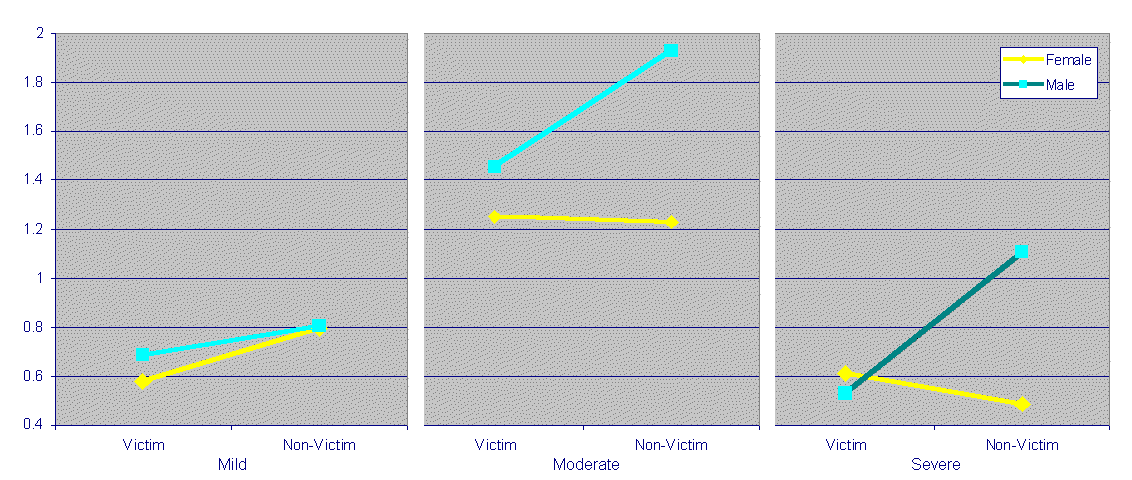
Although the interaction between gender,
victim status, and scenario severity was not significant (F = 1.46,
p = .23), planned comparisons were conducted. There was never a
significant difference in accuracy between men and women who had experienced
sexual harassment (mild scenarios, F = .57, p = .45; moderate
scenarios, F = .35, p = .56; severe scenarios, F =
.04, p = .84). When rating mild scenarios, there was no significant
difference in accuracy between men and women who had never experienced
sexual harassment (F = .02, p = .89). Of those who had never
experienced sexual harassment, men were significantly less accurate than
women when rating the moderate and severe scenarios (F = 10.24,
p = .002 and F = 5.84, p = .02, respectively). (See
Figure 4)
Discussion
This study extends earlier studies by finding that of those who have not
experienced sexual harassment, women categorize moderate and severe scenarios,
but not mild ones, more accurately than men. This suggests that when discussing
prior studies on sexual harassment, differences in results across studies
may be explained by the different levels of sexual harassment used by different
researchers. The results are also consistent with those of earlier studies
and adds support to the attribution hypothesis. Women are more likely to
say a behavior is sexual harassment than are men. Male and female victims
of sexual harassment do not differ in the severity of rating.
One limitation of this study which limits the generalizability of the findings
is the paucity of male sexual harassment victims in the sample. Although
significant differences were found in the expected direction, it would
be prudent to consider them as suggestive and conduct further research
with a larger sample. If this study is representative of the population
from which we drew participants, a sizable effort would need to be put
forth to identify and recruit males who have been victims of sexual harassment
as less than nine percent of the males in our sample reported having been
sexually harassed.
The results of the study have important implications to our current legal
system. Prior experience with sexual harassment typically disqualifies
potential jurors from serving in sexual harassment trials during voir dire.
We have some evidence, however, that male victims were significantly more
accurate than male non victims in identifying moderate and severe sexual
harassment – the type of sexual harassment that may proceed to a jury trial.
Jury panels composed of non-victims may be more likely to determine that
sexual harassment did not occur when it did. In addition, males and female
non-victims serving on jury panels are more likely to have conflicting
conclusions about whether or not sexual harassment did occur in any given
trial.
References
Adams, J.W., Kottke, J.L., & Padgitt, J.S. (1993). Sexual harassment
of university students. Journal of College Student Personnel, 24
(6), 484-490.
Fitzgerald , L.F. & Hesson-McInnis, M. (1989). The dimensions of sexual
harassment: A structural analysis. Journal of Vocational Behavior, 35
(3), 309-326.
Konrad, A.M. & Gutek, B.A. (1986). Impact of work experiences on attitudes
towards sexual harassment. Administrative Science Quarterly, 31
(3), 422-438.
McKinney, K. (1992). Contrapower sexual harassment: The effects of students
and type of behavior on faulty perceptions. Sex Roles, 27 (11-12),
627-664.
McKinney, K. (1990). Sexual harassment of university faculty by colleagues
and students. Sex Roles, 23 (7-8), 421-438.
Pryor, J.B. & Day, J.D. (1988). Interpretations of sexual harassment:
An attributional analysis. Sex Roles, 18 (7-8), 405-417.
Rigor, S. (1991). Gender Dilemmas in sexual harassment policies and
procedures. American Psychologist, 46 (5), 497-505.
Table 1. The Effect of Gender, Victim Status,
School Status, and Level of Scenario on Estimates of the Level of Sexual
Harassment (Return to body of document)
|
df |
MS |
Df |
MS |
|
|
|
Effect |
Effect |
Error |
Error |
F |
p |
| G |
1 |
1.38 |
139 |
.41 |
3.39 |
.07 |
| S |
1 |
.00 |
139 |
.41 |
.01 |
.93 |
| V |
1 |
.13 |
139 |
.41 |
.31 |
.58 |
| H |
2 |
64.05 |
278 |
.16 |
410.31 |
.00* |
| G x S |
1 |
.74 |
139 |
.41 |
1.82 |
.18 |
| G x V |
1 |
1.59 |
139 |
.41 |
3.90 |
.05* |
| S x V |
1 |
.10 |
139 |
.41 |
.24 |
.63 |
| G x H |
2 |
.12 |
278 |
.16 |
.74 |
.48 |
| S x H |
2 |
.20 |
278 |
.16 |
1.25 |
.29 |
| V x H |
2 |
.00 |
278 |
.16 |
.02 |
.98 |
| G x S x V |
1 |
.29 |
139 |
.41 |
.71 |
.40 |
| G x S x H |
2 |
.09 |
278 |
.16 |
.60 |
.55 |
| G x V x H |
2 |
.02 |
278 |
.16 |
.12 |
.89 |
| S x V x H |
2 |
.12 |
278 |
.16 |
.77 |
.46 |
| G x S x V x H |
2 |
.10 |
278 |
.16 |
.62 |
.54 |
Note. G = Gender, S = School Status, V = Victim Status, H = Level
of Scenario)
Table 2. The Effect of Gender, Victim Status,
School Status, and Level of Scenario on the Accuracy of Estimates of the
Level of Sexual Harassment in a Scenario (Return
to body of document)
|
df |
MS |
df |
MS |
|
|
|
Effect |
Effect |
Error |
Error |
F |
p |
| G |
1 |
3.29 |
139 |
.83 |
3.95 |
.05* |
| S |
1 |
1.42 |
139 |
.83 |
1.71 |
.19 |
| V |
1 |
2.04 |
139 |
.83 |
2.45 |
.12 |
| H |
2 |
12.66 |
278 |
.47 |
26.93 |
.00* |
| G x S |
1 |
1.18 |
139 |
.83 |
1.42 |
.24 |
| G x V |
1 |
1.60 |
139 |
.83 |
1.93 |
.17 |
| S x V |
1 |
.31 |
139 |
.83 |
.37 |
.54 |
| G x H |
2 |
.62 |
278 |
.47 |
1.32 |
.27 |
| S x H |
2 |
.10 |
278 |
.47 |
.21 |
.81 |
| V x H |
2 |
.02 |
278 |
.47 |
.04 |
.96 |
| G x S x V |
1 |
1.57 |
139 |
.83 |
1.89 |
.17 |
| G x S x H |
2 |
.12 |
278 |
.47 |
.26 |
.77 |
| G x V x H |
2 |
.69 |
278 |
.47 |
1.46 |
.23 |
| S x V x H |
2 |
.08 |
278 |
.47 |
.17 |
.84 |
| G x S x V x H |
2 |
.02 |
278 |
.47 |
.04 |
.96 |
Note. G = Gender, S = School Status, V = Victim Status, H = Level
of Scenario)
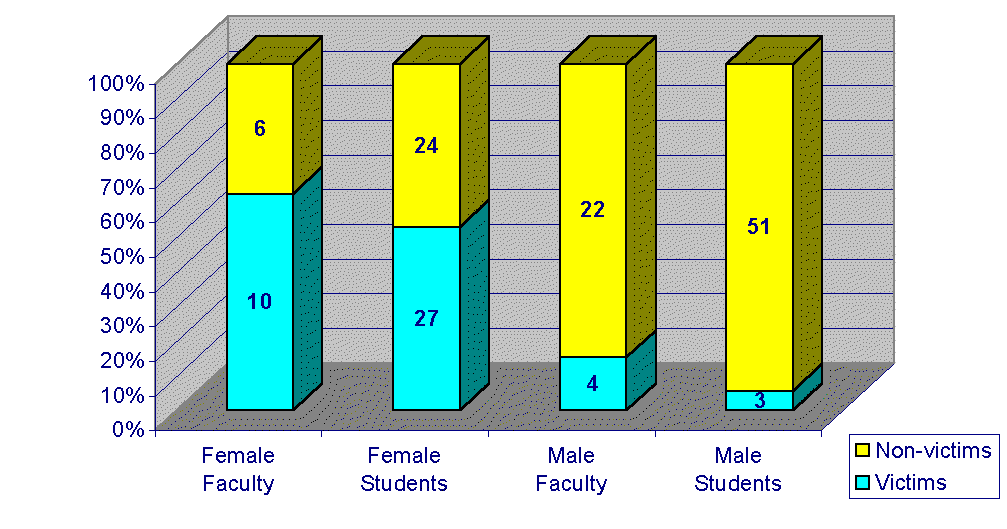
Figure 2. Mean Sexual Harassment
Score by Gender and Victim Status (Return
to body of document)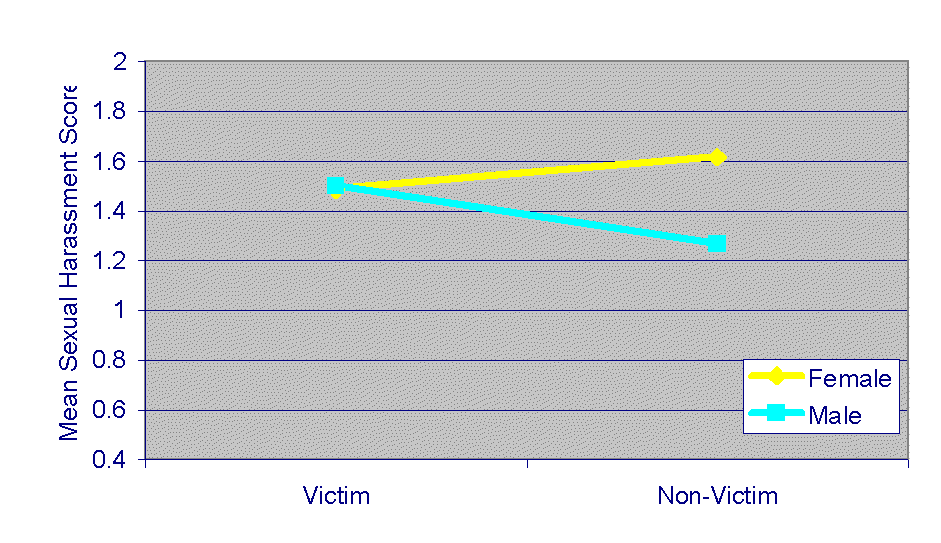
Figure 3. Mean Square Rating Error
by Gender and Victim Status (Return to
body of document)
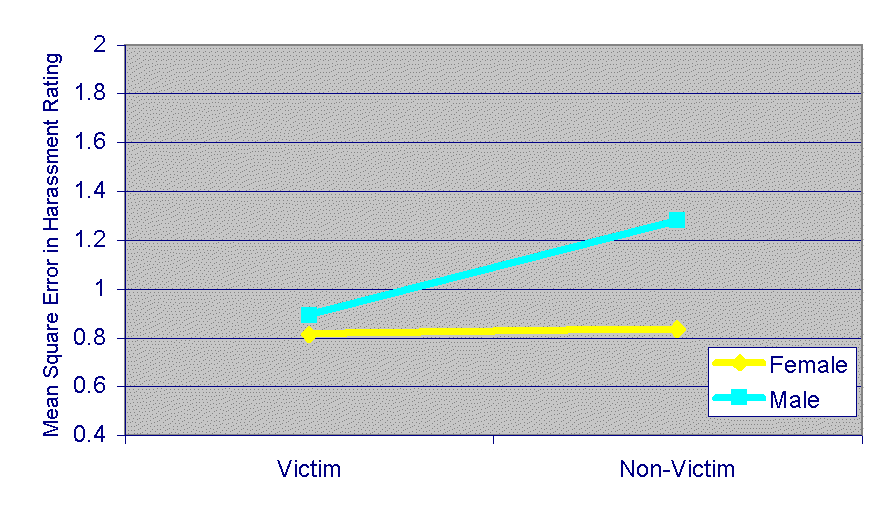
Figure 4. Mean Square Rating Error
by Gender and Victim Status and Scenario Severity (Return
to body of document)
Poster session presented at the 1998 Annual Meeting of the Eastern Psychological
Association, Boston, MA. Please direct any inquiries to Roxanne.
Copyright RM - To cite this document, please contact the author above for
additional citation information. There will be no charge for citation.