
José R. Lovadino, D.D.S.,* Luiz A. Ruhnke, D.D.S., M.S.,** and Simonides Consani, D.S.S., M.S.***
*Assistant Professor, Department of Operative Dentistry. **Professor and Chairman, Department of Dental Materials. ***Professor, Department of Dental Materials.
University of Campinas, Faculty of Dentistry, Piracicaba, São Paulo, Brazil
- Abstract - Mat. Method
- Results - Discussion
- Conclusions - References
To avoid marginal infiltration, Elliot1 in 1905 suggested that the amalgam should be burnished immediately after the cavity is filled. In view of this recommendation, many authors have studied the influence of burnishing on the silver amalgam adaptation. Studies by Markley,2 Phillips,3 and Nadal4 showed that burnishing disturbs surface crystallization, bringing an excess of mercury to the surface, with the possibility of weakening and susceptibility to tarnish and corrosion on that particular surface.
Kanai,5 however, demonstrated that burnishing has a tendency to increase the relative content of residual alloy grains and to decrease the residual mercury. In addition, Kanai5 found that the number of micropores was remarkably decreased by burnishing. Other authors, such as Kato et al.6 and Russo et al.7, found that burnishing improved the marginal seal significantly and decreased marginal infiltration.
This investigation studied the influence of burnishing on the adaptation
of amalgam to the walls of the cavity.
Three alloys were used to make the specimens: New True Dentalloy, a conventional fine cut alloy (S.S. White, Lakewood, N.J.); Novaloy, a conventional high-copper alloy (Sybron/Kerr, Romulus, Mich.); and Sybraloy, a spherical high-copper alloy (Sybron/ Kerr).
Cubical specimens (3 x 3 x 3 mm) were prepared with a metal mold made of two stainless parts connected by mortices and assembled in a metal frame to avoid displacement.
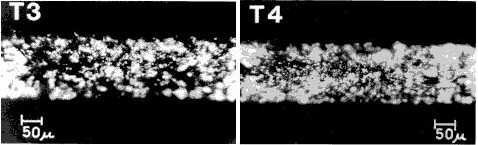
Fig. 1. Superficial aspects of specimen adaptation made with conventional fine cut alloy (New True Dentalloy). T3 unburnished; T4 burnished. (Magnification X500.)
The amalgam condensation was made by two methods:
1. Without burnishing. The amalgamated mass was divided into three equal parts and the mercury excess was removed by hand in a squeeze cloth. Each portion was condensed into the mold according to the technique suggested by Phillips' using a Hollenback type condenser with a 2 mm circular point. The condensation pressure was 1 kg as indicated by a mercury column dynamometer. Later, the excess amalgam was removed with a sharp blade.
2. With burnishing. Under the same work conditions used to make the unburnished condensation, the burnished specimens were obtained with the following modification: During the condensation, the amalgam was burnished against the lateral walls of the mold. This procedure was repeated until the mold was full and the amalgam excess was removed with a sharp blade. After the removal of excess amalgam, a superficial burnishing was made on the marginal surface.
All specimens were removed from the mold 1 hour after the condensation had started. Six burnished specimens and six unburnished specimens of each alloy type were made in the metal die. An optical rugosimeter (Carl Zeiss Jena, German Democratic Republic) was used to analyze the internal walls of the specimens. Black and white photographs of each specimen at a magnification of X500 were made by using No. 640 T, ISO-640 film (3M Co., Ferrania, Italy).
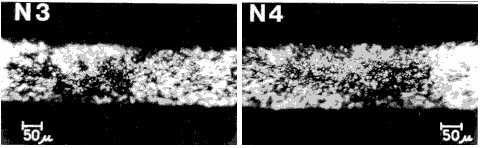
Fig. 2. Superficial aspects of specimen adaptation
made with conventional high-copper alloy (Novaloy). N3 unburnished; N4
burnished. (Magnification X500.)
Fig. 1 shows the superficial adaptation of the specimens made with New True Dentalloy alloy. The T4 image shows the burnished amalgam. The unburnished amalgam is shown in the T3 image. By comparing the two images, it can be seen that the burnished amalgam (T4) has better adaptation than the unburnished amalgam (T3).
Superficial adaptation of specimens made with Novaloy are shown in Fig. 2. The N4 image (burnished) shows better amalgam adaptation than N3 (unburnished). Similar results were obtained with Sybraloy (Fig. 3).
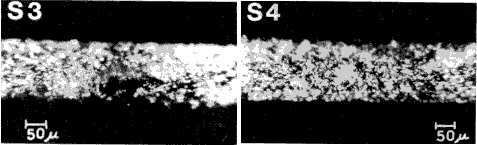
Fig. 3. Superficial aspects of specinicii adiptatioi-L
made with spherical high-copper alloy (Sybraloy). S3 unburnished; S4 burnished.
(Magnification X500.)
Better adaptation of the New True Dentalloy alloy was obtained when the amalgam condensation was associated with burnishing. Fig. I (T4) shows a greater amount of white points, indicating that greater surfaces of amalgam were adjusted against the die walls.
The adaptation level obtained in the burnished specimens confirm the results of Kato et al.,6 Russo et al,7 and Katora et al.8. They verified that burnishing improves amalgam adaptation, eliminates porosities, results in a smoother surface, and decreases marginal infiltration.
The same adaptation correlation verified for New True Dentalloy alloy can be observed in the specimens made with Novaloy and Sybraloy alloys. These results show that burnishing (N4 and S4) produces better mass adaptation against the die wall than unburnished amalgam (N3 and S3).
Spherical high-copper alloy resulted in better adaptation compared with other alloys burnished and unburnished (Fig. 3). Lower adaptation was observed with the conventional fine cut alloy (Fig. 1). The conventional high-copper alloy reached intermediary adaptation levels (Fig. 2). These findings confirm those of Leinfelder et al.,9 who suggested that the effectiveness of burnishing depends on the alloy used.
The results of this study confirm the data obtained by Jorgensen10
and Eames and MacNamara,11 which demonstrated that fine cut
alloy and copper contents improve amalgam adaptation.
This study indicated that burnishing during condensation improves amalgam
adaptation. High-copper alloys provided better adaptation than the conventional
fine cut alloy. Spherical high-copper alloy tested better than conventional
high-copper alloy.
FACULDADE DE ODONTOLOGIA DE PIRACICABA
13414-018-PIRACICABA, SP
BRASIL