Walt Disney
I wrote this paper for my intro to broadcasting class (Journalism 102). Feel free to read it and use it as a source, but please don't plagiarize...meaning...don't steal my work and pass it off as yours!
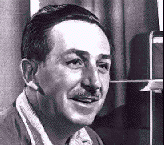
Walt Disney
In 1920 Walt Disney with Ub Iwerks founde his first studio in Kansas City called Laugh-O-Gram Films, and so began Disney's film and television career (Mosley 309.)
Laugh-O-Grams started with advertising shorts, but soon Disney made two seven-minute films, Puss in Boots and Red Riding Hood. These shorts did well enough in Kansas City that Disney had salesmen sell them to moviehouses in Chicago, New York, and Philadelphia. Unfortunately, these salesmen never turned over the receipts for the sales, so Laugh-O-Grams ended up losing money (67-68.)
Almost in bankruptcy, Disney made a short film called Alice's Wonderland(69.) This cartoon featured a live-action figure against an animated background (Maltin 30.) Though Alice was a good film, Laugh-O-Grams filed for bankruptcy in 1923 (Mosley 71.)
That year Disney moved the studio to Hollywood, and employing his brother, Roy, as the business manager, renamed it Disney Productions (73-82.)
More Alice comedies were made with six-year-old Virginia Davis playing Alice (77.) This series continued until 1927 (Maltin 343-344.) In 1925 Margie Gay replaced Davis, and the series just was not the same. The Alice series' appeal began to wane (Mosley 91.)
In 1927 Oswald the Lucky Rabbit was created. Universal Studios and Charles Mintz picked up the series, and it became a success. The next year when the contract for the Oswald series was up for renewal, Roy and Walt Disney met with Mintz. It became obvious that Universal and Mintz wanted the rights to Oswald. Not only that, they wanted the whole animation studio. Angrily, Walt Disney gave up the rights to Oswald. To make matters worse, many animators had signed on with Universal (93-99.)
After giving up the rights to Oswald in March 1928, Disney drew a big-eared mouse whom he called Mortimer. And so Mickey Mouse was born. The change of name from Mortimer to Mickey was thought up by Walt Disney's wife, Lillian, who thought Mortimer was a "sissy name for a mouse" (100-102.)
The first film with Mickey Mouse in it was Plane Crazy (103), a takeoff of the Lindbergh mania going on around the country (Maltin 34.) The short received only a lukewarm response (Mosley 103.) It was good, but no one had heard of Mickey Mouse, and there was nothing different about it (Maltin 34.) Then sound hit (Mosley 103.)
Disney was determined the third Mickey Mouse film Steamboat Willie would be done with sound. He and a musician he found in the studio, Wilfred Jackson, figured out a wasy to synchronize the sound to the film using a harmonica and a metronome. They perfected their system and Steamboat Willie opened on November 18, 1928 (104-116.)
Later in 1928, Disney came up with Silly Symphonies, the first of which was The Skeleton Dance (123.)
In 1932 he put out the first color Silly Symphony, Flowers and Trees (135.) It was the first cartoon short produced in full-color by Technicolor. It was a big success, such a big success that it won an Academy Award (Maltin 39.)
In 1934 Walt Disney decide that his studio would make a full-length animated feature entitled Snow White and the Seven Dwarves (Mosley 154-155.) Disney was the first studio to ever attempt this. Walt Disney wanted this to be his masterpiece, so he invented different techniques of animation (Maltin 53.) He brought in dancer Margie Belcher to walk, dance, and do other movements for animatior Fred Moore to sketch. Animals were brought in the studio to make the woodland animals look as real as possible. Shortcuts, such as using the same cel (the clear plastic sheet that animators use) over again, were forbidden. It became a very innovative process (Mosley 145-160.)
Snow White and the Seven Dwarves was released December 21, 1937 and was the Christmas attraction at Radio City Music Hall. The reception to the movie was very good, and Snow White became one of the most successful films of its time (163-164.)
Soon after Snow White was released, the studio began producing more full-length animated features (Maltin 57.) Pinocchio was the next, then Bambi, Fantasia, Dumbo, etc. (Maltin 335) So much had changed in animation in the ten years since Steamboat Willie because of Walt Disney.
Around 1952 Walt Disney wanted to start buiding a theme park he called, "Disneyland." Roy Disney thought his brother was crazy (Mosley 222-223.)
Since money was running low and Roy was certain Disney shareholders would not approve of the name, "Disney" being used, Walt formed a new company called Walt Disney, Incorporated to handle funds for Disneyland. The name waas later changed to WED Enterprises on the advise of his lawyers. Still, Disney needed to find ways to make money for the theme park (223-229.)
Television was not Disney's first choice as a money venture, but desperate for money for Disneyland, he went to television for help. CBS considered helping, but they wanted to see a pilot of the show Disney was promoting, Zorro. Disney refused. NBC was willig to help, but they also wanted to ass a pilot. In the spring of 1953 Disney got a call from Robert Kintner from ABC (230-233.)
In 1954 ABC had a deal with Disney to air an hour-long weekly series called Disneyland. ABC not only paid Disney for Disneyland, they also gave them money for the theme park (Castleman and Podrazik 94.) The show got rave reviews and was the show that eventually mad ABC one of the major networks (Mosley 233.)
Though some of the Disneyland shows were obvious "plugs" for the theme park and movies, they were interesting family entertainment. One of the episodes about the making of the movie 20,000 Leagues Under the Sea won an Emmy for Best Documentary. 20,000Leagues Under the Sea then became a big hit at the box office (Castleman and Podrazik 95.)
The Davy Crockett episodes came to be the most popular in the country. Coonskin caps became the popular headgear for children and even some adults (95.) A special ladies' version was even made (Mosley 248.)
Later in 1954 Walt Disney had an idea for a kids' show. This show was to become The Mickey Mouse Club. It starred chidren who were known as Mouseketeers who wore hats with mouse ears and sweaters with their names on them (Keller 20-26.)
The Mouseketeers were chosen from normal children. Walt Disney had said, "I don't want those kids that tap-dance or blow trumpets while they're tap-dancing or skip rope or have curly hair like Shirley Temple of nutty mothers. I just want ordinary kids."Most did come from "non-shoowbusiness families," but a few had worked professionally before (Santoli 29-30.) By the end of the auditions, the first 24 Mousekeeters were chosen: Nancy Abbate, Sharon Baird, Billie Jean Beanblossom, Bobby Burgess, Lonnie Burr, Tommy Cole, Dennis Day, Mary Espinosa, Annette Funicello, Darlene Gillespie, Bonnie Lou Kern, Carl "Cubby" O'Brien, Karen Pendleton, Mary Sartori, Bronson Scott, Michael Smith, Mark Sutherland, Don Underhill, Johnny Crawford, Dickie Dodd, Judy Harriet John Lee Johann, Ronnie Steiner, and Doreen Tracey (Keller 32-38.) Many would go on after the show was cancelled to become stars in their own right, including Annette Funicello, who wnt on to star in Babes in Toyland and several beach bunny movies.
The Mickey Mouse Club was on the air from October 3, 1955, to its cancellation on September 24, 1959 (Fischer 83.)
In 1961 Disney television moved from ABC to NBC with Walt Disney's Wonderful World of Color. Disney had produced most of the programs for ABC in color, but ABC showed them in black and white (Mosley 266-267.) NBC was more than happy to take on the show, and from the first show, Mathmagic Land (starring Donald Duck), it was shown in color (Castleman and Podrazik 149.) Disney hosted both Disneyland and Walt Disney's Wonderful World of Color until his death in 1966 (95.)
Walt Disney's Wonderful World of Color aired all the way through the 1970s, but during the 1980s The Wonderful World of Disney (as it was now being called) was only being shown as specials.
In 1989 the Disney studios released The Little Mermaid, and a new era began, for these many years after Steamboat Willie and Snow White and the Seven Dwarves, Disneyland, and The Mickey Mouse Club, Walt Disney's spirit is still alive throughout the world through Disney specials, the Disney Channel on cable, and every happy ending of every one of Disney's animated films.
Works Cited
Castleman, Harry and Walter J. Podrazick. Watching TV: Four Decades of American Television. New York: McGraw-Hill Book Company, 1982.
Fischer, Stuart. Kids' TV: The First 25 Years. New York: Facts on File Publications, 1983.
Keller, Keith. Mickey Mouse Club Scrapbook. New York: Grosset and Dunlap, 1975.
Maltin, Leonard. Of Mice and Magic: A History of American Animated Cartoons. New York: McGraw-Hill Book Company, 1980.
Mosley, Leonard. Disney's World. New York: Stein and Day, 1985.
Santoli, Lorraine. The Official Mickey Mouse Club Book. New York: Hyperion, 1995.
Back to Bffer's Disney Page
Back to Bffer's Homepage
Beth a.k.a. Bffer
Washington, Pennsylvania
[email protected]
Copyright � 1997, Beth a.k.a. Bffer
Revised-May 21, 1997
This page hosted by
 Get your own Free Home Page