The First Known Fistula
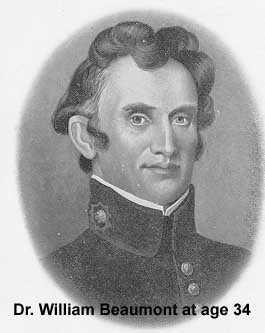
Dr. William Beaumont, having received his license to practice "physics and surgery" on June 9, 1812 by the Third Medical Society from the state of Vermont, stumbled upon a miraculous discovery on June 6, 1822.
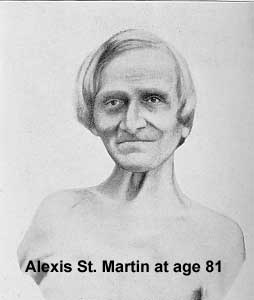
Alexis St. Martin, a French Canadian, sustained a life-threatening musket wound on his left side in Michillimackinac, Michigan. Dr. Beaumont, the town’s physician, was called to tend to his wounds; but upon leaving he gave his final diagnosis, "The man will not live longer than thirty-six hours." To much of his surprise, Alexis’ recovery improved with each passing hour. Alexis regained his lost independence two years later in 1824 when he was able to walk and help himself with little assistance. Although his many injuries healed, one did not, his stomach. This opening, which refused, despite many medical attempts, to heal became the aperture, a porthole, into the internal environment of the human digestive system. Dr. William Beaumont used this phenomena to conduct digestive experiments of the stomach’s gastric fluids without any pain or altercations to his patient. After ten years of being under Dr. Beaumont’s care, Alexis decided to return to Canada where he later married Marie Joly and had four children, Alexis, Charles, Henriette, and Marie. Alexis lead an extraordinary life until June 24, 1880, at the age of 83 he past away.
Return to Main