UPDATE - NOVEMBER 1999 This site is now more than two years old. Although much of the general information is still valid, I am no longer in a position to answer specific questions about work in Turkey as I no longer live there.
Turkey is a land of contrasts. Hovering between rich and poor, it will impress and shock. With a foot in the present and a foot in the past, it will fascinate. As a bridge between European and Asian cultures, it can provide a rewarding experience to any would-be teacher of English as a foreign language.
This is a proud country. Much was sacrificed in creating a secular republic and Turks today steadfastly defend all things Turkish. Remember this as you go. This is not the USA, Ireland or Australia. Attitudes are not the same and things are often done differently. Don�t try to impose your cultural values on Turkey. Adapt yourself. You will enjoy it more and you will earn more respect. Top
English is seen as vital in career advancement in Turkey. Most state banks, private banks and many other companies offer salary increases for successfully passing internal English language examinations. When you add to this a great significance placed on foreign trade and attracting tourism, it is no wonder that almost everyone wants to learn English. You will find your students eager to learn and extremely hospitable to their �guest�. Adult classes will invite you out to dinner where they love to practice their English, asking you about your country and your impressions of theirs.
Be prepared by reading English language difficulties of Turkish students.
The Turkish education system focuses on rote learning with little encouragement of creative or independent thinking. This has its most obvious effect at high school and university level where students expect to be spoon-fed facts and copying is not seen in a negative light. It can also reflect itself on adult learners who may put up resistance to the communicative approach and less structured techniques of teaching. You may find it extends to your Turkish colleagues who may be over-dependent on books and grammar-based syllabuses. Top
Highest paid jobs tend to be at private Turkish high schools or 'Lises'. Work is long and tiring, your reward is that a portion of your salary is in foreign currency. Teachers are generally expected to monitor corridors, take part in PTA meetings and mark many many papers when not teaching. The teaching can be equally stressful or rewarding. Expect to work Monday to Friday, with a half day sometime during the week.
Class contact hours at universities may be as low as 15 hours per week. Working at one of the many state universities may provide job satisfaction but this is counterbalanced by low salaries. Part time work is also available. The Marmara University 'Merkez' on the Asian side of Istanbul is particularly well run.
Private or Foundation Universities have recently started to appear in Turkey, mostly in Istanbul. At the last count, there were 16 private universities in the country. With high fees charged, most of the students come from very privileged backgrounds and all that that implies. Salaries are much higher than in the state sector. As this is a rapid growth area, career opportunities exist now and over the next couple of years. The most respected of the new universities is Koc University. Istanbul Bilgi University is a high profile university with vacancies for experienced teachers. Its new city centre building has just opened. They have more than 1200 students and 60 teachers on their English language program for the 1997/98 acdemic year. Other new entrants include Isik University and Fatih University. Yedi Tepe University has been operating for one year but is already experiencing a high staff turnover. Teachers who have left have complained of broken promises.
University teaching is at normal hours, Monday to Friday. Optional part-time courses at evenings and weekends.
There are many private language centres in Istanbul, Ankara, Izmir and Bursa and some in other cities. The quality of work and rate and method of payment varies considerably. Despite a few 'cowboy operators' who recruit at the airport or in the tourist area of Sultanahmet in Istanbul, most private courses tend to be fairly reasonable as regards pay and conditions. Hours may be long, with up to 28 class contact hours per week, usually in the evenings and at weekends. You will probably get one day off, usually in the middle of the week. Many language schools send their teachers out to companies, which may take up to an hour to get to. This time is often not counted although taxi fares are paid (A good reason to take the bus!). Try ITBA (+90 212 232 8200) or English Direct (+90 212 225 5572) Top
The education section of the Guardian newspaper and the Times Education Supplement often advertise positions in Turkey.
Going on spec is still an option in Turkey. You will probably find work fairly quickly, by walking through the streets. The quality of the jobs offered may leave a lot to be desired so be prepared to change schools two or three times before you find something suitable.
The British Council Teacher's Centre in Istiklal Caddesi, near Taksim in Istanbul used to carry a list of addresses of ELT institutions. They may still do so.
Few institutions recruit at fairs although Koc University, Isik University and some of the better high schools have had a presence at the TESOL conference in 1997. Top
 The Weather
Contrary to some preconceptions, most of Turkey does not bask in glorious Mediterranean sunshine all year round. Winters can be biting cold. Weeks of constant sub-zero temperatures are not uncommon in Ankara while Istanbul may suffer snow fall a half dozen times during the season. Izmir can also get very cold. Istanbul winters are long with little Spring time. In early May it tends to get warm very quickly. May and June are very nice while July and August are hot and humid, temperatures at around 29 to 33 degrees in Istanbul (higher in Ankara and Izmir). Autumn is superb. In a good year, you may be able to sit out and eat out into late October
. Food and Drink
Turks delight in telling visitors that theirs is one of the three best cuisines in the world. It may not share the elegance of French cooking, but it offers a wide variety of delicious and unpretentious dishes, usually at extremely reasonable prices. So wide is the range, that many of the dishes are regional and unheard of in other parts of the country. Still other dishes can only be found at home, never in restaurants. So there you have two good reasons for travelling around the country and getting to know the people.
Native Turkish drinks include Salep and Boza, a slightly fermented millet drink sold only in winter. On cold nights, you will hear the haunting call of the boza seller walking down the street. Truly memorable.
The national drink is Raki, a sister drink to Ouzo and Arak. Strongly aniseed, it is an acquired taste. The main beer is Efes Pilsen, a good drink, retailing at about 50 cents for a half litre bottle. Turkish wine sells for $1 to $4 in supermarkets. Within the price range there is enormous difference in quality, from the very fine Doluca Antik to the 'paint-stripper' Guzel Marmara.
Free Time
Visiting the many historical places around the city, pub crawling, swimming, tennis, people watching in Taksim, planning the holiday on the Med coast, sailing to Buyukada island, cinema watching, cable TV surfing ( cheapest cable in Europe at $1 per week including NBC, CNN, BBC and MTV?), learning Turkish from the boyfriend/girlfriend and, of course, eating out.
Living in Istanbul
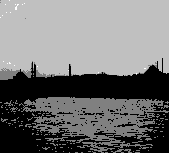
The population is 15 million, give or take a million or two. A thousand new migrants a day come to live in the city. Because of this there are many social and infrastructural problems. There are also some success stories. The water crisis and shortages of the early nineties are a thing of the past with new reservoirs feeding the city. Smog and pollution in the Winter has dramatically decreased in the past two years with the introduction of natural gas from Russia. On the flip side, the increasing population and demands for electricity mean brownouts and blackouts are becoming more frequent.
Money Matters
Compared to Western Europe and the USA, Turkey is a cheap place to live in. Prices in dollars or Dm are not at all expensive. For Turks, it is a different matter. The Turkish Lira (TL) is a very weak currency, undergoing constant devaluation against all the major currencies. Inflation stands at around 80%. As a foreigner teacher, you will find that your TL salary, though attractive at the beginning of your contract, soon loses much of its value in real terms. This is not to say that your salary will be low. Foreign teachers generally earn at least three times the average income. Fixed salaries can range from $700 to $2000 per month after tax. Hourly rates at the equivalent of $10 are common at language centres. Expect between $20 to $40 per hour for private lessons.
Some prices...
More information in Some Statistics about Turks.
Read Turkish news daily in Milliyet Newspaper.
TopBrian O�Flynn, MA TESOL, has taught English and computing in England, Greece, Kuwait and Turkey. During 6 years in Turkey, he taught general, business, technical and academic English. He taught at many institutions in Istanbul and to some leading companies including The Turkish Central Bank, Is Bank, Garanti Bank, Milli Reassurance, Michelin, The Mechanical Engineers Institute, The National Ferry Company, Portsmouth University and The University of Glamorgan. He left Turkey in 1997 after a spell as testing coordinator at Istanbul Bilgi University. He is now on the faculty of Zayed University in the United Arab Emirates.
[email protected]
A member of 

This page last edited on November 22nd 1999
 Get your own Free Home Page