
Collins: Deserters All!
Kent: Up the Republic!
Collins: Deserters all to the Irish nation in her hour of trial. We will stand by her!
Markievicz: Oath breakers and cowards!
Collins: Foreigners! Americans! English!
Markievicz: Lloyd Georgites!"
|
||||||||||||||||
| Michael Collins | ||||||||||||||||
|
||||||||||||||||
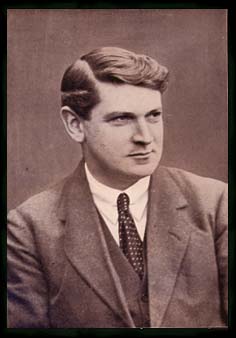
| Michael Collins - circa 1922 | ||||||||||||||||
| In all aspects of history, there are people who decide the fates of those who will come after them. Michael Collins was one such person. The situation in Ireland would not be as it is today were it not for him because Ireland would not exist. The Republic of Ireland is relatively new, having its genesis in the Irish Free State, which was born in 1922 after centuries of struggle against the British invaders. The man who had the power to bring about this new Ireland was Michael Collins. | ||||||||||||||||
| Michael Collins was born on October 16, 1890 to Michael John Collins and Marianne (O'Brian) Collins. Michael's father was 75 when Michael, the youngest of the 8 children, was born. When Michael John was on his deathbed, he drew his family around him, including a 6-year-old Michael, and admonished them to keep an eye on Michael because "One day he'll be a great man. He'll do great things for Ireland." This proved to be a most prophetic statement. At the age of 15, he was sent to London to work in the Postal Office. While in London, he became active in the Irish side of London, joining the Gaelic Athletic Association and becoming the treasurer for the Irish Republican Brotherhood in London. Collins moved up the ladder of authority swiftly, building a comprehensive knowledge of financial dealings that he could call upon at will. Living with his sister Hannie, he became a voracious reader and learned to enjoy the theater. It was in London that Collins' patriotic fervor became noticed. "But (his Guaranty Trust supervisor) also noted that: 'Only on very rare occasions did his sunny smile disappear, and this was usually the result of one of his fellow clerks making some disparaging and, probably unthinking, remark about his beloved Ireland. Then he would look as though he might prove a dangerous enemy.'" | ||||||||||||||||
| When the 26-year-old Michael Collins re-arrived in Ireland, he immediately threw himself into the age-old struggle for Irish Independence, leading up to the Easter Rising in April 1916. Michael was both an aide-de-camp to Joseph Plunkett, a leader of the rebellion; and Staff Sergeant. On Easter Monday, the Irish Volunteers captured the General Post Office (G.P.O.) in Dublin. The battalion marched down the street and into the Post Office, disarming the minimal guard unit and hoisting the Irish Republican flag, the Tricolour. In late afternoon of the same day, the Lancers, a division of the British Royal Army, calmly marched down the street to take back the Post Office where gunfire met them. Soon after the news spread, 4000 British military men were on their way to Dublin. The Rising was on. | ||||||||||||||||
| Unfortunately, the Rising was doomed from the start. The Volunteers were woefully underarmed, the country had not backed them as planned, and there was still a great deal of confusion in the Irish Volunteers as to what exactly was going on. The boat that was carrying their ammunition and supplies had been misplaced. The British Army began shelling the G.P.O. on Tuesday; a gunboat was brought up to destroy the G.P.O and the area surrounding it. On Thursday, James Connolly, another leader, had led a group of men out to find another building to control as a last resistance. After the Volunteers had taken control of a newspaper building, Connolly started back and was hit in the ankle by a ricochet bullet. He dragged himself back to the G.P.O. where a captured medical officer bandaged him up and placed him on morphine. By Friday, the G.P.O was practically gone. The roof had fallen in and there were fires scattered throughout the building. At 2:30 Friday afternoon, Patrick Pearse surrendered to General Lowe. The Rising was over. | ||||||||||||||||
| The captured volunteers, Collins among them, were marched to the gardens of the Rotunda Hospital where it was decided who would be executed and who would be sent into penal service. "The 'G' men initially selected (Collins) for inclusion amongst those severely dealt with, but after some time with selected batch of prisoners, he heard his name being called from the further end of the building. Looking, he could not see who was calling him. After two or three attempts to locate the caller, he grew impatient and decided to risk a walk across the room. And once there, he stayed. It was for him probably the luckiest escape of his career." Michael Collins was sent to Frongoch Interment Camp in Merionethshire, North Wales, after the surrender of the Volunteers. The camp had been separated into two sections, North and South; the best habitations being in the North, for its cleanliness. The only entertainment at the camp were the sports the men made themselves. Collins was fond of all sports, especially wrestling. "He was particularly fond of wrestling, but his opponents can't have been too fond of him. Apart from his custom of claiming a 'bit of ear', biting the ear of a victim after he had overpowered him, he tended to lose his temper during bouts: 'He would go into a bout with a friendly determination. Grimness would begin to rise later, particularly if he were closely matched, and the contest would end in a heated and often bloody fracas." | ||||||||||||||||
| Michael Collins was released from Frongoch Interment Camp in Wales in December of 1916. After his release, he ran for, and won, the position of Secretary to the National Aid and Volunteers Fund for the widows and dependants of the murdered Volunteers. The contacts he made here would prove invaluable later on. At this time, Collins also became Director of Intelligence for the Irish Republican Brotherhood. As the Director of Intelligence, Collins set up a network of information that modern-day guerrilla groups follow. The information he gathered in this time period prepared the country for the bigger war to come. | ||||||||||||||||
| On July 15, the President of the I.R.B., Thomas Ashe, was arrested for sedition. He automatically demanded political status, the right to wear his own clothes, and the right to associate with his fellow prisoners. When his demands were not met, Ashe and six others went on hunger strike. On September 23 Ashe was placed in a straitjacket and forcibly fed. Thomas Ashe died from the effects of the force feeding on September 27. Michael Collins, recognizing an opportunity when he saw it, immediately saw there was a way that Ashe's death would not be in vain. Thomas Ashe's funeral would be used as a demonstration for national feeling. And so it was, Ashe's funeral was one of the largest attended in the History of the war. So many people put flowers on his casket the funeral procession was held up by twenty minutes. At the end of the funeral, a firing party shot a volley into the air, and Michael Collins stepped forth from the crowd. "'Nothing additional remains to be said,' he declared. 'That volley which we have just heard is the only speech which it is popular to make over the grave of a dead Fenian.'" Ashe's funeral is considered responsible for the resurgence of the Irish political party, Sinn Fein, in politics. | ||||||||||||||||
| In the next British Election, Sinn Fein took 73 seats. The old Irish political party, the Irish Party, won only six. The elected officials from Sinn Fein refused to take their seats in Westminster, choosing not to acknowledge foreign rule. These officials formed the Abstentionist Parliament, called the Dail. Ironically, most of the people elected were arrested on one charge or another so that thirty-six members were unable to attend the fist meeting. At the first meeting of the Dail, the Irish Declaration of Independence was voted on and passed. On April 1, 1918, the Dail met again and elected Eamon de Valera as President. Arthur Griffith, founder of Sinn Fein, put forth the idea of a cabinet and it was passed. At the end of the meeting, the members of the first Irish Cabinet were Griffith in charge of Home Affairs, Cathel Brugha for Defense, Michael Collins was in charge of Finance, W.T. Cosgrove for Local Government, Robert Barton for Agriculture, Eoin MacNiell for Industry, Countess Constance Markievicz for Labour, Count Plunkett for Foreign Affairs, and finally, Richard Mulcahy as Minister for Defense. | ||||||||||||||||
| For Michael Collins, now 28, life was to become very interesting. In addition to being appointed as Minister of Finance, Collins was also appointed as Director of Intelligence in the Ministry of Defense. Collins had been trying to reorganize the I.R.B. since Ashe's death, and now he could put his plan into action. Collins used his connections made when he was Secretary of the National Aid. Collins was determined to "put out the eyes of the British". He knew to do this, he would have to have access to the names of informants and traitors to the Irish Cause. What better way than to have spies of his own? Collins kept his intelligence sources apart from each other. There is one famous tale of how two of Collins' Irish spies followed two of Collins' police informants. Each group suspected the other of being British spies. This secrecy was necessary for Collins' purpose however. Thus, if one group was captured and tortured, they could not supply information on other groups. | ||||||||||||||||
| For his purposes, Collins enlisted Eamonn Broy, one of the notorious "G" men, the intelligence officers for the British Army. Broy managed to slip Collins into the heart of the lion's den, the headquarters of British Intelligence in Ireland, Dublin Castle. Collins spent his time in their going through the British Intelligence Files on the Freedom Fighters, including the one on himself, which mysteriously disappeared that night. Having read the files, Collins knew the most dangerous British spies in Ireland, and had them killed. The first killing took place in July of 1919; another followed this in September, and a third in December. Britain was understandably annoyed at having their three most important, and intelligent, spies removed in such a manner. Britain sent in Detective Redmond as a plant to infiltrate Collins' operation. And it almost worked, had Redmond not bragged over the fact that he was meeting with Collins, history may have turned out differently. However, once it was discovered that Redmond was a spy, it was only a matter of time before Redmond, too, was eliminated. Collins had the British Intelligence world paralyzed. If they looked for information on the republican fighters, they would be shot. It put a damper on efficient work to say the least. Collins was able to do this through a highly trained squad of men. There were twelve of them and so the became known as The Twelve Apostles. The Apostles were Mick McDonnell, Sean Doyle, Joe Leonard, Paddy Daly, Jim Slattery, Bill Stapleton, Pat McCrae, James Conroy, Ben Barett, Tom Keogh, Mick O'Reilly, and Vincent Byrne. The Squad was fronted through a painter and decorator shop. When prospective customers came in, the would take the order and then inform the customer that, due to the heavy workload they had, it would take six months to fill this order. Needless to say, most customers went elsewhere. | ||||||||||||||||
| In March 1920, a new group entered the Irish war. British papers advertised for recruits for the Royal Irish Constabulary. Due to their uniforms of khaki trousers and dark green tunics and hats, the men became known as The Black and Tans. Not long after, Britain threw together another team of law enforcement officials called the Auxiliaries. The Auxiliaries were compromised of ex-officers of the 1914-18 war. The 'Tans' and 'Auxies', as they were called, took to their new jobs in a flash and proceeded to fulfill Britain's "Terror Campaign". This Campaign involved the murder of innocent people and the sacking of Irish towns under the guise of enforcing the law. In one day, the Tans caused over �50,000 of damage in one town. By November 1920, more than ten cities had been destroyed. | ||||||||||||||||
| Due to the success the Tans and the Auxies were having, Britain again began to build its information network. The infamous Cairo Gang was born. The members of this gang were unlike the previous officers. They did not work in the daylight, but traveled with the Tans or the Auxies to the houses being raided and gathered their information in that fashion. Soon, enough evidence was gathered to place Collins' entire operation in danger. Collins had to take action. The Cairo Gang had acted to draw Collins out by shooting the Lord Mayor of Dublin and the former Lord Mayor of Limerick. The killings of prominent men, loyal to the Irish cause, were being carried out swiftly. In the meantime, the Cairo Gang was swiftly building a dossier on the man they really wanted, Michael Collins. Collins, however, was doing the same thing to them. Collins' boys were working overtime to dredge up information on these men. Maids who worked in the boarding houses where these men stayed were employed to discuss the personal habits of the Cairo Gang. Soon Vaughn's Hotel, one of Collins' meeting places, was raided and one of Collins' men, Liam Tobin, narrowly escaped, but not before recognizing two of the men on their List of the Gang members. By now, Collins was fed up and decided to act. | ||||||||||||||||
| November 21 was the set date for the operation, which would become known as "Bloody Sunday". Collins and his men met the night before to finalize the plans for the next day. At exactly 9:00 in the morning, November 21, 1920, the shooting of British Intelligence officers began all over Dublin. "He heard a horror-stricken officer, coming back from the telephone, say 'About fifty officers have been shot. Collins has done in most of the secret service people.'�Actually Collins' men had been out to get twenty that morning, but not all of them were at home." Collins had once again terrified the British Intelligence squad into paralysis. The operation was not a total success however. Three of Collins' comrades-in-arms had been captured the night before the operation and held in the Castle. After the end of the operation, the men were tortured for information, and then, when they gave none, were shot to death. Collins was crushed by the deaths of his friends. However, the torture of the republican fighters was considered normal, as normal as the other atrocities the British forces forced on the Irish people. | ||||||||||||||||
| "Bloody Sunday was the day when British Rule broke in Ireland." After the Bloody Sunday incident, Britain became eager to sign a truce with Ireland. Irish Dail President Eamon de Valera worked with British Prime Minister David Lloyd George to work out a treaty. When it came time to negotiate, a delegation of Arthur Griffith, Eamonn Duggan, George Gavan Duffy, Robert Barton, and Michael Collins, was sent to Britain. De Valera wanted Collins to go in his stead, ostensibly so de Valera could control the Cabinet. In truth, de Valera knew that a complete separation with Britain was highly unlikely, and he did not want to be there for the fall out. In the end, not even Collins could get Britain to release the North of Ireland. When the Treaty cut six counties of the north from twenty-six counties of the south, there was a great outcry, which Collins tried to stem. "Collins had summed up by declaring that the Treaty 'would bring freedom; not the ultimate freedom that all Nations desire and develop to, but freedom to achieve freedom.'" Once the Delegation signed the treaty, de Valera, opposed to the idea of losing the north, demanded a vote for presidency in the Dail over the treaty. A large battle erupted in the Dail between the Pro-Treaty and the Anti-Treaty people. When the dust settled, de Valera walked out and Arthur Griffith had been installed as new President. "Then, as the vote was being taken de Valera rises and announces that, as a protest against the election as President of the Republic of a man pledged to subvert the Republic, he will leave the room. Collins seems to have been taken completely by surprise, and all the bitterness that has accumulated in him during the days of pricking and thwarting bursts out in one wild cry against this last damning proof that the unity of the people is broken. It is a cry of mortal despair. Collins: Deserters All! Kent: Up the Republic! Collins: Deserters all to the Irish nation in her hour of trial. We will stand by her! Markievicz: Oath breakers and cowards! Collins: Foreigners! Americans! English! Markievicz: Lloyd Georgites!" |
||||||||||||||||
| Ireland was on the brink of civil war, and there was no way to slow or stop its inevitability. The new republicans took over the Four Courts buildings where, six years earlier, they had fought once before. Collins found himself facing his friends, now having to view them as enemies. He felt betrayed, by his friends, by the country he loved, and, worst of all, by the man he viewed as his leader, Eamon de Valera. "'Was it worth it?' he asked wildly of a Republican acquaintance. 'Was it worth it?' 'The Treaty wasn't worth it.' Collins' head sank into his hands. 'No, and the Republic wasn't worth it,' he said bitterly." The war was harsh on Collins. The first casualty was Cathel Brugha, shot to death outside Hammam Hotel. Eamon de Valera began to hide then, following Collins' old strategy of "life on a bicycle", never spending the night in one place. Then, on July 20, Collins became commander-in-chief of the Irish Army. It had now become his responsibility to murder his friends. In August, Arthur Griffith, current President of the Dail, died from a burst blood vessel in the brain. Less than two weeks after attending the funeral of his friend and leader, Collins himself would be buried. | ||||||||||||||||
| On August 22, Collins began a trip to his native Cork. His reasons were thought to be to talk to an intermediary to end the war. Only a few miles from his house, in the Beal na mBlath, Collins and his convoy were ambushed. Collins, forever believing himself invincible, made the choice to stand and fight, a choice that would be fatal. Collins jumped out of the car and began to fire at his attackers, and then it happened. A bullet took Michael Collins in the head. He was dead before help could be reached. Michael Collins was thirty-two years old. | ||||||||||||||||
| The aftermath of Collins' death was ironic. Eamon de Valera became president, and the six counties of the north remained separate. Collins had fought and died for a country that had claimed all her heroes at an early age and Collins was no exception. It is tragic that so brave a man could have been vilified in his lifetime, and afterwards. Today there are still Irishmen who are unhappy with what Michael Collins did, but perhaps they view his accomplishment in the wrong fashion. They claim Collins lost the north. It would be better for them to realize that he gained the south. That is an accomplishment no other man could have done. | ||||||||||||||||
| Michael Collins lived and died for his country. The British Authorities wanted to kill him so badly he never stayed two nights in the same place. It is understandable why the Anti-Treaty fighters felt the price of the six northern counties was too high a price to pay for peace. But not a single one of the leaders of that group spent his or her nights wondering if they were going to be killed, for it was Collins the British authorities wanted. It was Collins who managed to worm his way into their headquarters and turn their own spies against them. Michael Collins felt that any peace was better than no peace, that the price was not too high. He knew that with the proper wording, the north could be rejoined with the south, and he intended to make it happen, for he had that power. However, all chances at a peaceful reconciliation were lost August 22, 1922 with one bullet. The bullet that took Michael Collins' life condemned Ireland to many more years of war, a war that goes on today. |
||||||||||||||||
|
||||||||||||||||
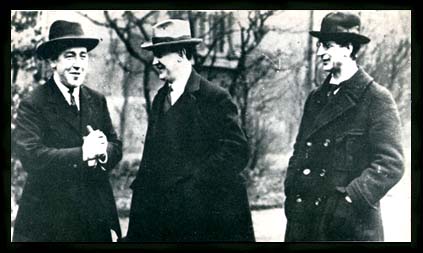
| Harry Boland, Michael Collins, and Eamon De Valera in better times | ||||||||||||||||
|
||||||||||||||||
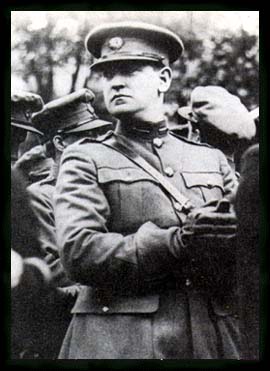
| Micahel Collins at Arthur Griffith's Funeral | ||||||||||||||||
|
||||||||||||||||
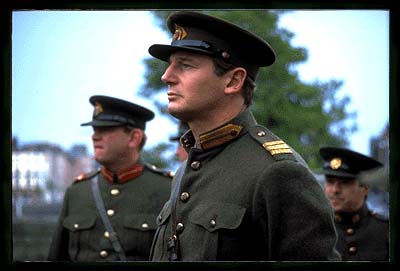
| Liam Neeson as Michael Collins in the film "Michael Collins" | ||||||||||||||||
| Bibliography-- | ||||||||||||||||
| Coogan, Tim Pat, Michael Collins The Man Who Made Ireland; Boulder, CO: Roberts Rinehart Publishers, 1996 | ||||||||||||||||
| O'Connor, Ulick, Michael Collins And The Troubles; London, England: W. W. Norton and Co., 1996 | ||||||||||||||||
| Collins, Michael, The Path To Freedom; Boulder, CO: Roberts Rinehart Publishers, 1996 | ||||||||||||||||
| O'Connor, Frank, The Big Fellow Michael Collins and the Irish Revolution; New York, NY: Picador USA, 1998 |
||||||||||||||||