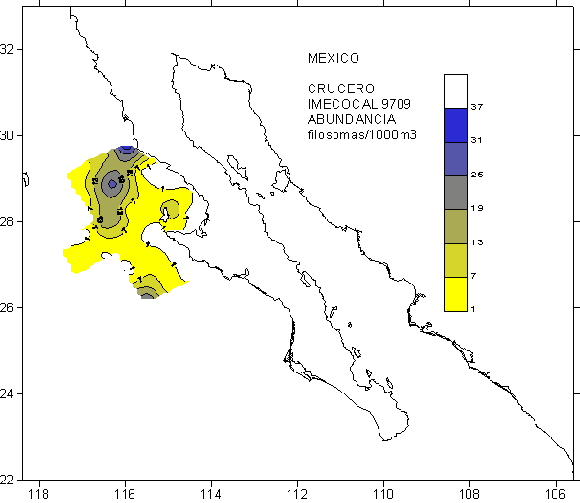
LARVAS DE LANGOSTA EN LA COSTA OCCIDENTAL DE BAJA CALIFORNIA DURANTE EL NIÑO 1997-1998.
ROGELIO GONZÁLEZ ARMAS ([email protected])
Se presentan los resultados en la distribución de larvas de langosta Panilirus interruptus en la costa occidental de la península de Baja California colectadas en dos cruceros oceanográficos, durante el evento "El Niño" 1997-1998. Las muestras proceden del proyecto "Investigaciones Mexicanas de la Corriente de California" (IMECOCAL) en donde participan: CICESE, CICIMAR, UNAM, UABC, COLEF, SEMAR, UABCS, CIBNOR y SEPESCA. Los cruceros oceanográficos se realizaron a bordo del B/O "Fco. de ULLOA", durante septiembre-octubre de 1997 y enero-febrero de 1998, colectándose 39 y 69 muestras de plancton respectivamente. Los arrastres oblicuos de plancton se realizaron con una red tipo bongo. El área de estudio comprendió de Ensenada, B.C. a Laguna de San Ignacio, B.C.S. Los resultados obtenidos muestran que el crucero IMECOCAL 9709 presentó la mayor abundancia de filosomas, con 261/1000m3 (total), mientras que el IMECOCAL 9801 tuvo una abundancia de 77/1000m3. Las mayores abundancias se presentaron en el crucero IMECOCAL 9709 entre los transectos110 y 113 (frente a Punta Baja) coincidiendo con el borde del giro anticiclónico que se forma en bahía Sebastián Vizcaino y que ha sido reportado previamente. La presencia de estadios avanzados (X y XI), así como organismos con el abdomen bien desarrollado indican la evidente transformación de larvas filosomas a puerulos. Dada la importancia de este recurso pesquero en la región y el marcado interés de las Sociedades Cooperativas por repoblar sus áreas concesionadas, estos resultados muestran las áreas susceptibles de asentamiento de puerulos, por lo que se contribuye en la planeación en la colocación de los colectores para captar larvas de langosta.
DISTRIBUCIÓN Y ABUNDANCIA DE LAS LARVAS DE Syacium ovale (Günter, 1864), EN EL GOLFO DE CALIFORNIA, 1984-1986
GERARDO ACEVES MEDINA (
[email protected])Las larvas analizadas en la presente investigación fueron recolectadas durante siete cruceros oceanográficos entre 1984 y 1986, por el personal científico del Departamento de Plancton y Ecología Marina, a través de arrastres oblicuos de una red tipo Bongo, siguiendo la metodología de Kramer et al. (1972). A partir de la distribución de las larvas del lenguado Syacium ovale en el Golfo de California, y en particular la presencia de larvas en estadio de preflexión, se determinó, que la temporada reproductiva de la especie en estudio comienza al inicio del verano y termina a principios del otoño, y la mayor actividad se realiza a mitad del verano. Las regiones centro y sur del Golfo, son las áreas de mayor actividad de desoves, ya que en ellas están concentradas el mayor número de larvas. Estas regiones están influenciadas por las corrientes cálidas que invaden el Golfo, estableciéndose condiciones térmicas que favorecen la reproducción de este lenguado (29-30
° C), en combinación con valores bajos de biomasa plánctica (50-250 ml/1000m3), característico de la corrientes ecuatoriales que invade el área de estudio en el verano.ICHTHYOPLANKTON COMPOSITION OF MAGDALENA BAY, SOUTHERN BAJA CALIFORNIA, MEXICO
RENÉ FUNES RODRIGUEZ ([email protected])
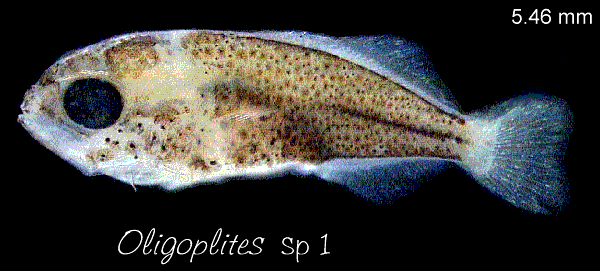
The Magdalena-Almejas Bay coastal lagoon system is the largest in extension on the coast of the Mexican Pacific. It maintains communication with the ocean through three main entrances that allow the exchange of water and marine fauna. Geographically, Magdalena Bay is located into a transition zone bordered by three major hydrological zones named North Equatorial, Pacific central and California Current principally. The transition nature of Magdalena Bay is reflected in its fauna, which facilitate the mixture of diverse fish populations characterized by tropical, subtropical and temperate faunas. Those faunas are represented by 344 taxa belonging to 82 families of Actinopterygii fishes distributed inlet and adjacent neritic waters. In fact, the lagoon system has an important ecological-fishery role, that is represented by a faunal complexity, and abundant resources like: mollusks, crustaceans; underline the importance of small pelagic fisheries by his highest catch volumes. It is well known that estuaries and coastal lagoons fulfill a roll in fish reproduction patterns as suitable areas for spawning adults, and food availability to juveniles development. All of these translate in a great fish diversity depending of reproductive strategies and fish migrations patterns. This was proved by the presence of fish larvae belonging to adults pertaining to different habitats. The preliminary results showed that larvae stages of 67 taxa and additionally 36 types undescribed including in 43 fish families, were collected within Magdalena Bay (spring to summer 1997). The larvae commonly collected included Clupeidae, Engraulidae, Serranidae, Carangidae, Gerreidae, Haemulidae, Sciaenidae, Kyphosidae, Stichaeidae?, Labrisomidae, Bleniidae, Gobiidae, Achiridae and Tetraodontidae families. In this work we described the principal diagnostic characteristics that could be used to identified some of those undescribed specimens.Therefore is possible to discern two fish larvae assemblages, showing an environment separation explained by the spawning habitat preferences of the different species. One of them, with oceanic influence associated to deeper areas, was dominated by larvae belonging to adults with coastal pelagic habitat (i.e. chub mackerel, Northern anchovy and the sardines Pacific sardine, and thread herring). And the other one, lagoon like, composed by resident species, mainly related to both shallow water bottom habitats (i.e. gobies, silverside, blenny and flatfishes), including also the sardines larvae that were found in abundance in this assemblage, showing that one important part of these populations came with reproductive purposes, occupying large extensions due its large school biomass.
ABUNDANCIA Y DISTRIBUCIÓN DE TALLAS DEL QUETOGNATO Sagitta euneritica (ALVARIÑO, 1961) EN BAHÍA MAGDALENA BAJA CALIFORNIA SUR MÉXICO
SOLEDAD COTA MEZA ([email protected])
Con el objeto de determinar la abundancia y distribución de tallas del quetognato S. euneritica, se realizaron colectas de zooplancton en el complejo lagunar bahía Magdalena B.C.S., durante los meses de marzo, junio, julio, agosto, septiembre y noviembre de 1982. S. euneritica presentó una amplia distribución en el área de estudio, representando un 90 % de las especies de quetognatos. La estructura de talla de S. euneritica es indicativa de una reproducción continua a lo largo del año, dado que se presentan organismos pequeños con 1 mm de longitud patrón desde marzo a agosto y de 2.5 a 1.5 en septiembre y noviembre. Sin embargo, su población presenta importantes fluctuaciones estacionales alcanzando su máximo poblacional durante el verano, época en la que se registran temperaturas promedio entre 24 y 25 °C.
ESPECIES CLAVE EN LA ESTRUCTURA DE LA COMUNIDAD DE COPEPODOS PELAGICOS EN LA COSTA OCCIDENTAL DE B.C.S. MÉXICO
SERGIO HERNÁNDEZ TRUJILLO ([email protected])
A partir de 511 muestras de zooplancton obtenidas en once cruceros oceanográficos efectuados por el CICIMAR entre 1984 y 1989, en la región noroeste del Pacífico mexicano (31°N 118°W, 22°N 108°W), se obtuvo la estructura de la comunidad de copépodos pelágicos. El análisis mostró que de los 144 taxa identificados, Acartia danae (templado-tropical), Calanus pacificus (transicional), Euchaeta marina (tropical) y Pleuromamma abdominalis (tropical) fueron las especies de mayor importancia, de acuerdo a su frecuencia de aparición, la abundancia y su máxima contribución a la varianza total de la comunidad. La dominancia de C. pacificus sobre las otras especies clave se observó en prácticamente todos los meses de estudio; la diferencia de la abundancia de la especie con las otras tres tendió a reducirse de norte a sur. A. danae, E. marina y P. abdominalis tuvieron cambios en abundancia que las ubicaron en distinta jerarquía mes a mes y por latitud. El predominio de C. pacificus sobre todas las especies de copépodos en el periodo y área de estudio, sugieren una distribución de recursos y ocupación de nicho sesgados hacia la especie. En términos generales, el ciclo estacional de abundancia de las cuatro especies estuvo relacionado a las condiciones de cada época del año, ya que las especies tropicales aumentaron su abundancia en verano y otoño, en tanto que la transicional lo hizo en invierno y primavera.
ECOLOGICAL INTERACTIONS AND OPTIMUM HARVESTING STRATEGIES IN A TWO-SPECIES MACKEREL FISHERY.
ERNESTO A. CHÁVEZ ([email protected])
A two-species, age-structured simulation model based on difference equations that take into account changes in size of each cohort over time was developed. Trophic niche overlapping implies changes in the stock size of the spanish mackerel may have a greater impact on the king mackerel than those occurring in reverse. The consequences of different management options and optimum harvesting strategies were defined for the assessment of the effects of selective fishing intensity on each species without interaction, and with predatory and competitive pressure of the king on the spanish mackerel. In addition, economic (Benefit/Cost) and social consequences over the long term of each scenario were evaluated. Evidence shows both stocks are overexploited, with a fishing mortality of F 0.5. Predation and competitive pressure by the king mackerel over the spanish mackerel (the prey) do not show evidence of any significant effect, but the prey seems to be more resilient under a heavily depleted condition of both stocks. The fishery operates above its economic equilibrium level, B/C= 2.2, and optimum yield level of both stocks can be attained at F= 0.32, when catch may approach 11,000 tonnes·year-1. The economic equilibrium limit (the level when B/C= 1) is reached at F= 0.76, which must not be attained. No further increments in fishing effort are advised, unless larger net mesh openings are adopted as a regulatory enforcement. Graphic display of the model allows its use as a management tool.
TROPHIC LEVEL EVALUATION OF THREE BALEEN WHALES (Balaenoptera musculus, B. physalus, and B. edeni) FROM THE GULF OF CALIFORNIA USING STABLE CARBON AND NITROGEN ISOTOPE RATIOS.
SERGIO AGUIÑIGA GARCIA ([email protected])
Stable nitrogen isotope analysis was used to determine the trophic relationships of three baleen whale species that coexist in the southern Gulf of California during winter-spring seasons. Measurement were made from whale feces, possible prey such as euphausiids and sardines, and skin biospy of blue (Balaenoptera musculus), fin (B. physalus) and Bryde´s (B. edeni) whales collected in the Bahía de La Paz during winter of 1995 and 1996. The range of
d 15N values obtained for the whales are consistent with their known feeding habits, with values increasing in the order B. musculus, B. physalus, and B. edeni. The low value for B. musculus (12.9 ± 0.3) confirms its known stenophagous habits, feeding almost exclusively on euphausiids. The closeness of d 15N values for B. physalus (15.4 ± 1.1) and B. edeni (15.8 ± 0.6) coincide with the known ictyophagous habits of B. edeni and the more generalist B. physalus feeding on both fish and plankton. The high d 15N level found for B. physalus indicates clupeiid fish are a more important food prey in the Gulf of California than previously thought. The trophic enrichment calculated in this study d 15N= 2.06‰ is situated at the lower end of published ranges. Both obtained and estimated d 15N values suggest B. physalus and B. edeni share the same trophic level, B. musculus and S. sagax share a lower level, and Nematocelis difficilis is at the lowest level.
Regreso al indice