AM 05/II.01s
MATRICULATION AND SECONDARY EDUCATION CERTIFICATE EXAMINATIONS BOARD
UNIVERSITY OF MALTA, MSIDA
MATRICULATION CERTIFICATE EXAMINATION
ADVANCED LEVEL
SEPTEMBER (SUPPLEMENTARY) SESSION 2001
|
Subject Title |
BIOLOGY |
|
Paper No./Title |
Paper 2 |
|
Date |
4th September 2001 |
|
Time |
8.30 p.m. to 11.30 p.m. |
Directions to Candidates
SECTION A
(Answer all questions in this section):Disease-Fighting Foods May Be Derived From Metal-Loving Plants
Too much metal in the soil and you have a contaminated brownfield. Too little metal in the diet and you see disease and malnutrition.
The solution to both problems may be metal-loving plants that take up large amounts of metal in their tissues, says David E. Salt, professor of plant molecular physiology at Purdue University.
There has been much scientific interest in recent years in using metal hyperaccumulating plants to clean up hazardous materials sites, a process called phytoremediation. But Salt says metal-accumulating plants have a broader potential as a way to improve people's diets or even to create foods that fight cancer.
"It's just two sides of the same coin," he says. "One of the things about metals that many people don't realize is that a lot of them are essential micronutrients that we need. They play a crucial role in certain enzymes that our bodies use to function."
Salt recently announced that he has identified and cloned the genes from a species of these plants that store metals in their tissue.
According to the World Health Organization, the lack of proper micronutrients in the diet causes health problems in many underdeveloped nations, particularly in children and pregnant women.
The metal selenium is known to be a potent anti-carcinogen, and there are wild plants that accumulate selenium naturally. If these genes could be moved into crop plants, Salt says, new foods could be created that have anti-cancer properties.
In the Western United States there is a plant known as locoweed (Astragalus bisulcatus), which accumulates selenium. The plant gets its descriptive name because livestock that eat it can become disoriented and stumble about after ingesting too much selenium. But locoweed hyperaccumulates selenium, and Salt says that it may be possible to create functional foods that have cancer-fighting properties from this plant. Although selenium supplements are available already, Salt says most of these are of little use because the human body can only absorb and use selenium if it is in certain chemical forms.
"If you go into the health food store right now, you'll see that there are many different selenium supplements. Most of those are actually sodium selenide, or sodium selenate, which is a chemical form that our bodies can't use very well. It has been shown to not be very effective," he says. "The other common supplements are yeast which has been fed selenium, and that has been shown to contain about 40 percent elemental selenium, which is completely unavailable to the human body."
Salt says the first products to market would be dried plant material that is enriched in bioavailable forms of selenium. "In the long term we'd probably like to try to engineer a vegetable crop so that we would take the selenium that's in the crops right now and move it into a more anticarcinogenic form in the foods we already eat," he says.
Adapted from: Purdue University News Release. 13th August 2001
|
[two marks] |
|
[three marks] |
|
[five marks] |
|
[two marks] |
|
[one mark] |
|
[four marks] |
|
[three marks] [Total: twenty marks] |
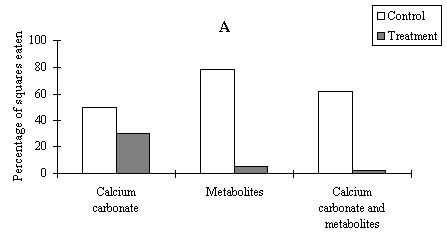
The effects exerted by these additives on feeding patterns of an amphipod Cymadusa filosa, a mixed-species group of parrotfish and the sea urchin Diadema antillarum are recorded in Figure 1 and Figure 2.
Figure 1 shows the results obtained when secondary metabolites from the alga Rhipocephalus phoenix were added to the mixture while Figure 2 records the results noted when secondary metabolites from the alga Udotea cyathiformis were used. In the control treatments no calcium carbonate or metabolites were added to the algal mixture.
(Data adapted from Hay, M.E.; Kappel, Q.E. & Fenical, W. 1994. Synergisms in plant defenses against herbivores: interactions of chemistry, calcification and plant quality. Ecology, 75 (6): 1714-1726.)
Figure 1 and Figure 2 are on the following pages
|
[two marks] |
|
[two marks] |
|
[three marks] |
|
[three marks] |
|
[three marks] |
|
[three marks] |
|
[four marks] [Total: twenty marks] |
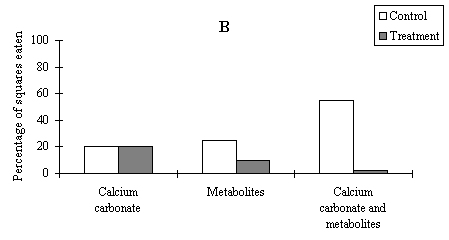
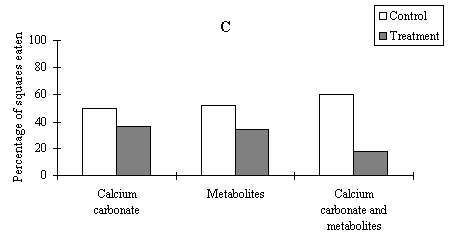
Figure 1: The effects of adding calcium carbonate and secondary metabolites derived from the alga Rhipocephalus phoenix on feeding by [a] the amphipod Cymadusa filosa; [b] a mixed-species group of parrotfish and [c] the sea urchin Diadema antillarum.
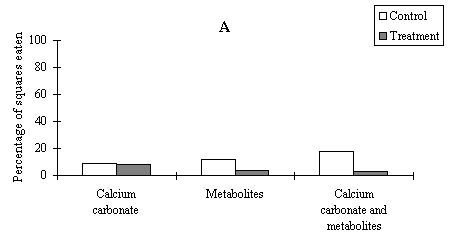
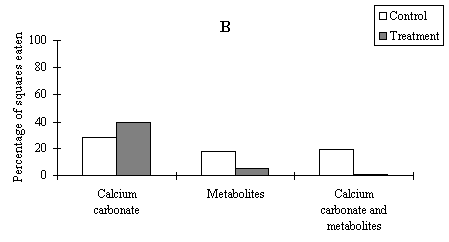
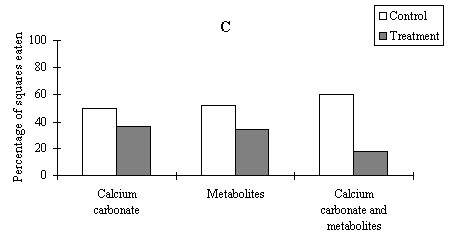
Figure 2: The effects of adding calcium carbonate and secondary metabolites of the alga Udotea cyathiformis on feeding by [a] the amphipod Cymadusa filosa; [b] a mixed-species group of parrotfish and [c] the sea urchin Diadema antillarum.
SECTION B
(Answer any two questions from this section; your answers should take the form of essays. Each question carries twenty marks).
SECTION C
(Answer ONE question only from this section; your answer should take the form of an essay. Each question carries twenty marks).
Option 1: Biotechnology
Evaluate the role of enzymes in genetic engineering.
OR
Give a detailed account of the role of micro-organisms in treatment of sewage.
Option 2: The Diversity of Eukaryotes
Homologous structures present in a group of organisms can reflect evolutionary relationships and are thus used in phylogenetic classification. Difficulties may however be encountered due to adaptive radiation and convergent evolution. Discuss.
OR
Compare the reproductive structures, seed formation and seed dispersal in gymnosperms and angiosperms.
Option 3: Topics in Applied Botany
Plant hormones are of central significance in propagation and pest control. Discuss.
OR
Give a comparative evaluation of methods that are used for genetic modification of crop plants.