- Why is nitrogen essential for living organisms?
- Why is nitrogen generally a significant limiting factor in agriculture?
- Briefly describe each of the following processes in the context of the nitrogen cycle:
- Nitrogen fixation
- Nitrification
- Denitrification
|
|
|
|
|
[one mark] |
|
|
|
|
|
[one mark] |
|
|
|
|
|
|
|
[two marks] |
|
|
|
|
|
|
|
[two marks] |
|
|
|
|
|
|
|
[two marks] [Total: eight marks] |
- Humans possess a vestigial appendix.
- Viral DNA has the same basic structure as the DNA of prokaryotes and eukaryotes.
- The survival rate of the melanic form of the Peppered Moth (Biston betularia) in industrial areas was higher than that of the non-melanic form.
- At least four different sub-species of the Maltese Wall Lizard (Podarcis filfolensis) are recorded from different islands of the Maltese Archipelago (Podarcis filfolensis maltensis from Malta, Gozo and Comino; Podarcis filfolensis kieselbachi from St.Paul’s Islands; Podarcis filfolensis generalensis from General’s Rock and Podarcis filfolensis filfolensis from Filfla).
|
|
|
|
|
|
|
[two marks] |
|
|
|
|
|
|
|
[two marks] |
|
|
|
|
|
|
|
[two marks] |
|
|
|
|
|
|
|
[two marks] [Total: eight marks] |
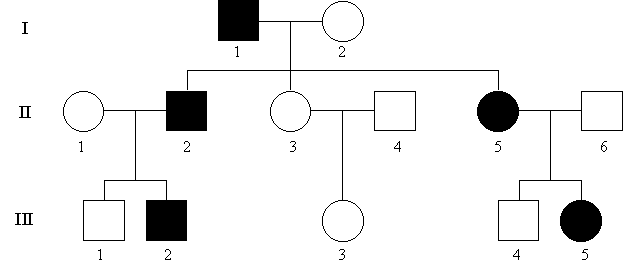
- What is pedigree analysis?
- III 1 x III 3
- III 2 x III 3
- III 3 x III 4
- III 1 x III 5
- III 2 x III 5
|
|
|
|
|
|
|
[two marks] |
Use the pedigree diagram to determine the probability of notched progeny being produced from each of the following matings. Your working and reasoning must be shown.
|
|
|
|
|
|
|
[two marks] |
|
|
|
|
|
|
|
[two marks] |
|
|
|
|
|
|
|
[two marks] |
|
|
|
|
|
|
|
[two marks] |
|
|
|
|
|
|
|
[two marks] [Total: twelve marks] |
- Complete the table below:
- Briefly describe the structure of the mature sporophytes of mosses, ferns and flowering plants:
|
Mosses |
Ferns |
Flowering Plants |
|
|
Presence or absence of vascular tissue (xylem and phloem) |
Non- vascular |
||
|
Relative importance of gametophyte and sporophyte generations in life cycle |
Sporophyte dominant |
||
|
Male gametes
|
Free-swimming sperm (water required) |
||
|
Habitat
|
Wide range of habitats |
||
|
[four marks] |
|||
|
Mosses: |
|
|
|
Ferns: |
|
|
|
Flowering Plants: |
|
|
|
[six marks] [Total: ten marks] |
- Some birds avoid eating black and orange cinnabar moth larvae because of their unpleasant taste and avoid all similarly coloured larvae even though they may be nutritious.
- Mice will immediately explore a new burrow thoroughly, even though this knowledge seems to have no apparent immediate value.
- When presented with wooden boxes and bananas too high to reach, chimpanzees stacked up the boxes beneath the bananas and climbed up to get them.
- Goslings and ducklings deprived of a parent will follow a human being and use it as a substitute parent.
- An adult male robin (Erithacus rubecula) will attack a stuffed male robin displaying a red breast and will also attack an isolated clump of red breast feathers. It will not attack a stuffed young male robin that does not have a red breast.
- What is habituation?
- How does habituation differ from other forms of learning?
|
|
|
[one mark] |
|
|
|
[one mark] |
|
|
|
[one mark] |
|
|
|
[one mark] |
|
|
|
[one mark] |
|
|
|
|
|
[one mark] |
|
|
|
|
|
[one mark] [Total: seven marks] |
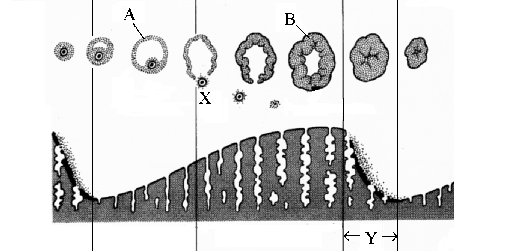
(adapted from Eckert, R., Randall, D. & Augustine, G. 1988. Animal Physiology: mechanisms and adaptations. W.H. Freeman and Company.)
- Identify structures A and B; name ONE hormone secreted by each structure and list ONE function of each hormone you mentioned.
- Identify the process marked as X. What hormone induces this process and what is the source gland of this hormone?
- Give a brief description of the processes that would be expected to operate during the phase marked as Y.
- Briefly describe the hormonal changes that bring about phase Y.
- What would you expect to happen to structure B in case of fertilisation?
- What is the role of the placenta in nutrition of the embryo?
- What is the role of the placenta in protection of the embryo?
|
Label |
Structure |
Hormone secreted |
One function of hormone |
|
A |
|
||
|
B |
|
|
|
|
[three marks] |
|||
|
Process X: |
|
Hormone: |
|
Source Gland: |
|
[one mark] |
|
|
|
|
|
[one mark] |
|
|
|
|
|
[one mark] |
|
|
|
|
|
[one mark] |
|
|
|
|
|
[one mark] |
|
|
|
|
|
[one mark] [Total: nine marks] |
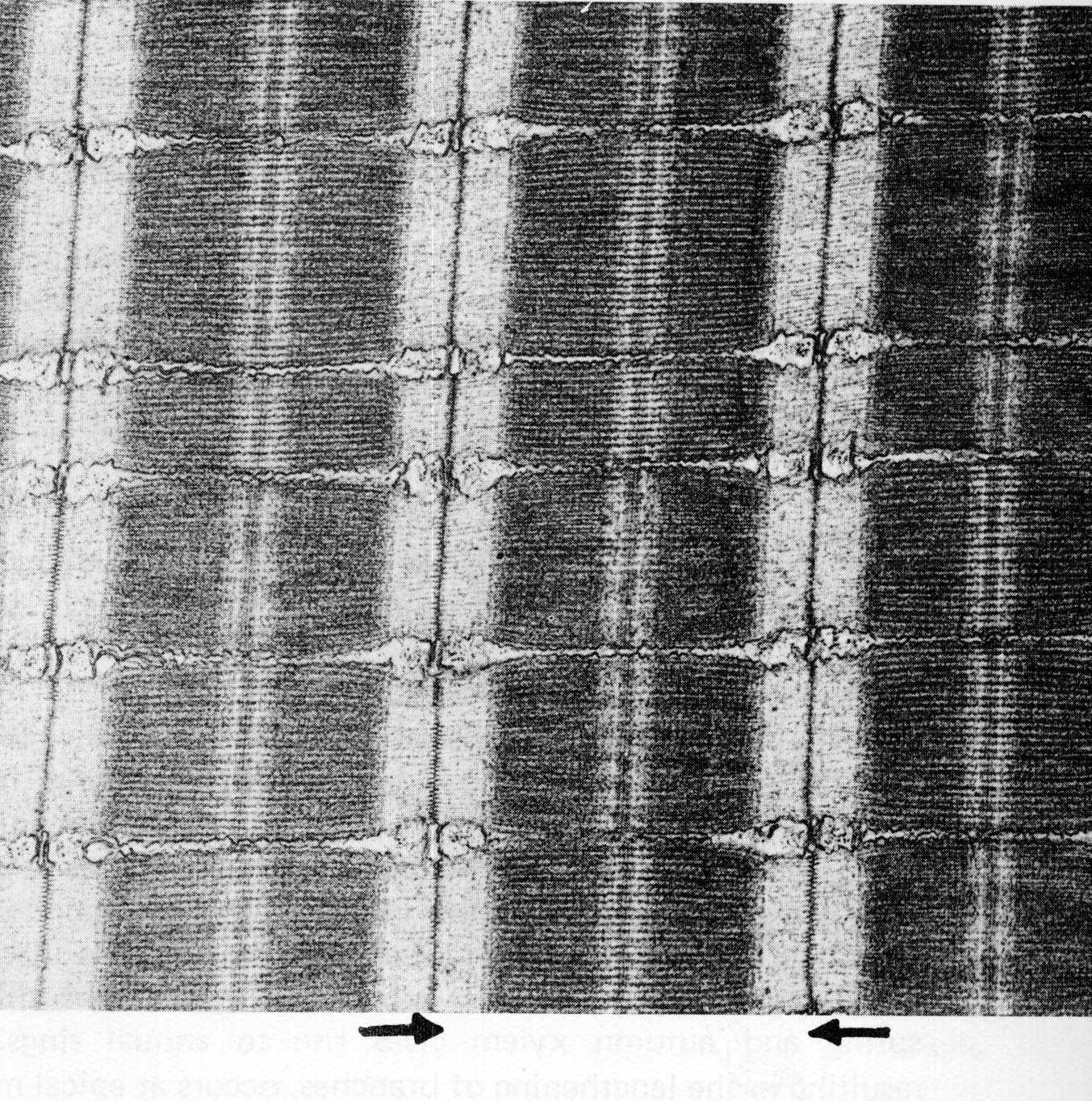
- What type of muscle tissue is shown in the figure?
- What name is given to the region delimited by the horizontal arrows in the diagram?
- Briefly describe the structure of this region.
- Give a brief outline of the role of actin, myosin and ATP in the functioning of this type of muscle.
|
|
|
[one mark] |
|
|
|
[one mark] |
|
|
|
|
|
|
|
|
|
[two marks] |
|
|
|
|
|
|
|
|
|
[three marks] [Total: seven marks] |
- The following table lists some physical properties of water. Complete the table by stating how each physical property contributes to making water such a biologically important molecule.
- Describe the chemical structure of the water molecule and indicate the main characteristic that gives water the physical properties listed in the previous part of the question.
- Give the name of the process that refers to the movement of water molecules.
- Give two examples of this process happening in biological systems.
|
Physical Property |
Biological Significance |
|
High latent heat of vaporisation |
|
|
Expansion on freezing |
|
|
High surface tension |
|
|
High specific heat capacity |
|
|
[eight marks] |
|
|
|
|
|
|
|
|
|
|
[three marks] |
Water molecules are mobile and can cross membranes.
|
|
|
[one mark] |
|
|
|
|
|
[two marks] [Total: fourteen marks] |
- Name the vessel that supplies the liver with oxygenated blood at high pressure.
- Name the vessel that delivers blood rich in the soluble products of digestion to the liver.
- Name the vessel that supplies the liver with blood rich in insulin.
- Deamination and Transamination
- Glycogenesis and Gluconeogenesis
- Küppfer cell
- Macrophage
|
|
|
[one mark] |
|
|
|
[one mark] |
|
|
|
[one mark] |
Distinguish between the following pairs of processes that occur in the liver.
|
|
|
|
|
[one mark] |
|
|
|
|
|
[one mark] |
Describe the role of the following cells that are found in the liver:
|
|
|
|
|
[one mark] |
|
|
|
|
|
[one mark] [Total: seven marks] |
- What is a biological species?
- List three criteria on the basis of which organisms are classified into different taxonomic groups.
- Re-arrange the following classification categories in descending order of taxonomic rank:
- Identify the errors of biological nomenclature in each of the following names of species:
|
|
|
|
|
|
|
[two marks] |
|
|
|
|
|
[one mark] |
Order, Phylum, Class, Family, Phylum, Species, Kingdom, Genus
|
|
|
|
|
[two marks] |
|
Triops Cancriformis: |
|
|
|
Triops cancriformis: |
|
|
|
triops cancriformis: |
|
|
|
[three marks] [Total: eight marks] |
SECTION B
(Answer one question from this section):Option 1: Biotechnology
|
Stage I |
A mouse is injected with HCG |
|
Stage II |
After a few weeks, the mouse is killed and the spleen removed. |
|
Stage III |
Lymphocytes are washed out and centrifuged. |
|
Stage IV |
Lymphocytes are fused with myeloma cells to form a hybridoma. |
|
Stage V |
The hybridoma cells are cloned and tested for antibody production. |
|
Stage VI |
Clones that produce the required monoclonal antibody are sub-cultutred. |
- What are monoclonal antibodies?
- Why does Stage II occur several weeks after Stage I?
- What differences would be evident if Stage II occurred:
- Within minutes of Stage I:
- Years after stage I:
- Why are lymophcytes centrifuged in Stage III?
- Why do lymphocytes need to be fused with myeloma cells?
- Give a brief outline of a method through which hybridoma cells could be cloned.
|
|
|
|
|
[one mark] |
|
|
|
|
|
[one mark] |
|
|
|
|
|
[one mark] |
|
|
|
|
|
[one mark] |
|
|
|
|
|
[one mark] |
|
|
|
|
|
[two marks] |
|
|
|
|
|
|
|
|
|
|
|
|
|
[three marks] [Total: ten marks] |
Option 2: The Diversity of Eukaryotes
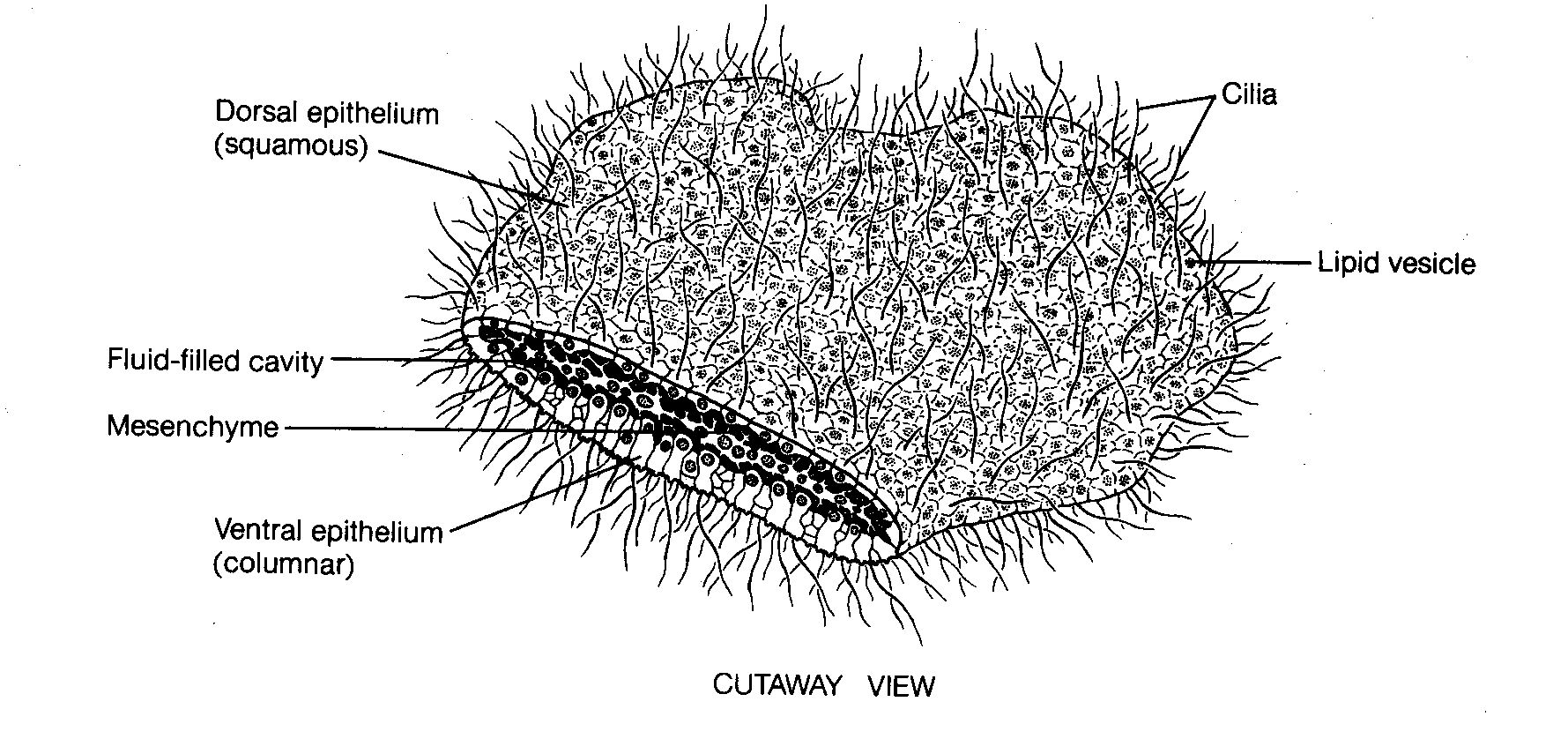
(adapted from Margulis, L. & K.V. Schwartz 1988; Five Kingdoms. Second Edition. W.H .Freeman)
- In what major taxonomic group (apart from the Animalia) would you classify Trichoplax adhaerens? Give reasons for your answer.
- Briefly outline the structure and function of the mesenchyme layer.
- Use your knowledge of biology to suggest how Trichoplax adhaerens may acquire its food.
- Ciliated epithelium
- Fluid-filled cavity
- Lipid vesicles
- Trichoplax adhaerens is similar to the planula larva of cnidarians.
- There is no known fossil record for Trichoplax adhaerens.
|
|
|
|
|
|
|
[two marks] |
|
|
|
|
|
|
|
[two marks] |
|
|
|
|
|
|
|
[one mark] |
Suggest ONE function for each of the following structures visible in the diagrams:
|
|
|
|
|
[one mark] |
|
|
|
|
|
[one mark] |
|
|
|
|
|
[one mark] |
Suggest reasons for the following observations:
|
|
|
|
|
|
|
[one mark] |
|
|
|
|
|
|
|
[one mark] [Total: ten marks] |
Option 3: Topics in Applied Botany
- What is a cutting?
- What chemical substances would you expect to be present in the rooting powder?
- How does grafting permit propagation?
- Why is grafting generally only successful if the scion and stock are from closely related species?
- Suggest two advantages of micropropagation over more conventional propagation techniques.
- Construct a concise outline (in point form) of the steps followed when culturing plant tissue.
- It has been reported that addition of silver nitrate to a plant culture medium increases the probability of successful culture. Suggest a reason for this observation.
|
|
|
|
|
[one mark] |
|
|
|
[one mark] |
Another widely used method for propagation of woody species is grafting, in which the plant to be propagated (the scion) is grafted on to another plant (the stock).
|
|
|
|
|
[one mark] |
|
|
|
|
|
[one mark] |
Plants can also be propagated through plant tissue culture and micropropagation techniques.
|
|
|
|
|
[two marks] |
|
|
|
|
|
|
|
|
|
|
|
|
|
[three marks] |