

(1887 - 1920)
by Rasil Warnakulasooriya.
In January 1913 the British mathematician G.H. Hardy received
a heavy mail post-marked Madras. Inside was a pile of papers, with this
humble letter.
Dear Sir,
I beg to Introduce myself to you as a clerk in the Accounts Department of the Post Trust Office at Madras ... I am now about 23 years of age. I have had no University education... I have been employing the spare time at my disposal to work at mathematics... I am striking out a new path for myself...
I would request you to go through the enclosed papers. Being poor,
if you are convinced that there is anything of value I would like to have
my theorems published... Being inexperienced I would very highly value
any advice you give me. Requesting to be excused for the trouble I give
you,
I remain, Dear Sir,
Yours truly,
S. Ramanujan.
Hardy could easily have thrown the package away; but a page of strange formulae caught his eye. He recognized a few, but rest was quite unusual. Hardy was quickly convinced that this was no crank, but a self-taught mathematician of the highest order.
Born on 22 December 1887 Ramanujan's life and his mathematics were inseparable. By the age of twelve he was asking questions whose answers were beyond the ability of his teachers.
Some time in 1903, he came across a copy of 'A synopsis of elementary results in pure and applied mathematics' by Prof. George Carr. It was Ramanujan's first encounter with the hilltops of mathematics. He started moving quickly through the valleys of mathematics which he began to see from those hilltops.
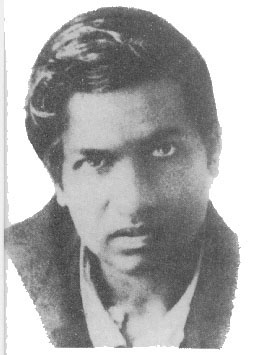
Ramanujan in 1919
Although he bagged the college prize for mathematics in
1904, he had to neglect everything else in the school curriculum, so much
so by 1907, he had failed his exams, twice over, and had to say good bye
to schooling.
In December 1910 Ramanujan met one Mr.Ramachandra Rao,
a district revenue collector of Nellore, who was kind enough to make Ramanujan
live on a dole of twenty-five rupees a month from his own pocket. He was
also keen that Ramanujan should get a suitable scholarship.
Ramanujan published a paper in the Indian Journal of Mathematics
but his attempt to convince several mathematicians to strike a bargain
for a scholarship ended in failure.
Disappointed but not discouraged, he were to make one
final attempt, he wrote to Hardy. Hardy and his colleague John Littlewood
pored over the list of Ramanujan's formulae that attempted to prove some
of the simpler results. Soon they discovered that Ramanujan was keeping
a great deal of proofs up his sleeve. Some results kept three mathematicians
working on them for a decade or so. Hardy declared that the results "must
be true, because if they were not true, none would have the imagination
to invent them". With Hardy's invitation Ramanujan set sail for England
on March 17, 1913.
Between 1914 and 1920, with Hardy or singlehandedly, Ramanujan
wrote some three dozen research papers. Several are all time classics in
mathematics. He was strong on algebraic calculations and the manipulation
of symbols, and had a genius for formulae. One of the greatest works of
Ramanujan is concerned with partitions (ways to express a given number
as a sum of smaller numbers). Through his formula developed in 1918 with
Hardy, he proved that the number 100 has 190,569,292 partitions.
Despite a record of attempts to commit suicide while in
England and opposition of some Fellows at Trinity college Cambridge, Ramanujan
was elected a Fellow of the Royal Society- the first Indian to be so honoured.
Ramanujan strictly followed a Brahmin life that gave him only little nourishment
and he could not withstand the biting winters either.
In 1917 he fell ill and was found to be suffering from
serious gastric ulcer. Hardy once visiting Ramanujan in hospital casually
mentioned to him the taxi number he was travelling in to the hospital.
The number was 1 7 2 9. "It's rather a dull number isn't it? "
Hardy said. " No, it is not, Hardy, I think it is a very interesting
number." Ramanujan contested."It's the smallest number expressed
as the sum of two cubes in two different ways". Now that we know that
123 +13 =103 + 93 =1729, one
can imagine the size of Ramanujan's brains and brilliance in mathematics.
In April 1919 he returned to India which his wife Janaki
did not know beforehand because his mother had contrived to keep the two
people separate. Amidst mother's protest Ramanujan decided to be with Janaki
ever after.
By this time his life long ill health was down to new
depths. Inspite of this agonizing ill health, Ramanujan continued to work
on Mock Theta Functions, which were to be his last distinctive contribution
to mathematics.
On April 26, 1920 he breathed his last, only to fade away
to be in the annals of mathematics as an all time great who stamped his
foot print on the unknown-infinity. His papers are still being studied
by the mathematicians world over and his theorems are being applied in
areas- polymer chemistry, computers, and recently it has been suggested
that his mathematics can be applied to cancer research.
Mathematics is an infinite jungle. Many of us see only
broad paths trodden by the pioneers. It is often trampled flat by generations
who are simple followers. Only a few go out and hatch new paths of their
own.
Ramanujan, no doubt, was a creature of this jungle. But
he did wander about the jungle without leaving any traces of his movements.
He was not lucky enough to live long either.
For India he is a symbol of national pride, if not guilt. For us he is a living fountain of inspiration.