

|
Excerpts from the lecture delevered by Dr.Chandana JayaratneSenior Lecturer, Dept. of Physics, University of Colombo. Consultant on Astronomy, Arthur C.Clarke Centre for Modern Technologies. |
We are living in the Universe's prime, long after most
of the exciting things have happened. Gaze into the sky on a starry night
and you will see a few thousand (about seven thousand stars.) Most of the
stars that we see around us belong to a great swath called the Milky Way.
This is all the ancients knew of the Universe.
Gradually, as telescopes of greater and greater size and
resolution have been developed, a universe of unimagined vastness has swum
into view, revealing a great cosmic drama.
Our Sun is one of at least 100,000 million stars that
make up the pinwheel-shaped system known as the galaxy. Our galaxy is given
the special name 'Milky Way'.(The word 'galaxy' comes from the Greek 'galactos'
meaning milk) It was William Herschel (1738-1822), one of the greatest
observers of all time, who first revealed the structure of the galaxies.
He concluded that the stars were arranged in a lens-shaped system, about
five times as wide as it was thick, with the Sun approximately at the centre.
He called this overall system of stars the Galaxy, and the galaxy was assumed
to be all that existed in the Universe: beyond was just empty space. Later
studies, specially by the American astronomers Harlow Shapley (1885-1972)
and Edwin Powell Hubble (1889-1953), showed that our galaxy - The Milky
Way - is not the only such star system in the Universe, but that space
is filled with countless other galaxies as far as telescopes could penetrate.
On current estimates, the Milky Way is about 100,000 light years in diameter,
and the Sun lies about 25000 light years from the centre. ( A light year
is the distance that a beam of light travels per year at a velocity of
2.99792458 x 10 - 8 m/s) The centre of our Milky Way is called
its nucleus. 50,000 light years from the centre lies a region known as
the galactic halo, which is a sparsely populated and roughly spherical.
The halo contains globular clusters and has very little matter in contrast
to the disc and the central bulge.
Nothing is at rest in the Universe. The earth's average
speed about the Sun is 30 km/s, whereas the whole Solar system moves through
the Milky Way at about 20 km/s. It takes the Sun about 225 million years
to complete one revolution about the centre of the Milky Way - the time
period known as an interstellar year.
What lies outside our galaxy - The Milky Way? Astronomers had long known of the existence of certain fuzzy patches in space, called Nebulae from the Latin word meaning cloud. Some of these nebulae - for instance, the famous nebula in Orion - obviously are glowing clouds of gas within the Milky Way. But others show a distinct spiral shape, and astronomers were far less sure about the nature of these. The controversy was resolved in 1923 by Hubble when he observed the individual stars in the great spiral galaxy in Andromeda.
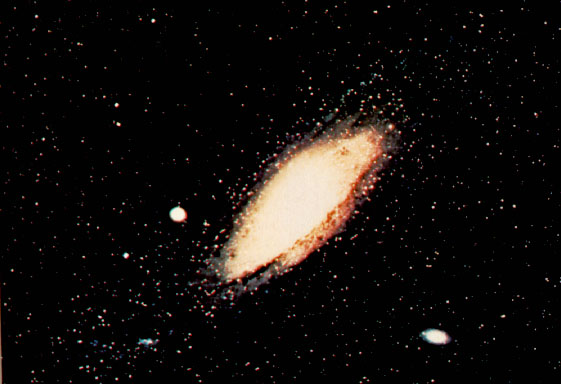
Andromeda Galaxy
The stars were so faint that he realized them to be far
off in the universe. It is, in fact, a separate spiral - shaped island,
or galaxy, of stars like our own. According to latest measurements the
Andromeda galaxy is 2.2 million light years away, so that the light entering
our eyes today actually left that galaxy 2.2 million years ago, when our
ape-man ancestors were roaming the plains of Africa. The Andromeda galaxy
is the farthest object visible to the naked eye.
A galaxy is a family of stars held together by their mutual gravitational attraction, and with a distinct identity separating it from other galaxies. The sizes and shapes of galaxies vary. According to their shapes they can be classified as spirals, barred spirals, ellipticals and irregulars.
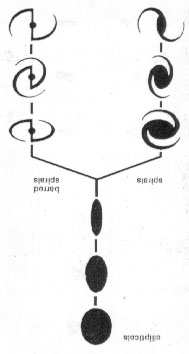
The Milky Way is believed to be an average spiral. From
afar our milky way would look like the Andromeda spiral. Spiral galaxies
have a dense core of old stars, while their outer spiral regions contain
younger stars plus much dust and gas, like the orion Nebula, which still
has to form into stars. Most of the clearly visible galaxies fall into
this category. Elliptical galaxies, o6n the other hand, contain mainly
old stars, and almost no dust or gas. For them, star formation has finished.
Astronomers once assumed that galaxies evolved from one
type into another as they aged, but they now believe that all the galaxies
were formed at the same time and remain the same type throughout their
lives. Whether a galaxy becomes a spiral or an elliptical, probably depends
on how quickly the gas cloud was spinning that gave birth to the galaxy
with spiral galaxies being the fastest spinners and ellipticals the slowest.
Spiral galaxies range from about 20,000 to 100,000 light
years or more in diameter, and contain from 1000 million to over 100,000
million stars. So our own milky way is among the largest spirals. Most
of the remaining galaxies are ellipticals, which fall into two classes,
giants and dwarfs. Giant ellipticals, which are rare, include the biggest
and brightest galaxies in the universe. They can be up to several hundred
thousand light years across and contain the mass of 10 million, million
stars. The most massive galaxy known, the elliptical M-87 (M stands for
Messier who first proposed the relevant classification system) contains
3000 billion solar masses.(About 15 times that of our own galaxy) By contrast,
dwarf ellipticals are the smallest galaxies known, measuring only about
5000 light years across and containing a few million stars. They are the
most abundant. The 3-dimensional shape of elliptical galaxies can be spheroidal
or virtually spherical. Irregular galaxies, which have no distinct shape
at all, make up a small percentage (about one fourth) of known galaxies.
A very small number of galaxies have unusual structure,
often attributed to a gravitational interaction with another galaxy. Others
emit exceptionally large amounts of energy and exhibit other evidence such
as variability, suggesting that unusual and violent processes are at work.
Such active galaxies include Seyfert galaxies and radio galaxies.
Let us now look at the life cycle of a star. When we look
up at the stars in the sky, we get the impression that they are changeless.
Although the sky we see today is not very different from the view that
our ancestors had 5000 years ago, the stars do change. Like human beings,
they are born; they live; and they die.
Astronomers can work out the story of a star's life by
picking out stars at different stages of their lives. The theory of stellar
evolution is one of the great achievements of science in the twentieth
century.
Stars are born from the tenuous gas which fills the whole
of space. This gas is composed mainly of hydrogen atoms, with a sprinkling
of helium. In some places the gas clumps together in rather more dense
interstellar gas clouds. According to gravitational theory the gas cloud's
own gravity makes it attract itself, compressing the cloud to ever higher
densities. The centre of the cloud should be the most compressed region.
When a gas is compressed, it becomes hotter. So, the temperature at the
centre rises to 10 million C - hot enough to start nuclear reactions. These
reactions turn hydrogen to helium and create vast amounts of energy. As
a result the condensed mass begins to shine; a star is born.
The formation of a star (the Sun) from an interstellar
gas cloud is intimately connected with the birth of our planets according
to some astronomers. According to this theory, a collapsing cloud of gas
and dust forms a dense core (a protostar) surrounded by a disc of gas and
dust known as the accretion disc. Outflows of hot gas then drive away the
remains of the original cloud. As nuclear reactions begin in the protostar,
it becomes a star, and the matter in the disc eventually condenses into
planets orbiting the new star. The solar wind which blows at a speed of
500 km/s drives away the hot gases from the primordial atmospheres of the
planets.
The formation of the solar system from an interstellar
gas cloud has wide acceptability over other ideas. One such theory was
that the planets were formed by the condensation of gaseous extracts from
a star which passed near our sun. This idea did not gain much ground since
it did not respect some of the conservation laws of physics such as the
conservation of momentum.
Another theory links the formation of the planets to binary
star systems. Telescopes show that many stars are not single stars but
have companions. Such twin-star systems are known as double stars. In some
cases the two stars lie in the same line of sight when viewed from Earth,
but may actually be at vastly differing distances from us. These are optical
doubles. The great majority of stellar twins are, however, physically related
orbiting each other over long periods of time, and are called binary stars.
In a binary star, the brighter star is known as the primary, while the
fainter star is the secondary. The double nature of very close pairs of
stars may only be revealed by analysis of their light in spectroscopes.
These are spectroscopic binaries.
There are more complicated stellar families - triples,
quadruples, and even larger groups. The maximum that has been observed
so far is a system consisting of six stars.
Although many stars belong to binary systems, astronomers have failed to detect a companion for our Sun. Hence, they suggest that the planets were born out of the companion star of the Sun. Some even speculate that the planet Jupiter might be the remnant of that star. Indeed if Jupiter had a mass ten times that of its currently measured mass it would have had the capability to start a nuclear reaction of its own. According to some astronomers however, the suns companion does exist and this may well be the reason for the origin of the comet rains known to come from the hypothetical - Oort-Opik cloud (after J.H.Oort and E.Opik) every 230 million years. A popular belief holds that the incipient comets were formed near the present location of the outer planets and ejected to a much greater distance later. It may be that the Sun's companion passes through or near the Oort cloud which causes its comets to agitate.
Some attribute the comet rain from the Oort-Opik cloud
to be the reason for the instant extinction of dinosaurs.
Let us return to our discussion on the life of the stars.
Ordinary telescopes cannot actually show us stars being born in the interstellar
gas clouds. The reason is dust. In the denser clouds of gas, where the
dust is more concentrated, dust particles absorb light passing through
the cloud. As a result, we can see the clouds as dark silhouettes against
a background of distant stars. To overcome this problem astronomers have
built infrared telescopes which pick infrared radiation instead of visible
light. The dust particles in space do not absorb infrared radiation and
the infrared astronomical satellite (IRAS) found thousands of young stars
hidden deep within the interstellar clonds. More elaborate methods exist
to detect stars which are hidden from the ones that are closer to us and
also in line of sight. The use of gravitational lenses, allows to detect
such objects through the bending of their light near the gravitational
field of massive objects similar to the bending of light rays by refraction
when they pass through a glass lens.Generally, double or multiple images
are observed of quasars (these are supposed to be nucleii of younger galaxies)
whose light passes through intervening galaxies before reaching us.
Once the star is shining, it produces a powerful 'wind' of hot gas that forces its way outwards in opposite directions, above and below the accretion disc. The wind drives away most of the original gas cloud that hides the star from view. They light up the final tatters of gas from the original cloud, making it glow as a bright nebula. Nebulae, each surrounding a 'nursery' of young stars, form some of the most beautiful sights in the sky. Most famous is the Orion nebula in the constellation of Orion.
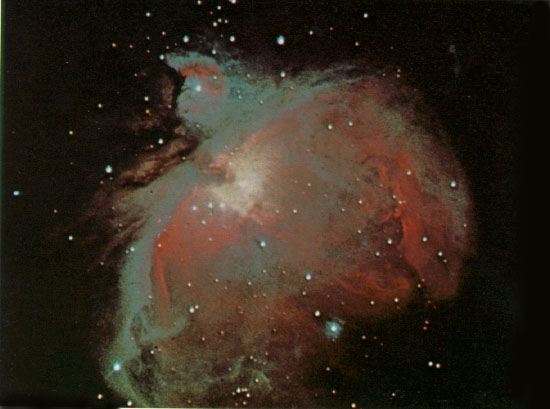
The Great Orion Nebula
The horse head nebula in the same constellation is dark
since it does not give birth to stars.
When a star is born it is a ball of hot gases, composed
mainly of hydrogen. To this extent, all newborn stars are the same. The
main thing that marks out one star from another is its mass. The mass of
a star is fixed at its birth and it determines both a star's lifetime and
its ultimate fate.
The stars in our skies have a bewildering range of properties:
there are giant stars and dwarf stars; bright stars and dim stars; hot
stars and cool stars. In 1914 the Danish astronomer, Ejnar Hertzsprung
(1873 - 1967) and an American, Henry Norris Russell (1877 - 1957) found
the most useful kind of graph in classifying the stars now known as Hertzsprung
Russell diagram,or H-R diagram. On an H - R diagram, the vertical axis
represents the luminosity or brilliance of a star. The horizontal axis
represents the star's temperature. In an H - R diagram most of the stars
occupy a narrow strip on the graph running from top left to lower right.
This is known as the 'main sequence'. These are the stars that derive their
energy by turning hydrogen into helium. Astronomers categorize the stars
of the main sequence according to their surface temperatures (spectral
type) as O, B, A, F, G, K, M ( remembered as Oh Be A Fine Girl Kiss Me!)
Where O stars are the hottest and M stars are the coolest. Red stars are
the coolest; orange and yellow stars are hotter; while white and blue-white
stars are the hottest of all.
Our Sun is a very typical star, currently in the prime
of its life (aged 4.6 billion years). Nuclear reactions run fastest in
the heaviest stars, because their centres are the hottest and most compressed.
So the heavier stars are the brighter stars, with hotter surfaces. Light
weight stars have a surface temperature of about 3000 ºC. The Sun
is in the middle of the main sequence ( the sun is a G2 star ) with a surface
temperature of 6000 ºC, and an internal temperature of million ºC.
The heavyweight stars shining as brightly as 100,000 suns, has a surface
temperature of 30.000 ºC or more.
As mentioned above the life-span of a star depends very
critically on how heavy the star is. Taking the sun's lifetime as 10 billion
years the heaviest stars survive for only one thousandth of this time whereas
the very light weight stars can last for 100 times longer than the sun.
When a star starts to run out of hydrogen at its core,
having turned it all to helium, the hydrogen burning moves out into the
surrounding zone. When this happens, the star gets hotter inside, and the
result of this extra energy release is that the star swells up in size.
As it swells, its surface temperature drops so that it becomes red in colour.
The star has become a red giant.
A red giant can be as much as 100 times the size of the
present sun. When our sun reaches this stage in about 5 billion years from
now, it will engulf the Earth, thereby ending all life on our planet. Compared
with the main sequence stars, red giant stars are not very common. However,
because they are red and appear bright, they stand out conspicuously in
our skies. The most famous is Betelgeuse in the constellation Orion. A
red giant finds it difficult to hold on to its huge outer regions. The
star becomes unstable and eventually the outer gas drifts off in to space.
Before completely disappearing the gas forms a bubble around the dying
star - the effect is like a glowing smoke ring in space. Astronomers call
these bubbles planetary nebulae, because they look rather like a planet
when observed from a small telescope. After the star's outer regions have
disappeared, the tiny, very hot core remain. It is only one hundredth the
diameter of the Sun - no larger than the Earth, and is so hot that it shines
whitehot. This is called a white dwarf.
A white dwarf no longer produces any energy. As time passes,
it gradually cools down, fading through yellow, orange and red, until it
fades from sight altogether. This is the ultimate fate of the Sun.
White dwarfs can be detected when they are a companion
to another star, through a phenomenon known as a nova. Novae are thought
to be close binary systems (one companion is a white dwarf) in which gas
flows from one star to the white dwarf and ignites in a nuclear eruption,
causing the sudden surge in brightness and throwing off a shell of gas.
This sudden increase in brightness was once thought to be new stars, hence
the name nova which means 'new'.
White dwarfs are formed from stars which have masses less
than 1.4 times that of the Sun. The limit of 1.4 is known as the Chandrasekhar
limit after the Indian physicist Subrahmanyan Chandrasekhar (1911 - 1995).
It has been found that only about 2.5% of the stars have solar masses greater
than that of 1.4 .
Stars with more than about 3.2 solar masses die a spectacular
death. They turn into red supergiants, larger and brighter even than red
giants, and then a series of run-away nuclear reactions sets in at their
core. In the middle of such a massive star, the pressure and temperature
keep on rising until helium atoms begin to fuse into a heavier element
like carbon. Eventually, the increasing temperature and pressure force
the carbon to change to even heavier elements, such as neon, silicon and
iron. But the process cannot carry on indefinitely and the star's centre
collapses entirely. The shock wave of the collapsing core blows the star
apart, in a gigantic nuclear holocaust known as a Supernova.
One famous supernova was seen by the Chinese astronomers in 1054 AD, and is now idenfified as the crab nebula.
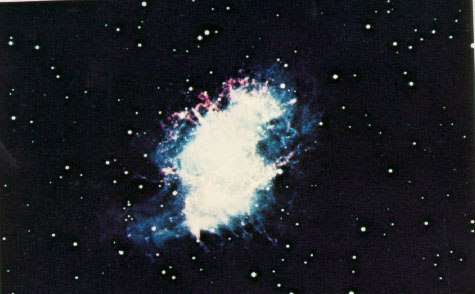
The Crab Nebula
Some stars blow themselves completely to bits in a supernova.
But in many cases the heavy core of the dead star remains as an object
even smaller, denser, and more amazing than a white dwarf. The dense, heavy
stellar core left behind by a supernova collapses under the inward pull
of its own gravity and the force of the explosion above it crushing together
the protons and electrons of its atoms to form the neutrons. The object
becomes a neutron star. A thimbleful of neutron star material would weigh
a staggering 1000 million tonnes. It has been found that a neutron star
can be formed by a star having a mass of 1.4 - 3.2 solar masses without
a supernova.
The existence of neutron stars were first predicted theoretically
in 1939 by Fritz Zwicky and Walter Baade. In 1969, two radio astronomers
Tony Hewish and Jocelyn Bell, picked up regular signals coming from the
sky. They realized that the signals must have come from a cosmic lighthouse
that was emitting beams of radio waves. These objects were termed pulsars
although we now know that both the pulsars and the neutron stars are the
same since only neutron stars are small enough to spin once a second or
less.
In 1968, a pulsor was discovered at the centre of the
crab nebula. The crab pulsar flashes at the rate of 30 times per second,
one of the fastest pulsars known. The flashes of pulsars may be in the
region radio, visible, x-ray or even in gamma ray wavelengths.
Supernovae do not only represent death and destruction.
The blast from a supernova sweeps up the gases in space, compressing them
into dense clouds. These gas clouds give birth to new stars and planets,
as mentioned earlier. Thus the death of a star as a supernova can trigger
off the birth of a new generation of stars as well as life forms.
When a star dies - as a planetary nebula or a supernova
- it seeds space with the new elements that it has created during its lifetime
(-elements such as carbon, iron,gold and even uranium and other radioactive
elements). Astronomers believe that in the very early Universe, the gases
consisted almost entirely of Hydrogen and Helium. Dying stars have formed
all the other elements and several generations of birth and death may predoce
the necessary ingredients to trigger complex life on a suitable planet.
In this regard our Sun is considered as a third generation star, since
we on earth are supposed to be an intelligent life form! In other words
we all consist of a little bit of stardust.
What if the remnant core of the supernova has a mass more
than 3.2 times that of the Sun? If the collapsing core of a supernova is
too massive, it cannot end up as a neutron star. Its own gravity is so
powerful that the core continues to shrink, until it becomes a mathematical
point, (a singularity) with no size at all and infinite density. Surrounding
this point is a region a few kilometers across where gravity is so strong
that nothing can escape- not even light. A black hole is formed. It is
'black' because it does not let light escape. It is a 'hole' because anything
that you throw into it can never emerge again.
The existence of black holes was first predicted in 1796 by Pierre Simon de Laplace who called them corps obscurs. Armed with Albert Einstein's (1879-1955) general relativity modern physicists concluded that they do exist; the name black hole being coined by the physicist John Wheeler. Consider the light radiated from the surface of a neutron star. As the surface gravity increases as the star collapses¸ the deflection of light emitted normal to its surface increases. Eventually, the star reaches a size at which a horizontal beam of light enters a circular orbit. ( If an object is thrown horizontally at the speed of about 7900 ms -1, just above the surface of the earth, it will circulate the earth indefinitely trapped in the earth's gravitational field. No fuel needed for the process!). A surface of that radius is called the photon sphere. When the radius of the star is about two thirds that of the photon sphere, no light can escape at all. At this point, the velocity of escape from the star (the escape velocity) equals the speed of light. (The escape velocity of earth is about 11.2 km/s) As the star contracts still more, light and everything else is trapped inside, unable to escape through that surface where the escape velocity is the speed of light. That surface is called the event horizon, and its radius is the Schwarzschild radius, named for Karl Schwarzschild, who first described the situation a few years after Einstein introduced general relativity. It is this surface that is the boundary of the black hole. All that is inside is hidden forever from us; as the star shrinks through the black hole, it literally 'disappears' from the Universe.
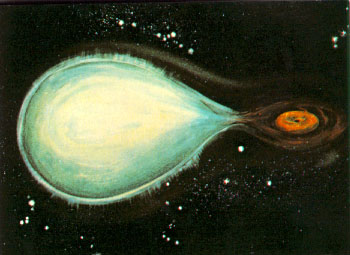
Red giant in orbit with black hole
If the Sun is squeezed to a size of 2.9 km in radius,
it will become a black hole. (the radius of the Sun is 696,000 km.) But
it will never end up as a black hole since it does not have enough mass.
For the earth to become a black hole, it would have to be compressed to
a radius of only 1 cm. Stars with a solar mass of about ten times that
of the Sun will become black holes if they are compressed to a radius of
29 km and this is a possibility since they have enough mass to shrink to
this size in contrast to our sun.
If black holes are invisible how can we detect them? Fortunately,
they give their existence away by swallowing gas from the space around
them. It has been mentioned that many stars are double. In cases where
one star has died and formed a black hole, it may continue to orbit a companion
star that is still shining normally. Gas from the companion star streams
into the intense gravitational field of the black hole, heating up to many
millions of degrees.
At such temperatures, the gas emits x-rays which can be
detected by observations satellites. A possible candidate is in the constellation
Cygnus. The powerful source of x-rays there is named as Cyg x-1. Astronomers
have found a star at this point in the sky. The star itself is quite ordinary,
and cannot be producing the x-rays. But it is not on its own. It is swinging
around a companion star that is invisible in ordinary telescopes. By observing
the visible star carefully, astronomers found that its invisible companion
was exerting the gravitational pull of an object as heavy as ten Suns.
This is much too heavy to be a neutron star, and so the only possibility
is that it is a black hole.
Though it is mentioned earlier that black holes are invisible, ( in the sense that they attract even light) the British physicist Stephen Hawking (1942- ) had suggested that the black holes ain't so "black". The phenomenon now known as Hawking Radiation is rather involved and we will skip the discussion about it. However, the basic idea of Hawking radiation is that if an electron and a positron ( the positron is the anti-particle of the electron and has the exact properties of the electron but differs only in sign of the charge. Every particle has its corresponding anti-particle and these are collectively known as anti- matter.) come into existence momentarily in the vicinity of the black hole (event horizon) there is a chance that one or the other will fall into the hole and hence not be able to annihilate with its anti-particle. Its anti-particle therefore, can escape unscathed. But many such positrons and electrons so created near black holes and escaping from them, do annihilate each other, creating energy. That energy cannot come from nothing; according to Hawking's Theory, it must come from the black hole itself. Robbing the black hole of energy in this way, robs it of mass (according to E = mc2), so the black hole must slowly evaporate through this process of pair production. Hawking radiation is not yet observed although the speculation remains an interesting possibility.
Edwin Hubble announced in 1929, that the galaxies seem to be moving apart from each other at speeds that increased with distance. The relation was that the speed (v) between two galaxies is directly proportional to the distance (d) between them.
ie., v a d
v = H d
where H is known as the Hubble constant. According to
him the Universe is like a balloon being inflated. The effect that Hubble
observed is known as the Gravitational Red Shift, because as the stars
are receding from us, their light is shifted towards longer wavelengths
(Doppler Effect).
The Hubble constant is a measure of how fast the Universe
is expanding, and its value is expected to lie in the region 40 - 100 km/s
(mega parsec per second) (1 parsec = 3.26 light years). The precise value
is yet to be determined.
What is the cause of this running away of clusters of
galaxies from each other, or simply what is the cause of this expansion?
The Belgian cosmologist, Georges LeMaitre (1894-1966) proposed that once
upon a time the Universe was compressed into a small, super dense blob
which for some unknown reason exploded. The explosion termed the Big Bang,
marked the origin of the Universe as we know it, and the components of
this Universe have been rushing apart ever since. The galaxies are fragments
flung outwards in all directions from the explosion.
If we could determine the exact value of H 0, then 1/H
0 is the time since the Big Bang and the current calculation show the Universe
to be about 15 billion years old.
According to the Big Bang Theory physics starts after
10-43 seconds from explosion. The temperature is estimated to
be above 1032 K at this point. Before this time, the laws of physics breaks
and it is assumed that the fundamental forces of nature, the strong force,
the elctromagnetic force, the weak force and the gravitational force were
all unified before this time. At 10-43 secs. after the explosion
the diameter of our Universe was 10-28 cm.
Finely tuned course was set by 10-32 seconds
after the Big Bang. Much later - when it was a millionth of a second old,
the Universe had cooled sufficiently for quarks to clump into protons and
neutrons. At about one second, a ghostly particle called a neutrino broke
free. It is these neutrinos many scientists believe are responsible for
the hidden mass of the Universe.
Three minutes after the Big Bang, the temperature of the
expanding Universe had dropped to one billion degrees. Protons and neutrons
could then clump to form atomic nucleii. Hydrogen and Helium nucleii appeared.
After 100,000 years, the temparature had dropped to 3000 degrees. Electrons
bound with the nucleii, creating full-fledged atoms.
Turning back to the hidden mass, astronomers believe that
at least 90% and possibly 99% of all the matter in the Universe is completely
invisible. Astronomers call this invisible stuff 'dark matter'. What constitutes
dark matter? This is one of the greatest puzzles of astronomy today, and
two possible candidates are neutrinos and WIMPS (Weakly Interacting Massive
Particles). A discussion of these particles and their behaviour is rather
involved and we will leave the subject of dark matter and related topics
in particle physics for a discussion on future date.
Opposed to the big bang theory Thomas Gold (1920 -), Hermann
Bondi (1919 -) and Fred Hoyle (1915 -) proposed that the universe has always
existed in much the same state as today, and that there was no single instant
of creation. Instead, they said, new matter is being slowly created everywhere
to fill space as the universe expands. This is known as the steady state
theory.
The steady state theory received a blow in 1965 when the
American physicists Arno Penzias (1933 -) and Robert Wilson (1936 -) detected
what is known as the 'echo' of the big bang. The 'echo' is known as the
cosmic background radiation which is now in the microwave region. The reason
for this radiation is that space is not entirely cold, but has a temperature
two or three degrees above absolute zero (ie. about -270 C). This slight
warmth pervading the universe is interpreted as being energy left over
from the intense fireball of the big bang, and its existence is completely
inexplicable on the basis of the steady state theory.
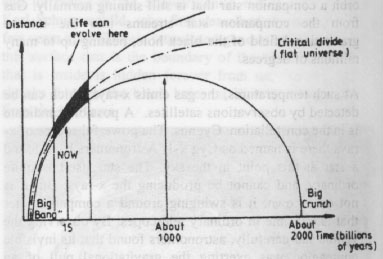
Although now it is accepted that the universe is expanding,
there's no fixed background space into which the universe can expand. The
universe contains all the space there is! The problem is whether the state
of expansion we witness in the universe will continue indefinitely. For
an ever expanding universe the launch speed of the material must exceed
the critical launch value (much like the escape velocity) at the start.
The gravitational pull of all the material in such a universe will not
be able to halt the expansion, and will keep expanding forever. On the
other hand if the speed is less than the critical value, eventually the
expansion will halt and reverse, culminating in a contraction back to zero
size, known as the big crunch, the very same state in which it apparently
began. A big bang may again follow this big crunch leading to an oscillating
universe.
In between, there exist the speed which is exactly the critical launch speed. That is, the smallest value that will keep it expanding forever. One of the great mysteries about our universe is that it is currently expanding tantalizingly close to this critical case. So close infact, that we cannot yet say for sure on which side of the critical divide it lies. The amount of dark matter plays a crucial role in determining the fate of the universe and this is why the research on neutrinos and WIMPs have been more important. However for now we do not know what the long-range forecast is.
We discussed earlier how the elements formed in the stars
may trigger complex life forms after several generations of Supernovae.Through
these processes an untold number of Sun-centered planetary systems - perhaps
much like our own - may have formed. Of the 100,000 million stars in the
Milky Way perhaps no more than one out of every hundred would have a planet
in orbit suitable to give birth for life. It has been estimated that only
one star in every 18,000 has the potential for supporting a planet similar
to earth.
The search for Extra Terrestrial Intelligence is one of
the most thouroughly engaged human projects ever undertaken. Although we
have developed incredibly complex and efficient communication systems on
Earth, a civilization hundreds - or millions - of years more advanced may
have devised systems vastly more efficient. Indeed, their messages could
now be reaching earth in a form unfamiliar to us.
Radio wave transmissions now seem the most likely method
of interstellar communication. But the radio portion of the electromagnetic
spectrum covers a broad range of wave lengths. Which frequency would advanced
civilizations most likely choose for broadcasting?
There are several ' natural ' frequencies, including that
at 1,420 MHz. This frequency is emitted by a Hydrogen atom when the electron
in orbit around the atom's nucleus reverses its spin (spin-flip transition).
Most astronomers believe that this frequency may be a fundamental frequency
for interstellar communication and that most advanced civilizations must
have thought about using this frequency.
The Pioneer 10 and 11 spacecrafts, both used to explore the outer planets of the Solar
System, carry plaques bearing messages for unknown recipients
somewhere in space.
The plaques are identical. Each six inch by nine inch gold coated plate is engraved with the time and date of launch, earth's cosmic location, and a graphic representation of humans.
In the upper left hand corner, there is a representation
of the spin-flip transition of Hydrogen that can be translated into a unit
of measurement for time and distance.
Below the Hydrogen engraving, 14 pulsars are indicated,
with their rates of pulsation. The pulsars are arranged on the plaque around
a central point - our Sun - with their distances from that point specified.
The figures of the man and woman are shown in scale with a representation
of the Pioneer spacecraft. A diagram of our Solar System showing the course
travelled by Pioneer through the planets is engraved along the bottom of
the plaque. Very possibly, the plaques on either Pioneer 10 or 11 will
not be deciphered for millions of years. By then, there may be no earthlings
left to take credit for their creation.
Voyager 1 and 2 each have a long-playing record that plays
the 'sounds of earth' including greetings in many languages (including
Sinhala.), with pictures also encoded into its grooves.
Some scientists have said we should not be trying to contact
other civilizations. If we succeed, and 'they' are much more advanced than
us, then our culture might be overwhelmed just as the native cultures of
South America disappeared under the onslaught of European culture.
If we do receive a message from a far-off world, what
might it say? Astronomer Carl Sagan believes our first communication may
contain information about how to prevent earth's destruction by runaway
technology. But the physicist Freeman Dyson wants instead, that any civilization
contacting us may well be itself 'a technology run wild' looking for new
worlds to conquer. Since all creatures in the Universe must face death,
when the life-giving 'Sun' runs out of fuel and dies, unless they can escape
to another, more healthy solar system perhaps, the first interstellar message
we receive will contain neither advice nor threats. It may instead, contain
a cry for help; the last goop of a dying civilization, received too late.
The study of the origins of the Universe is fascinating, and poses a number of deep questions. It is doubtful whether we could ever resolve this grand enigma. And as we try to construct the history of the Universe, searching for the fossil remnants of its youth and adolescence, we find that by the coming together of the largest and the smallest as specks of the physical world, our appreciation of the unity of the Universe becomes more impressive and complete.


